Олдос Хаксли - Antic Hay
Здесь есть возможность читать онлайн «Олдос Хаксли - Antic Hay» весь текст электронной книги совершенно бесплатно (целиком полную версию без сокращений). В некоторых случаях можно слушать аудио, скачать через торрент в формате fb2 и присутствует краткое содержание. Год выпуска: 2017, Издательство: epubBooks Classics, Жанр: Классическая проза, на английском языке. Описание произведения, (предисловие) а так же отзывы посетителей доступны на портале библиотеки ЛибКат.
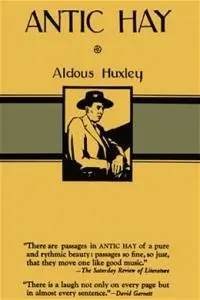
- Название:Antic Hay
- Автор:
- Издательство:epubBooks Classics
- Жанр:
- Год:2017
- ISBN:нет данных
- Рейтинг книги:5 / 5. Голосов: 1
-
Избранное:Добавить в избранное
- Отзывы:
-
Ваша оценка:
Antic Hay: краткое содержание, описание и аннотация
Предлагаем к чтению аннотацию, описание, краткое содержание или предисловие (зависит от того, что написал сам автор книги «Antic Hay»). Если вы не нашли необходимую информацию о книге — напишите в комментариях, мы постараемся отыскать её.
Antic Hay — читать онлайн бесплатно полную книгу (весь текст) целиком
Ниже представлен текст книги, разбитый по страницам. Система сохранения места последней прочитанной страницы, позволяет с удобством читать онлайн бесплатно книгу «Antic Hay», без необходимости каждый раз заново искать на чём Вы остановились. Поставьте закладку, и сможете в любой момент перейти на страницу, на которой закончили чтение.
Интервал:
Закладка:
'Those people at the coffee–stall,' Gumbril answered. 'It's appalling that human beings should have to live like that. Worse than dogs.'
'Dogs have nothing to complain of.' Shearwater went off at a tangent. 'Nor guinea–pigs, nor rats. It's these blasted anti–vivisection maniacs who make all the fuss.'
'But think,' cried Gumbril, 'what these wretched people have had to suffer! Walking all the way to Portsmouth in search of work; and the woman with child. It's horrifying. And then, the way people of that class are habitually treated. One has no idea of it until one has actually been treated that way oneself. In the war, for example, when one went to have one's mitral murmurs listened to by the medical board—they treated one then as though one belonged to the lower orders, like all the rest of the poor wretches. It was a real eye–opener. One felt like a cow being got into a train. And to think that the majority of one's fellow–beings pass their whole lives being shoved about like maltreated animals!'
'H'm,' said Shearwater. If you went on sweating indefinitely, he supposed, you would end by dying.
Gumbril looked through the railings at the profound darkness of the park. Vast it was and melancholy, with a string, here and there, of receding lights. 'Terrible,' he said, and repeated the word several times. 'Terrible, terrible.' All the legless soldiers grinding barrel–organs, all the hawkers of toys stamping their leaky boots in the gutters of the Strand; at the corner of Cursitor Street and Chancery Lane, the old woman with matches, for ever holding to her left eye a handkerchief as yellow and dirty as the winter fog. What was wrong with the eye? He had never dared to look, but hurried past as though she were not there, or sometimes, when the fog was more than ordinarily cold and stifling, paused for an instant with averted eyes to drop a brown coin into her tray of matches. And then there were the murderers hanged at eight o'clock, while one was savouring, almost with voluptuous consciousness, the final dream–haunted doze. There was the phthisical charwoman who used to work at his father's house, until she got too weak and died. There were the lovers who turned on the gas and the ruined shopkeepers jumping in front of trains. Had one a right to be contented and well–fed, had one a right to one's education and good taste, a right to knowledge and conversation and the leisurely complexities of love?
He looked once more through the railings at the park's impenetrable, rustic night, at the lines of beaded lamps. He looked, and remembered another night, years ago, during the war, when there were no lights in the park and the electric moons above the roadway were in almost total eclipse. He had walked up this street alone, full of melancholy emotions which, though the cause of them was different, were in themselves much the same as the melancholy emotions which swelled windily up within him to–night. He had been most horribly in love.
'What did you think,' he asked abruptly, 'of Myra Viveash?'
'Think?' said Shearwater. 'I don't know that I thought very much about her. Not a case for ratiocination exactly, is she? She seemed to me entertaining enough, as women go. I said I'd lunch with her on Thursday.'
Gumbril felt, all of a sudden, the need to speak confidentially. 'There was a time,' he said in a tone that was quite unreally airy, off–hand and disengaged, 'years ago, when I totally lost my head about her. Totally.' Those tear–wet patches on his pillow, cold against his cheek in the darkness; and oh, the horrible pain of weeping, vainly, for something that was nothing, that was everything in the world! 'Towards the end of the war it was. I remember walking up this dismal street one night, in the pitch darkness, writhing with jealousy.' He was silent. Spectrally, like a dim, haunting ghost, he had hung about her; dumbly, dumbly imploring, appealing. 'The weak, silent man,' she used to call him. And once for two or three days, out of pity, out of affection, out of a mere desire, perhaps, to lay the tiresome ghost, she had given him what his mournful silence implored—only to take it back, almost as soon as accorded. That other night, when he had walked up this street before, desire had eaten out his vitals and his body seemed empty, sickeningly and achingly void; jealousy was busily reminding him, with an unflagging malice, of her beauty—of her beauty and the hateful, ruffian hands which now caressed, the eyes which looked on it. That was all long ago.
'She is certainly handsome,' said Shearwater, commenting, at one or two removes, on Gumbril's last remark. 'I can see that she might make any one who got involved with her decidedly uncomfortable.' After a day or two's continuous sweating, it suddenly occurred to him, one might perhaps find sea–water more refreshing than fresh water. That would be queer.
Gumbril burst out ferociously laughing. 'But there were other times,' he went on jauntily, 'when other people were jealous of me.' Ah, revenge, revenge. In the better world of the imagination it was possible to get one's own back. What fiendish vendettas were there carried to successful ends! 'I remember once writing her a quatrain in French.' (He had written it years after the whole thing was over, he had never sent it to any one at all; but that was all one.) 'How did it go? Ah, yes.' And he recited, with suitable gestures:
'"Puisque nous sommes là, je dois
Vous avertir, sans trop de honte,
Que je n'égale pas le Comte
Casanovesque de Sixfois."
Rather prettily turned, I flatter myself. Rather elegantly gross.'
Gumbril's laughter went hooting past the Marble Arch. It stopped rather suddenly, however, at the corner of the Edgware Road. He had suddenly remembered Mr Mercaptan, and the thought depressed him.
Chapter VI
It was between Whitfield Street and the Tottenham Court Road, in a 'heavenly Mews', as he liked to call it (for he had a characteristic weakness for philosophical paronomasia), that Casimir Lypiatt lived and worked. You passed under an archway of bald and sooty brick—and at night, when the green gas–lamp underneath the arch threw livid lights and enormous architectural shadows, you could fancy yourself at the entrance of one of Piranesi's prisons—and you found yourself in a long cul–de–sac, flanked on either side by low buildings, having stabling for horses below and, less commodiously, stabling for human beings in the attics above. An old–fashioned smell of animals mingled with the more progressive stink of burnt oil. The air was a little thicker here, it seemed, than in the streets outside; looking down the mews on even the clearest day, you could see the forms of things dimming and softening, the colours growing richer and deeper with every yard of distance. It was the best place in the world, Lypiatt used to say, for studying aerial perspective; that was why he lived there. But you always felt about poor Lypiatt that he was facing misfortune with a jest a little too self–consciously.
Mrs Viveash's taxi drove in under the Piranesian arch, drove in slowly and as though with a gingerly reluctance to soil its white wheels on pavements so sordid. The cabman looked round inquiringly.
'This right?' he asked.
With a white–gloved finger Mrs Viveash prodded the air two or three times, indicating that he was to drive straight on. Halfway down the mews she rapped the glass; the man drew up.
'Never been down 'ere before,' he said, for the sake of making a little conversation, while Mrs Viveash fumbled for her money. He looked at her with a polite and slightly ironic curiosity that was frankly mingled with admiration.
'You're lucky,' said Mrs Viveash. 'We poor decayed gentlewomen—you see what we're reduced to.' And she handed him a florin.
Читать дальшеИнтервал:
Закладка:
Похожие книги на «Antic Hay»
Представляем Вашему вниманию похожие книги на «Antic Hay» списком для выбора. Мы отобрали схожую по названию и смыслу литературу в надежде предоставить читателям больше вариантов отыскать новые, интересные, ещё непрочитанные произведения.

![Олдос Хаксли - О дивный новый мир [Прекрасный новый мир]](/books/11834/oldos-haksli-o-divnyj-novyj-mir-prekrasnyj-novyj-thumb.webp)




Обсуждение, отзывы о книге «Antic Hay» и просто собственные мнения читателей. Оставьте ваши комментарии, напишите, что Вы думаете о произведении, его смысле или главных героях. Укажите что конкретно понравилось, а что нет, и почему Вы так считаете.