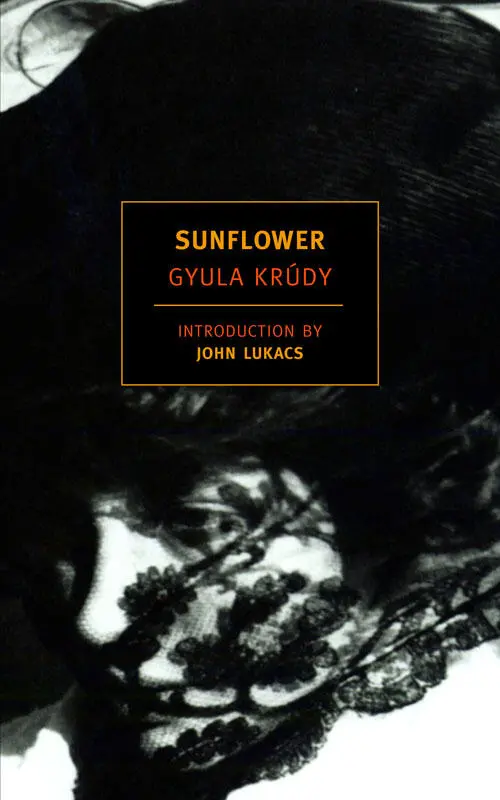
Gyula Krudy - Sunflower
Здесь есть возможность читать онлайн «Gyula Krudy - Sunflower» весь текст электронной книги совершенно бесплатно (целиком полную версию без сокращений). В некоторых случаях можно слушать аудио, скачать через торрент в формате fb2 и присутствует краткое содержание. Город: New York, Год выпуска: 2007, Издательство: New York Review Books, Жанр: Классическая проза, на английском языке. Описание произведения, (предисловие) а так же отзывы посетителей доступны на портале библиотеки ЛибКат.
- Название:Sunflower
- Автор:
- Издательство:New York Review Books
- Жанр:
- Год:2007
- Город:New York
- ISBN:нет данных
- Рейтинг книги:4 / 5. Голосов: 1
-
Избранное:Добавить в избранное
- Отзывы:
-
Ваша оценка:
Sunflower: краткое содержание, описание и аннотация
Предлагаем к чтению аннотацию, описание, краткое содержание или предисловие (зависит от того, что написал сам автор книги «Sunflower»). Если вы не нашли необходимую информацию о книге — напишите в комментариях, мы постараемся отыскать её.
In
young Eveline leaves the city and returns to her country estate to escape the memory of her desperate love for the unscrupulous charmer Kálmán. There she encounters the melancholy Álmos-Dreamer, who is languishing for love of her, and is visited by the bizarre and beautiful Miss Maszkerádi, a woman who is a force of nature. The plot twists and turns; elemental myth mingles with sheer farce: Krúdy brilliantly illuminates the shifting contours and acid colors of the landscape of desire.
John Bátki’s outstanding translation of
is the perfect introduction to the world of Gyula Krúdy, a genius as singular as Robert Walser, Bruno Schulz, or Joseph Roth.
Sunflower — читать онлайн бесплатно полную книгу (весь текст) целиком
Ниже представлен текст книги, разбитый по страницам. Система сохранения места последней прочитанной страницы, позволяет с удобством читать онлайн бесплатно книгу «Sunflower», без необходимости каждый раз заново искать на чём Вы остановились. Поставьте закладку, и сможете в любой момент перейти на страницу, на которой закончили чтение.
Интервал:
Закладка:
Eveline was petite, with black hair. She loved the color red. To amuse herself at home she dressed as a Gypsy girl, and told Mademoiselle Montmorency’s fortune: she predicted the wilting old maid would have ten children.
2. The Return Of a Bygone Eveline
One fine day Mr. Álmos-Dreamer up and died.
He did this every year after spending some time in Miss Eveline’s company, at times when love, the torments of lone wolves and the howling winds assailed him. At times like these, he started to play the violin in the house on this island frequented by the wind and storm-tossed birds. At such times his servant boy, with his brass buttons, shabby white gloves and antique spats, would retreat into a cubbyhole. Mr. Álmos-Dreamer played the violin from dusk to dawn in front of his lectern like an officer in Queen Maria Theresa’s bodyguard preparing for a duel to the death. He played old melodies from a score on which the writer’s hand had doodled roses and ladies’ faces. French chansons: grandmothers’ reveries. German student songs: souvenirs of Hungarian gentlemen traveling abroad. Viennese waltzes: the light-hearted, floppy perukes of forefathers. Compositions by Lavotta and Czerny: fantasies of musicians returned to their homeland to muse over the aimlessness of life.
While making music, Álmos-Dreamer neither ate nor drank. He sat wearing a black tailcoat, white vest and lacquered pumps. His face as serene as an autumn landscape, his eyes brooding over dry fallen leaves, his lips proudly pressed together — all this was no mere histrionics. He was in truth a specimen of the dreamy, retiring and scornful Hungarian country gentleman who asks nothing more of the world than a nook from where all obnoxious climbers are banished. A place where life’s business may be conducted with the occasional small gesture or barely audible word. Such behavior would be called depressed by some people, yet it is in fact a splendid human trait, this regal disdain.
He liked to call these hours “withdrawing from life.”
He did not have to go far, in his solitude, to arrive at his goal. The house, built on this remote island wilderness by an eccentric ancestor to escape the “yellow peril” that would one day overrun Hungary and all of Europe, was a natural home to death and extinction. Around this household there could be no lust for life, for life was a succession of monotonous, idle days, its sole purpose, a preparation for extinction. The gutter hung from the roof, slowly dying like a superannuated watchdog. There were chairs that limped like grandfather himself. The cupboard had a vertiginous stance, prone to fainting spells like a fat old lady. The lamps gave a tired light, the walls were crumbling, windowpanes cracked without being touched, the carpets shed knots like hair falling from a head and the chimney emitted laborious puffs of smoke, as if tired of life. Everyone and everything was getting ready to leave the place like rovers at a tavern when the wine gets tiresome after the dreams of ecstasy wear thin. The portraits on the wall, once viewed with such youthful pride, had yellowed to the point of unrecognizability. The ideals carried in the heart, the colorful chords, solitary caterwaulings and songs hummed by one’s lonesome self had all turned into a meditation unrolled like some rare, treasured rug in the quiet hours around midnight. The wisdom of books, the dust of sunsets, the puppylike energy of the morning hours, had all faded away like the used-up toys of childhood.
Such reclusiveness, if intruded upon, comes charging out of its cave brandishing a club, like a hermit aroused from his dreams. One’s mood reaches the freezing point, and becomes bearish, like a black cloud over the woods. At night the wind howls like some terrible hellhound immune to ordinary bullets. The furniture, as a rule so obedient, now turns obtrusive so that the room’s inhabitant bumps knees and elbows against fiendishly protruding edges. The mirror’s reflection grows faint, or perhaps the face itself does, taking on an acrid, fastidious look like that of a cobwebbed old daguerreotype set by sentimental hands on a headstone. In the pupil of the eye tiny, swimming dots appear: they are rowboats steered by melancholy boatmen conveying luggage and traveler — departing life — from the shore to the vast old bark awaiting.
At times like these the quiet man opted to die.
By way of the violin’s melodies he took his leave of all that was pleasing and dear to him. Friendly faces cropped up in the hedgerows of miniscule black musical notes. Green mansions, porches wreathed in wild grape, stretching greyhounds, loud, friendly greetings, merry eyes and fancy bow ties. Men, companions who raised their glasses in a toast to homeland or womanhood. White table linen, cool arbors, fine, lingering autumns, frost-nipped leaves, orchard scents and places where he had been happy without being aware of his happiness. Years that yawned leisurely, poplar-bordered walking paths, rippling waterways, playfully curling chimney smoke, distant creaking of the well windlass, brown gateways and bedsteads that promised wonderful, untroubled dreams. The odor of fur on a winter’s journey, a tavern room redolent with marjoram, a lady’s name traced on a frosty windowpane, and a lingering pause over a small footprint in the freshly fallen snow. Women, glowing white under Christmas trees, indolent women whose soft flesh was made for embraces, romantic girls who tied their garters with fancy ribbons, reddish streaks in blonde hair and rings on slender fingers whose touch meant happiness once upon a time. Prayerbooks full of devotions, crucifixes at crossroads, high masses complete with kettledrum celebrated in childhood, playful strolls on the castle hill, girls with firm calves, and tiny earlobes that he could no longer place. Illnesses that were so good to recover from, convalescence like a breath of spring air, the buzz of the alarm clock signaling frozen dawns that smelled of the crypt, the coachmen’s ample capes exuding the scents of the road, and the mysterious bearing of the lady who happens to be your fellow passenger. Memorable hounds and majestic trees in the corner of a courtyard, strange old men, red autumnal twilights, birds’ cries and storytelling old women…All of life swept by during the violin’s play. Now Mr. Álmos-Dreamer was ready to die. He sat in the armchair, wrapped a rosary around his hand, closed his eyes and expired, for that was what he wanted.
His servant boy rode off posthaste to relay the news to Miss Eveline.
She put on her fur-trimmed skirt and boots, called for her sled and drove off across the frozen Tisza taking along only two large hounds.
The Álmos-Dreamers died for women. These dreamers, loiterers on bridges, strollers under shaggy-browed weeping willows, musers on solitary dark benches surrounded by the burgundy red tones of autumn: by now all of them painted in oil and vermilion, and hanging on the walls of this ramshackle old island domicile, the mansard roof so thickly layered by moss that storks landed there as in a meadow. All of the portraits showed Andor Álmos-Dreamer’s thin face as if every member of the family had been born into this world half- heartedly, tentatively, and always one-fourth obscured by shadow. Their true and majestic form had remained over there, in that netherworld, the solemn appendages of a headless, taciturn knight. Only their feminine aspect arrived in this world, like a white flower handed through an open window. Here they were, all of them, holding the wake over their dead impassively, without batting an eyelash. Over the past century every male in the family had ended his life with his own hand. Serene and resolved, having said their benisons and devised complicated last wills, they died premeditated, ritualistic deaths, for the same cause: the love of a woman.
Читать дальшеИнтервал:
Закладка:
Похожие книги на «Sunflower»
Представляем Вашему вниманию похожие книги на «Sunflower» списком для выбора. Мы отобрали схожую по названию и смыслу литературу в надежде предоставить читателям больше вариантов отыскать новые, интересные, ещё непрочитанные произведения.












Обсуждение, отзывы о книге «Sunflower» и просто собственные мнения читателей. Оставьте ваши комментарии, напишите, что Вы думаете о произведении, его смысле или главных героях. Укажите что конкретно понравилось, а что нет, и почему Вы так считаете.