Gyula Krudy - Sunflower
Здесь есть возможность читать онлайн «Gyula Krudy - Sunflower» весь текст электронной книги совершенно бесплатно (целиком полную версию без сокращений). В некоторых случаях можно слушать аудио, скачать через торрент в формате fb2 и присутствует краткое содержание. Город: New York, Год выпуска: 2007, Издательство: New York Review Books, Жанр: Классическая проза, на английском языке. Описание произведения, (предисловие) а так же отзывы посетителей доступны на портале библиотеки ЛибКат.
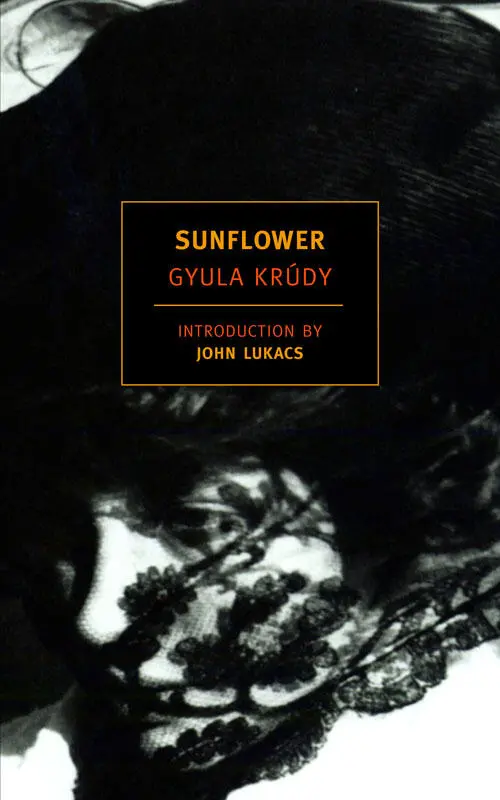
- Название:Sunflower
- Автор:
- Издательство:New York Review Books
- Жанр:
- Год:2007
- Город:New York
- ISBN:нет данных
- Рейтинг книги:4 / 5. Голосов: 1
-
Избранное:Добавить в избранное
- Отзывы:
-
Ваша оценка:
Sunflower: краткое содержание, описание и аннотация
Предлагаем к чтению аннотацию, описание, краткое содержание или предисловие (зависит от того, что написал сам автор книги «Sunflower»). Если вы не нашли необходимую информацию о книге — напишите в комментариях, мы постараемся отыскать её.
In
young Eveline leaves the city and returns to her country estate to escape the memory of her desperate love for the unscrupulous charmer Kálmán. There she encounters the melancholy Álmos-Dreamer, who is languishing for love of her, and is visited by the bizarre and beautiful Miss Maszkerádi, a woman who is a force of nature. The plot twists and turns; elemental myth mingles with sheer farce: Krúdy brilliantly illuminates the shifting contours and acid colors of the landscape of desire.
John Bátki’s outstanding translation of
is the perfect introduction to the world of Gyula Krúdy, a genius as singular as Robert Walser, Bruno Schulz, or Joseph Roth.
Sunflower — читать онлайн бесплатно полную книгу (весь текст) целиком
Ниже представлен текст книги, разбитый по страницам. Система сохранения места последней прочитанной страницы, позволяет с удобством читать онлайн бесплатно книгу «Sunflower», без необходимости каждый раз заново искать на чём Вы остановились. Поставьте закладку, и сможете в любой момент перейти на страницу, на которой закончили чтение.
Интервал:
Закладка:
(In Pest there were few women of the Orthodox faith to make use of the holy chapel for their devotions. Therefore ladies of the Catholic, Protestant and Jewish persuasions, who, in their respective houses of worship, would not have dared to lift their eyes in the Almighty’s majestic presence, felt free to frolic without guilt in the Russian chapel with Mr. Paul Burman, high official of the viceregal government. The Buda hills had seen many a Pest lady making this excursion to Üröm, having departed early in the morn by coach, accompanied by a faithful confidante, and eagerly awaited by Mr. Burman, who, in his impatience for the moment of consummation, passed the time by examining the icons and devotional objects of the Muscovite popa .)
Before long Mr. Burman had occasion to note that Eveline was a pious creature. That fine spring hardly a week passed without her making an excursion to the chapel at Üröm.
“It’s the only place where I can truly pray,” was what she said, and, amazing to behold, her husband did not doubt her veracity. Husbands tend to credit their own wives with superhuman powers of abstention. They refuse to believe that their wife in any way resembles those married women with whom they had innumerable liaisons in their bachelor days. In fact, Mr. Burman experienced heartfelt satisfaction whenever his wife expressed an urge to repair to Üröm for her devotions.
Until one fine day an anonymous letter, written in a hand that Mr. Burman recognized as belonging to one of his former lady loves, opened up the eyes of this gullible husband. “Eveline, not content with her civilian husband, has renewed her penchant for the white uniform of military officers,” went the letter, which the cocksure Mr. Burman threw away without a moment’s hesitation.
“Of course, many women must be jealous of my wife,” he mused. “But I’ve had enough of love bites, and those tormenting, clandestine, fearsome couplings, cuckolded husbands, anxieties…Enough of those blundering little women on whose account I had so often felt the noose tighten around my neck.”
The second anonymous letter reached Mr. Burman at his office chambers. The writer of the letter warned him that, for those women of Pest who still thought of him fondly, their former chevalier was now an object of pity. In the salons they now referred to him simply as “that poor man.”
Mr. Burman’s temples flushed red.
When the third warning arrived, Paul Burman stood tall as a poplar, clenched his fists and vowed that he would no longer suffer being made a fool of. He stealthily followed his spouse the next time she set out on a jaunt to the Üröm chapel. There he managed to catch Eveline in flagrante with a tomcat-whiskered officer of the cuirassiers who knelt as worshipfully in front of her as if she had been a holy icon untouched by human hands.
“You poor jackass,” shouted Mr. Burman and spat in Eveline’s face.
“I hope you’ll avenge this,” screamed Eveline, her eyes flashing, and indeed the honest cuirassier had no alternative but to challenge Mr. Burman to a duel.
The combat that ensued resulted in Mr. Burman’s unnecessary death. In a wooded corner of the city park, perhaps the very same place where the Colonel’s blood had spilled on the fallen leaves, Mr. Paul Burman dropped face first, the cuirassier’s bullet in the middle of his forehead. It must be noted that this austere civil servant behaved most calmly before the duel, and stated in front of his seconds more than once that were he to die in the duel, he would consider his death as absolution, for his sad end would serve as a memorial to all husbands who, in spite of being deceived by their wives, still leave an exemplary last will and testament.
He left everything to Eveline, who had asked his forgiveness on the final night, confessing that she herself had written the anonymous notes because she had started to doubt her husband’s love for her. She announced that she had always loved him, and him alone, just like a plant loves the soil it grows in. Thus she consoled and prepared him for death, giving much pleasure and gratification in the process.
And so, at the age of thirty, Eveline became Ákos Álmos-Dreamer’s fourth wife.
All we know about Ákos Álmos-Dreamer, the father of our Andor, is that he was an even-tempered, phlegmatic village gentleman who enjoyed sound sleep and digestion, a man who had buried his three former wives without undue emotional distress. From each woman’s trousseau and belongings he selected the useable items — clothes, shoes, furs, shirts — and carefully saved them for the next. For his fourth wife he did not bother to remake the marriage bed in which the previous one had expired in particularly agonizing circumstances. The ill-fated woman had swallowed poison, and the assembled midwives and medicine women did everything in their power to remove the ingested substance from her stomach. Repulsive traces of the sickness were still evident in the bedroom when Ákos Álmos-Dreamer brought the pampered Eveline from the capital down to his rustic mansion. Eveline immediately fainted upon arrival.
“My poor ex-wife,” murmured Ákos, “her passing was definitely not for the weak of heart. Well, it’s up to you now to put the place in order.”
As it turned out, Eveline would even put up with the occasional beating, as long as she could amply console herself with vagabonds, peasants, and itinerant musicians. She routinely told her husband about all her affairs. Ákos Álmos-Dreamer roared like a lion, and with each passing day his love for his wife grew stronger. It was an aging man’s desperate, sleepless passion.
Ákos Álmos-Dreamer suffered the torments of a woodcock winged by a poacher. He was the unhappiest man in the entire windy Nyírség — The Birches — a region wrapped in dreamy veils of mist. Men laughed at him and women scorned him; no one pitied him except his court jester, a failed student who in all likelihood had assisted at the former wives’ burials. Older folk still recalled one subprefect of the county, a certain Krucsay, who had his faithless wife beheaded. They called Álmos-Dreamer spineless; in his defense, his well-wishers cited the old saw, “hoary-headed groom, fiery young bride.” Others opined that the old milquetoast ought to be horsewhipped out of the county. And so he took his shame into hiding, out on the remote Tisza island where Álmos-Dreamers have lived ever since, as if ashamed of a mother’s misbehaving. But Ákos kissed his wife’s hand for following him into exile and solitude.
What happened now to this robust, strapping man who used to laugh at women who shed tears for him? What changed this aloof man, so miserly with his words, kisses and caresses, who only once in a blue moon condescended to acknowledge a woman’s loving stratagem or her artful attempt to please? His giant frame became broken and bent as a gatepost that has outlived its use. His bloodshot eyes watched over his wife’s healthy, deep slumber; he savored each tender little moan, murmur and sigh that escaped during her sleep, and absorbed them into his heart. He would have loved to hear her call out lovers’ names in her dream, so that he could have those men instantly assassinated, or at least beaten up, tarred and feathered, banished forever. But this woman playacted in her sleep like a born actress. She cooed and giggled, mumbling Ákos’s name in a faint voice. She hugged a pillow as if it were her lover’s muscular neck, her promise-laden mouth shaped into a kiss, as if she were wooing a swaddled infant or a gingerbread hussar. Her breathing was sheer music, like the delicate notes from a small wooden box lightening up one of those grim old Magyar dining rooms with silvery Viennese waltzes. Ineffable delights emanated from her neck, her shoulders, her full calves and thighs. Precious, savory love, sweet as ripe pears, love that has no need to conjure with closed eyes shapes of other women in place of this one, no need for furtive thoughts recalling memories of dear distant loves, like a retired guardsman licking his chops on recollections of the beauteous queen he had served in the days of his youth. Even Eveline’s little toes radiated a love that is full recompense for all earthly woes. There was pleasure in her hair, in those fresh honey-blonde curls on the nape of her neck. For one of those locks in days of yore noble knights would have gladly returned from the most distant crusades in the Holy Land. Her shoulder alone was worth a kingdom. For one of her kisses, one of her embraces, a man would have willingly placed his neck on the chopping block, for possession of this exquisite woman meant knowing all of life’s secrets and mysteries.
Читать дальшеИнтервал:
Закладка:
Похожие книги на «Sunflower»
Представляем Вашему вниманию похожие книги на «Sunflower» списком для выбора. Мы отобрали схожую по названию и смыслу литературу в надежде предоставить читателям больше вариантов отыскать новые, интересные, ещё непрочитанные произведения.












Обсуждение, отзывы о книге «Sunflower» и просто собственные мнения читателей. Оставьте ваши комментарии, напишите, что Вы думаете о произведении, его смысле или главных героях. Укажите что конкретно понравилось, а что нет, и почему Вы так считаете.