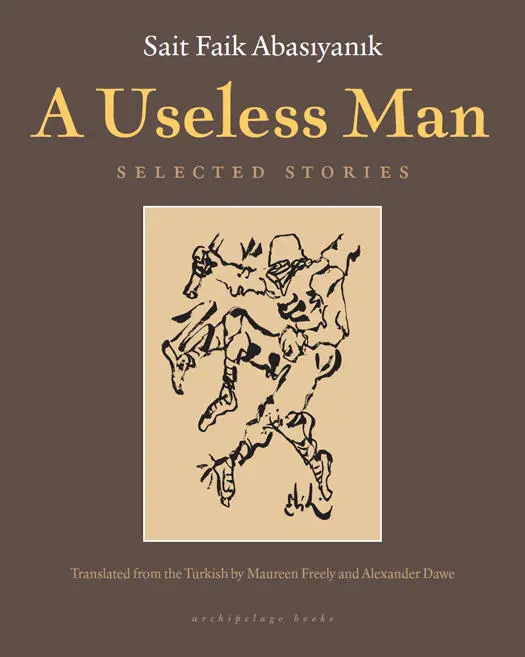
Sait Abasiyanik - A Useless Man
Здесь есть возможность читать онлайн «Sait Abasiyanik - A Useless Man» весь текст электронной книги совершенно бесплатно (целиком полную версию без сокращений). В некоторых случаях можно слушать аудио, скачать через торрент в формате fb2 и присутствует краткое содержание. Год выпуска: 2015, Издательство: Archipelago, Жанр: Классическая проза, на английском языке. Описание произведения, (предисловие) а так же отзывы посетителей доступны на портале библиотеки ЛибКат.
- Название:A Useless Man
- Автор:
- Издательство:Archipelago
- Жанр:
- Год:2015
- ISBN:нет данных
- Рейтинг книги:3 / 5. Голосов: 1
-
Избранное:Добавить в избранное
- Отзывы:
-
Ваша оценка:
A Useless Man: краткое содержание, описание и аннотация
Предлагаем к чтению аннотацию, описание, краткое содержание или предисловие (зависит от того, что написал сам автор книги «A Useless Man»). Если вы не нашли необходимую информацию о книге — напишите в комментариях, мы постараемся отыскать её.
Sait Faik donated his estate to the Daruşafaka foundation for orphans, and this foundation has since been committed to promoting his work. His former family home on Burgazada was recently restored, and now functions as a museum honoring his life and work. He is still greatly revered: Turkey's most prestigious short story award carries his name and nearly every Turk knows by heart a line or a story by Sait Faik.
A Useless Man — читать онлайн бесплатно полную книгу (весь текст) целиком
Ниже представлен текст книги, разбитый по страницам. Система сохранения места последней прочитанной страницы, позволяет с удобством читать онлайн бесплатно книгу «A Useless Man», без необходимости каждый раз заново искать на чём Вы остановились. Поставьте закладку, и сможете в любой момент перейти на страницу, на которой закончили чтение.
Интервал:
Закладка:
Now, if I were Ömer, I’d check out that dark elevator that’s been sitting idle there for years. When he gets to the second floor, he regrets not looking in. But it’s too late to go back.
Not a single beam of light slips out onto the torn and dusty linoleum floor. That’s good — it means everyone’s asleep. Why not light a cigarette? His match hits the floor, leaving a little scratch in the dust. Like the wick of a dynamite stick, almost. Oh mother of God! What’s become of us? he asks himself. This place gives him the creeps. Why in the world would anyone want to be here?
He tries every room on the third floor. A woman peers out through the sack that’s been taped over the broken glass. Calling back into the room, she says:
“Careful, Hüsnü, there’s a guard downstairs.”
She stands erect and silent; Hüsnü must be doing the same. Isn’t that why she stays there, eyeing the corridor?
“Hüsnü,” she says. “Give me a cigarette.”
He is three steps behind her. He hands her a cigarette. Then the matches. He waits. She takes them.
The woman says:
“Hüsnü, I’m leaving tomorrow. That’s why I called you here. Did Hatice tell you?”
He comes three steps closer. With one stroke, he pushes the door open. As the darkness in the room collides with the darkness outside, she cries:
“Come to the pier tomorrow morning and we can talk there. If you don’t come, I’ll leave my clothes at the gazino.”
She has stepped outside now, with Hüsnü. But Ömer doesn’t understand a thing she’s saying. Who is Hüsnü? Which Hüsnü? Which clothes, at which gazino?
The second room is locked. The man in the third room groans:
“Who’s that? Who the hell’s out there? You’ve got the wrong room, my friend.”
The handle on the next door turns. A blinding shaft of light pins him to the doorsill. Man! This light is slicing right into his brain like a bullet.
There is a bed on the floor and an overturned strawberry basket in the corner. A plateful of onions, cucumbers, and bits of tomato, and a bottle of water beside it. Is it water? Two people are in the bed. One has graying hair. He can’t see the other. Just a bit of leg peeping out from the covers. Smooth and slender. Olive-skinned. He imagines long black hair. Good, he can’t see it!
What a powerful bulb! How many watts? A hundred? That hulking, graying man has pushed the tiny olive-skinned leg into a corner. That little bump under the covers is snoring. No — not snoring. Whistling. Wheezing, like the strops in a rakı plant. How beautiful is that? There’s nothing revolting about it. Doesn’t rakı make that sound when it passes through the alembic, and those zinc tubes? Something between a whistle and a snore? But no, it turned out not to be that little creature snoring under the yellow blanket: it is just a puppy, snatched from its pack. None of this is arousing. Well, just one thing: the protruding shoulder under the blanket. If he were not already slipping through the door and into darkness, he’d be pulling back that blanket. Kissing that shoulder. Facing the music! Maybe a matter for the switchblade. He turns to look but lets the idea go.
In the corridor he bumps into three young baker’s boys. He doesn’t argue with them because he has other things on his mind: rocky shoulder under the yellow blanket. The whiff of dust.
The boys retreat into their room. He hears the clink of coins … Simit sellers always slap down their coins when they count them. There’s no other way to count the money made from simits . It’s one thing to wet your thumb and index finger and flick through a wad of paper cash. But slapping down coins is what it sounds like: a slap. And then another. And another.
He joins his hands. Laces his fingers. Hits his knee. Slap. Slap. Slap! Then he looks up. Our Külhanbey is acting like a little child. What if someone sees? What is the difference between darkness and childhood? But he has no time for this. He is in love. He’s broke. He leaps up the steps in fours, and now he reaches his floor.
“Hey, you in there!” he cries. “It’s me. Wake up, you bastards!”
Doors open and close. Then silence. A woman appears from behind one of the doors. He stares. She goes back inside. Then an old woman opens another door. Ömer looks at her. She says:
“Come on, Ömer, get inside.”
“You go, mother, just relax.”
“You’ll get cold, Ömer.”
Oh, the way she speaks, a booming voice, like a man. What a woman! The mother of a Külhanbey!
“Mind your own business.”
His mother stiffens. She closes the door.
Ömer turns toward the other door. On the other side of this door is the person he is waiting to see leave the han . He walks over and sits down. He puts his head on the mat. He drops off.
“Ömer, Ömer, get up!”
He stays silent as the tenant shakes him and sweeps him away, dragging him down the stairs. Now they are standing in front of the truck. She says:
“You have anything to say, Ömer?”
“Nah, what would I have to say, nothing!”
She presses two pale twenty-five notes into his hand. She has come into some cash, then. Ömer looks down at the money.
“Whore’s money, man. Screw it,” and he spits on the ground.
The streets of Galata are waking up to the smell of rakı.
The Little Coffeehouse

I came often in the summer to sit in the garden of this little coffeehouse, and so no one thought it strange when I walked in that evening through swirls of snow and an angry northwest wind. The coffeehouse was in a quiet and secluded neighborhood. The bare branches of the willow trees that made the garden so charming in the warm months were now coated with snow, as was the vine from which three or four dry leaves still dangled, and I was so entranced by the scene I had just glimpsed that I reached over to the misty window and rubbed a patch clear, and there it was again, that bright white glow rising from every root, and the air tinged with violet. Night fell so quickly that the violet was gone before the lights came on inside. As the proprietor set the loveliest of his tulip tea glasses on my table, he said, “It’s beautiful here in the winter, too, isn’t it?”
He gestured at the snow that had settled over his blue chrysanthemums. “If I knew the old men weren’t going to grumble, I’d leave the lights off longer, but then, who knows, they might start snoring.”
The lights in the coffeehouse had snuffed out the snowlight. I looked around me. There could not have been more than seven or eight others in the coffeehouse. The flames were licking the little lid of the stove whose right-hand side would soon, I knew, be molten red. Next to me were some men playing backgammon. For a while I watched them. And occasionally I would wipe a patch of the window clear, and press my forehead against the glass to gaze at the scene outside.
Leaving home that afternoon, I had been struck by the sudden silence, and by the great snowflakes falling into it: taken by the urge to walk, I turned away from the avenues that were certain to be crowded, and where I might run into friends; wishing for a place less frequented, where the snow might be left to accumulate untouched, I had boarded a tram and come here. But along the way the weather had worsened, the northwest wind had grown fiercer and the large, wet snowflakes had begun to mix with hail.
I turned to the proprietor.
“Do you have today’s paper?” I asked.
He pressed a newspaper into my hand. Though my thoughts now turned to the day’s rumors, I continued to dip in and out of the conversations around me. These were the usual desultory discussions about how hard it was to make a living. Now and again a door would fly open, sending in a great gust of wind, and a man would blow on his hands as he crossed over to the stove. Once he had warmed himself, he would find a perch somewhere, or lose himself to a daydream, or join two men who had been perfectly content playing backgammon by themselves, and, despite their protests, become their unwanted third.
Читать дальшеИнтервал:
Закладка:
Похожие книги на «A Useless Man»
Представляем Вашему вниманию похожие книги на «A Useless Man» списком для выбора. Мы отобрали схожую по названию и смыслу литературу в надежде предоставить читателям больше вариантов отыскать новые, интересные, ещё непрочитанные произведения.






Обсуждение, отзывы о книге «A Useless Man» и просто собственные мнения читателей. Оставьте ваши комментарии, напишите, что Вы думаете о произведении, его смысле или главных героях. Укажите что конкретно понравилось, а что нет, и почему Вы так считаете.