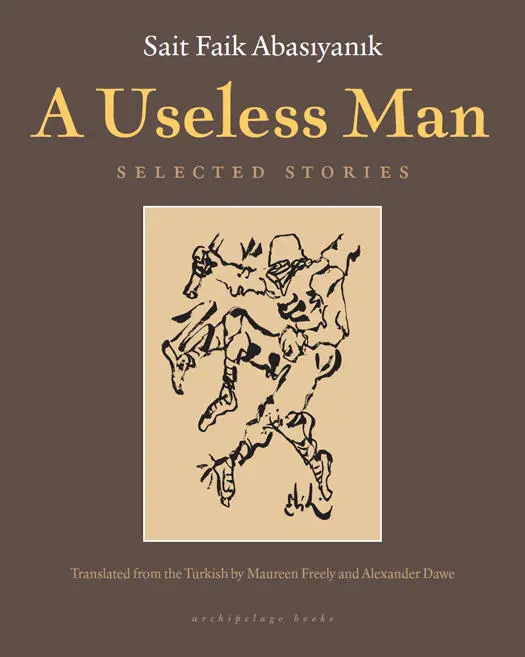
Sait Abasiyanik - A Useless Man
Здесь есть возможность читать онлайн «Sait Abasiyanik - A Useless Man» весь текст электронной книги совершенно бесплатно (целиком полную версию без сокращений). В некоторых случаях можно слушать аудио, скачать через торрент в формате fb2 и присутствует краткое содержание. Год выпуска: 2015, Издательство: Archipelago, Жанр: Классическая проза, на английском языке. Описание произведения, (предисловие) а так же отзывы посетителей доступны на портале библиотеки ЛибКат.
- Название:A Useless Man
- Автор:
- Издательство:Archipelago
- Жанр:
- Год:2015
- ISBN:нет данных
- Рейтинг книги:3 / 5. Голосов: 1
-
Избранное:Добавить в избранное
- Отзывы:
-
Ваша оценка:
A Useless Man: краткое содержание, описание и аннотация
Предлагаем к чтению аннотацию, описание, краткое содержание или предисловие (зависит от того, что написал сам автор книги «A Useless Man»). Если вы не нашли необходимую информацию о книге — напишите в комментариях, мы постараемся отыскать её.
Sait Faik donated his estate to the Daruşafaka foundation for orphans, and this foundation has since been committed to promoting his work. His former family home on Burgazada was recently restored, and now functions as a museum honoring his life and work. He is still greatly revered: Turkey's most prestigious short story award carries his name and nearly every Turk knows by heart a line or a story by Sait Faik.
A Useless Man — читать онлайн бесплатно полную книгу (весь текст) целиком
Ниже представлен текст книги, разбитый по страницам. Система сохранения места последней прочитанной страницы, позволяет с удобством читать онлайн бесплатно книгу «A Useless Man», без необходимости каждый раз заново искать на чём Вы остановились. Поставьте закладку, и сможете в любой момент перейти на страницу, на которой закончили чтение.
Интервал:
Закладка:
A number of grave-faced middle-aged men joined the old men on the long divan. I was a long way away from them. I couldn’t hear what they were saying, but I could see they were at peace. For the longest time they sat there in silence. And then a moment arrived when I realized that no one had come into the coffeehouse for quite some time. The proprietor’s little clock was facing the other way so I couldn’t read it. More time passed. More people left. At last the proprietor turned his clock around for me. It was half past ten. I was feeling so drowsy that I couldn’t summon the energy to get up and go. Sensing that I would be on my way soon, the proprietor said:
“If you live nearby, there’s no hurry. We’re open till one. Do you really think you could find a better place than this?”
“Oh, all right,” I said. “Make me another tea. With a slice of lemon.”
Just then a man came inside. He was blanketed in snow. Even his eyebrows and eyelashes were white. He walked over to the stove. Swept off the snow. Collapsed into a chair. He was young, this man, very young. The snow melted to reveal a round, white face.
All conversation stopped. The backgammon players in the corner slammed the wooden box shut and left. The silence grew deeper.
I examined the young man. He was sitting in a chair, staring straight ahead. The old men sat still and solemn on their sofa. In their eyes I could see a touch of malice. The proprietor was sitting in front of his stove, his head between his hands. It is a terrible thing to sit in a public space in silence. Ten minutes passed and still the fearsome silence continued.
The young man kept throwing his left leg over his right, and then his right leg over his left. He couldn’t seem to make himself comfortable in that chair of his. From the waist up, he looked like a student at an exam. A student shifting in his chair and then looking up, to make sure the examiners hadn’t seen his crossed legs beneath the table. One of his shoes was a scrap of old tire covered with red patches; he had tied it to his foot with a piece of string. On the other foot was an old gym shoe that gaped open like a fish, with its sole swinging.
The silence continued. I kept hoping for someone to say:
“The devil passed.”
Or:
“A girl was born!”
And then we would all laugh.
But still no one spoke. Once again, I turned my gaze toward the new arrival. It was not his face that drew me now, but his forehead. It was blank and unlined. He wasn’t wearing a jacket. Instead he wore a loose, collarless shirt, white lined with black. Over this he had wrapped a bulky, dirty white sweater, held together in the front with a hook needle.
By now my curiosity had got the better of me. I sat there, unable to move.
Just then the coffeehouse door opened and another man walked in. He went straight over to the old sages.
“He’s called for you,” he said. “His mind is still clear but I’d bet my life on it, he won’t last till morning. He keeps going in and out. Ali Ağa, he’s asked for you. And you, too, Sergeant Mahmut. And if you want, you can come, too, Hasan. He was very fond of you.”
The three elders rose to their feet. Though they did not so much as glance at the young man seated by the stove, their eyes somehow managed to bore into him as they passed. It was as if they were deliberately looking away from him. He watched them go, his large eyes pleading.
The proprietor had not offered him so much as a glass of tea. When he came over to take my own glass, I said, “Make the poor boy some tea. You can put it on my tab.”
The proprietor shut his eyes and opened them again, giving me the oddest look. Then he walked away, to get the young man his tea, I thought.
As he passed before him, the young man jumped to his feet. He stood right in front of the proprietor, who circumvented him, still refusing to acknowledge his presence. As he walked off, the young man said:
“It’s my father, isn’t it? He’s dying, isn’t he?”
The proprietor said nothing. This was a hateful, evil, painful silence. Then the ice melted. But his answer made no sense to me, and it hurt the boy.
“He’s not your father.”
The young man said nothing. He rushed to the door, suddenly full of purpose, but couldn’t get it to open.
The proprietor said, “I hope you aren’t thinking of going home. Your aunt’s son is at the door waiting for you, and he’s ready to kill you.”
The boy paused to think. He had lost all resolve. His face dissolved in confusion. Driving himself through the wind that was trying to hurl him back inside, he left.
For a time, I kept my questions to myself. The proprietor had his back to me. He was making a lot of noise washing something. I waited for him to finish. But whatever he was doing, he was taking his time. At last he turned around.
“For God’s sake, tell me what’s going on!” I cried.
As he removed his apron, the proprietor seemed to search for words.
The door opened. Another young man came back in, an old man at his side.
“I gave him his blessing. Has the other one slipped away yet?”
The proprietor’s hands were behind his back, clutching the ties of his apron. Instead of untying them, he did them up again. He came over to my table. It was as if he thought I needed to hear what he had to say.
“Kamil Ağa, the driver, he’s just died. That dog you saw over there by the stove, that was his son. But he took his sister down the wrong path. His father cast him out.”
Then he turned to the other men.
“He has no honor. He says so himself. But not out of remorse. He came back hoping for his inheritance.”
One of the old men arranged his face to show that he was impartial.
“Even if he showed remorse,” he said, “there would be no forgiveness.”
I have no idea why I asked the question that now came to my lips. Why I didn’t pause to consider what effect my foolish words might have.
“What happened to the girl?” I asked.
Then something strange happened. Without so much as lifting their eyes, these men exchanged glances. No one spoke as we sank into a very different sort of silence.
Without lifting their eyes, they challenged the silence, and its stillness.
“Why did you ask?”
“What was the point?”
“Was that the only thing you could think to ask?”
“Why are you so curious all of a sudden?”
The one who asked this last question took a menacing tone.
No one offered me an answer. I left my money on the table. I glanced over at the proprietor. He was still lost in thought, head bowed. His skin was yellow. He was still trying to untie his apron. I opened the door and stepped outside. I had not been able to find out what happened to the girl, so why was I so sure that this coffeehouse owner had rescued her from the wrong path?
I Just Don’t Know Why I Keep Doing These Things

In the evenings I go out to a rather ordinary coffeehouse on a crowded avenue. I go straight to a table right behind the ones next to the window, and for the next few hours, I just sit there, watching the people passing by. Do I ever get bored? On the contrary, I enjoy it tremendously. Do I examine people’s faces and observe their behavior and think up stories about them? Chance would be a fine thing. How could that be anyone’s idea of a good time? So how do I amuse myself? I think about dying, and I think about growing old; I think about all the wars that haven’t happened yet … The darker the thoughts I let into my mind, the better I amuse myself.
Everyone on this earth is evil. Life has no meaning. Only an idiot would fall in love … And so on, and so on. So all right. You’re asking how it could be any fun to entertain such thoughts. If you want to know, then just think about it. What you do is find the easy way out. Here’s the hardest one: the remedy for death! I convince myself I’m not going to die, and then I’m fine. Go on, give it a try.
Читать дальшеИнтервал:
Закладка:
Похожие книги на «A Useless Man»
Представляем Вашему вниманию похожие книги на «A Useless Man» списком для выбора. Мы отобрали схожую по названию и смыслу литературу в надежде предоставить читателям больше вариантов отыскать новые, интересные, ещё непрочитанные произведения.







Обсуждение, отзывы о книге «A Useless Man» и просто собственные мнения читателей. Оставьте ваши комментарии, напишите, что Вы думаете о произведении, его смысле или главных героях. Укажите что конкретно понравилось, а что нет, и почему Вы так считаете.