Sait Abasiyanik - A Useless Man
Здесь есть возможность читать онлайн «Sait Abasiyanik - A Useless Man» весь текст электронной книги совершенно бесплатно (целиком полную версию без сокращений). В некоторых случаях можно слушать аудио, скачать через торрент в формате fb2 и присутствует краткое содержание. Год выпуска: 2015, Издательство: Archipelago, Жанр: Классическая проза, на английском языке. Описание произведения, (предисловие) а так же отзывы посетителей доступны на портале библиотеки ЛибКат.
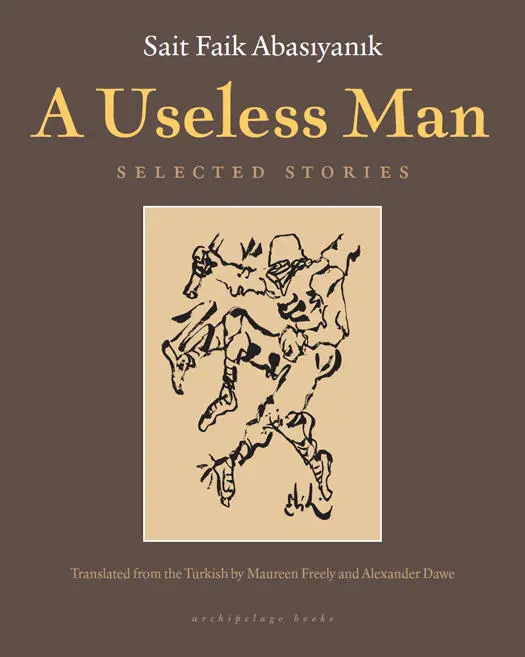
- Название:A Useless Man
- Автор:
- Издательство:Archipelago
- Жанр:
- Год:2015
- ISBN:нет данных
- Рейтинг книги:3 / 5. Голосов: 1
-
Избранное:Добавить в избранное
- Отзывы:
-
Ваша оценка:
A Useless Man: краткое содержание, описание и аннотация
Предлагаем к чтению аннотацию, описание, краткое содержание или предисловие (зависит от того, что написал сам автор книги «A Useless Man»). Если вы не нашли необходимую информацию о книге — напишите в комментариях, мы постараемся отыскать её.
Sait Faik donated his estate to the Daruşafaka foundation for orphans, and this foundation has since been committed to promoting his work. His former family home on Burgazada was recently restored, and now functions as a museum honoring his life and work. He is still greatly revered: Turkey's most prestigious short story award carries his name and nearly every Turk knows by heart a line or a story by Sait Faik.
A Useless Man — читать онлайн бесплатно полную книгу (весь текст) целиком
Ниже представлен текст книги, разбитый по страницам. Система сохранения места последней прочитанной страницы, позволяет с удобством читать онлайн бесплатно книгу «A Useless Man», без необходимости каждый раз заново искать на чём Вы остановились. Поставьте закладку, и сможете в любой момент перейти на страницу, на которой закончили чтение.
Интервал:
Закладка:
What this means is that after you’ve mastered all your grimmest thoughts, you gain entrance to a new world where everyone is laughing, and everyone is content. It’s only at the very beginning that you feel glum. After that, there’s no problem. You’re back to being the man you were. You’re happy without a care in the world.… Or not! At the end of this journey from bad to good, I leave the coffeehouse, and there I am again, walking the streets, thinking about death, and wars, and rising prices, and worries about the future — but never mind!
Just as I’m leaving the coffeehouse, this old man walks in. He’s all bones. How tiresome to have to go through the motions of shaving every day, isn’t there a better way? It’s always the same two-day beard. How does he keep it from growing, why is it always exactly the same? Now that’s something to admire.
His eyes are the same black as the black on his grizzled cheeks. His eyelashes, too: what power I see there. The place on the map of Turkey where I put his birthplace: Van. Whether it’s true or not — that doesn’t concern me, not one bit. If he turned out to be from Istanbul, or Balıkesir, I’d still say the same thing: “You’re wrong, old man. You’ve forgotten. You can’t be from Balıkesir, you’re from Van. So stop lying! What’s wrong with Van? Don’t you like it there? If only you could see Lake Van as I see it, when I close my eyes … It’s surrounded by snow-capped mountains. Go down to the water’s edge at night and you’ll see wild men on winged horses skirting the lake’s silent shores. And pale, whiter than white, black-eyed girls washing their clothes in the water. Everything is like that water. Nothing’s fit to drink. You have to see it with your own eyes to get any sense of it. And the wind — I don’t know what they call it, but even at the dead of night it sends little ripples to the shore, and the whole surface shimmers. When the gulls of Lake Van call out, women give birth to sons, and fillies colts, and cows calves. Only when the waters of the lake are still can a person die. You’re telling a lie, old man. You’re from Van. I can tell just from your prayer beads. Yes, I can tell just from those amber prayer beads you’re slapping against the palm of your hand. Why do you keep insisting you’re from Balıkesir? You’re from Van, you hear? You’re from Van!”
He would go to the table next to the window, take out his silver-rimmed glasses and settle down to read the paper. When I said this happened just as I was leaving, I was telling the truth. But I still had the chance to see him place his melon-colored velvet eyeglass case on the table, and put on his glasses to read the paper. Because after I took my leave of the coffeehouse, I would stroll past the window four or five more times, as part of my evening promenade.
He was somewhere between fifty and eighty years of age. If he’d told you he was fifty, you’d tell yourself he looked pretty rough and had aged before his time. If he’d said he was eighty, you’d have nothing to say except, “Maşallah! You look so much younger!” Who is he, what is he, when did he arrive here from Van, what sort of work does he do? I’m afraid I can’t answer these questions. But there’s no doubt he’s a bachelor. He must be renting a room in some cheap hotel. He must be doing the sort of little job that people from Van do in this city. I was never able to pin down what he did exactly. A middleman, I thought. A tradesman. A head porter. A retired porter. A nightwatchman. I tried out all these ideas, but none of them quite fit. In the end, though, I found a job for him. When I looked at him closely, I noticed that his suit came from a good tailor. Yes, I thought. He must be a retired law clerk.
When I saw him sitting there, his free hand propped on the table and his amber prayer beads dangling from the side of his chair, I would try to imagine what he was reading.
And so it went on. It surprised me how he always managed to arrive at exactly the same moment I was leaving, and before long it began to get on my nerves. In the end I got into the habit of preparing to leave before he even came through the door. I’d watch him come in and sit down and put on his glasses, and then I’d leave.
One night, I had some business. I got to the coffeehouse later than usual. The old man was already seated at his table. I took the table just behind him. It was already late. The coffeehouse was almost empty. The old man had long since finished his paper, and now he was gazing at the street outside.
And so I did the same. When he lit a cigarette, I lit one, too. Then he took out those prayer beads, those amber prayer beads he always brought with him. He began to pass them through his fingers. Click, click, click. If I’d had a set of my own, I’d have done the same. But I had no prayer beads, so I couldn’t. And that really annoyed me. He was looking out at the street, and I was looking at him, and he looked sad. But it was not the sort of sadness that comes with death, or heartbreak. I began to wonder what sort of thing it might come from. I thought: money worries. And as we’ll soon see, I turned out to be right. Who knows what effect money worries might have on a person’s face, or manner, or complexion? Maybe I didn’t know, maybe it was a coincidence. Somehow I divined the fact that this man was suffering from money worries, without his telling me. For a while I put the old man out of my mind and just looked out at the street. If I said that I didn’t even notice when he rose from the table to vanish like a ghost, I wouldn’t be lying.
The next day, when I arrived at the coffeehouse at the normal time, I saw that something strange had happened. The old man had arrived two and a half hours before schedule. Once again, I took the table right behind him. Suddenly he turned with a smile to look me straight in the eyes.
“Yesterday evening,” he said. “I hung my prayer beads right there, on my chair … and now I’ve lost them.”
So much emotion on his face: he was bursting with hope, and with worry. He was agitated. His usually sallow skin had gone pale. That five-millimeter beard of his was quivering.
“I’m so sorry,” I said. “What a terrible shame.”
“Only yesterday, I took them to the Bedesten to sell them. They offered seventy but I wouldn’t take it. I wanted eighty. If only I’d taken their money,” he said.
“They were valuable then, I take it?”
“Of course. They were amber. The purest kind, too: Balgami!”
“I’m sure you’re right. They were very handsome indeed.”
“You probably saw me holding them last night.”
“To tell you the truth, I wasn’t paying attention.”
All at once, his expression changed. Suddenly I was the enemy. I could see the hatred burning in his eyes.
“I’m going to the police,” he said.
“You should,” I said.
For a moment, I thought he was going to say: “You took them. I know full well. Hand them over.” He even looked as if he were going to say it. I kept my cool.
Again his expression changed.
“If I ever find the man who took it, believe you me …”
“It won’t be easy!” I said.
Without raising his eyes, he bit his lip.

Day after day, he came to the coffeehouse early. He never greeted me, but as he took his usual seat, he’d make it clear he’d seen me. Without so much as a glance in my direction, he would read his paper, and everything about him — his pallor, his fury — told me that he was sure I’d stolen his prayer beads. When I got up to leave, he would follow me with his eyes, as I caught him doing a few times when I pretended to have forgotten my cigarettes on the table and went back to get them.
Читать дальшеИнтервал:
Закладка:
Похожие книги на «A Useless Man»
Представляем Вашему вниманию похожие книги на «A Useless Man» списком для выбора. Мы отобрали схожую по названию и смыслу литературу в надежде предоставить читателям больше вариантов отыскать новые, интересные, ещё непрочитанные произведения.









Обсуждение, отзывы о книге «A Useless Man» и просто собственные мнения читателей. Оставьте ваши комментарии, напишите, что Вы думаете о произведении, его смысле или главных героях. Укажите что конкретно понравилось, а что нет, и почему Вы так считаете.