Sait Abasiyanik - A Useless Man
Здесь есть возможность читать онлайн «Sait Abasiyanik - A Useless Man» весь текст электронной книги совершенно бесплатно (целиком полную версию без сокращений). В некоторых случаях можно слушать аудио, скачать через торрент в формате fb2 и присутствует краткое содержание. Год выпуска: 2015, Издательство: Archipelago, Жанр: Классическая проза, на английском языке. Описание произведения, (предисловие) а так же отзывы посетителей доступны на портале библиотеки ЛибКат.
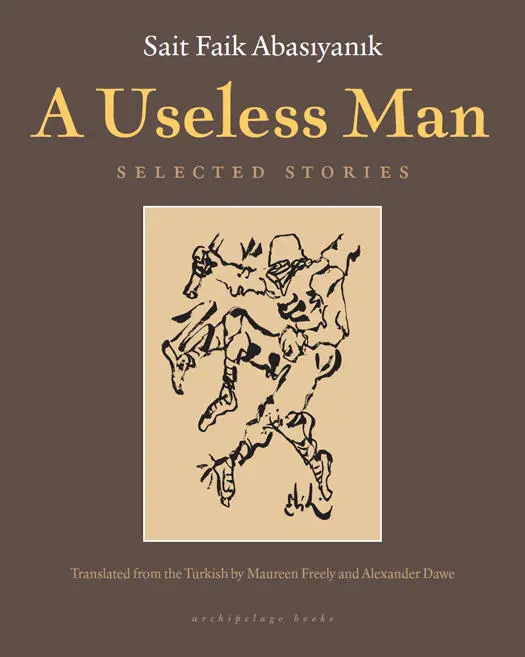
- Название:A Useless Man
- Автор:
- Издательство:Archipelago
- Жанр:
- Год:2015
- ISBN:нет данных
- Рейтинг книги:3 / 5. Голосов: 1
-
Избранное:Добавить в избранное
- Отзывы:
-
Ваша оценка:
A Useless Man: краткое содержание, описание и аннотация
Предлагаем к чтению аннотацию, описание, краткое содержание или предисловие (зависит от того, что написал сам автор книги «A Useless Man»). Если вы не нашли необходимую информацию о книге — напишите в комментариях, мы постараемся отыскать её.
Sait Faik donated his estate to the Daruşafaka foundation for orphans, and this foundation has since been committed to promoting his work. His former family home on Burgazada was recently restored, and now functions as a museum honoring his life and work. He is still greatly revered: Turkey's most prestigious short story award carries his name and nearly every Turk knows by heart a line or a story by Sait Faik.
A Useless Man — читать онлайн бесплатно полную книгу (весь текст) целиком
Ниже представлен текст книги, разбитый по страницам. Система сохранения места последней прочитанной страницы, позволяет с удобством читать онлайн бесплатно книгу «A Useless Man», без необходимости каждый раз заново искать на чём Вы остановились. Поставьте закладку, и сможете в любой момент перейти на страницу, на которой закончили чтение.
Интервал:
Закладка:
Exactly thirty years ago, I was twelve years old and living in an Anatolian city. My father was a civil servant. We’d arrived in this city in late summer. We’d struggled through a bad winter — snowdrifts as high as a man. Then one day, spring came. The snow melted. The snow melted, but it wasn’t the sun’s doing. It was the rain’s. In Anatolian cities, spring begins with an afternoon deluge. In the mornings the sky is a bright blue, and the sun looks as cold as if it’s sparkling on snow. Toward eleven, a black cloud rolls in — it could be from the east, or the west, or the north. Ten minutes later, it begins to pour — pour like water from a glass. And that’s it, for the rest of the day. Great lashes of rain, one after the other. Through my window I could see a dark green pasture, known in the vicinity as “Black Meadow.” I would never have felt the urge to burst out of the house screaming like a madman if not for that play of colors on the meadow that, like the sea, soaked up every pigment of the sky.
I had been in poor health all winter. Every time I went out into the cold, my head would spin. Then there was this strange, oppressive stretch of rain and black clouds, with three gloomy days for every bright one, but there was also spring, filling the air with the aroma of earth and meadow, people and barns, and all I wanted to do was shout and cry and then lie still.
One morning I was gazing at the ceiling. The clouds hadn’t rolled in yet. The sky was still sparkling. I lay on my mattress, wondering how long it would be before the rain came. Just then a bright bird flew through my room. I sat up in bed. It flew past again. Then, on the wall to my right, I saw a band of light flicker and disappear. Then it vanished. I rubbed my eyes. When I looked again I could see a bright circle, shaking and trembling. It seemed to be trying to pin itself to the wall. This was light reflecting off a mirror — it could be nothing else.
I jumped out of bed to look out the window. Our upper garden looked out onto the garden of the house beneath us. The light on my wall must have come from a mirror somewhere over there. She was sitting on a wicker mat among the peach blossoms. Behind her she had placed a chair. She must have been sixteen or seventeen. I did not leave the window. When the light from her mirror touched my eyes, I didn’t shield them with my hands. I looked straight in front of me, eyes unblinking.
The next day I, too, had a mirror in my hands. When the light from my mirror hit her eyes, she’d avert them, smiling faintly. This game never lasted longer than half an hour. She would race back into her house with rain dripping from her hair, and I would return to my bed. The next day would bring another beautiful morning, and it would always be her mirror that arrived first, racing across my room to hover trembling on the wall, as if looking for a hook to hang from. And again I would look straight into her mirror light, my eyes unblinking; as she shielded her beautiful eyes, we would together gaze at mine. Then the clouds would roll in, with the afternoon deluge. Nothing else interested me, and that is why I paid no attention to the horse carriage that stopped outside our house one morning. Only my mother caught me playing with my mirror. She had an odd expression on her face as she took in the garden, the girl, the light from the mirror, and the mirror in my hands.
“Come on now,” she said. “Get dressed.”
We got into the carriage. Behind us, they’d tied on two trunks to carry our belongings. My father had a new posting. Off we went. As we passed through a forest, the sun came bursting through the clouds, lighting up the new leaves on the trees, and then disappeared. And, with a pang, I remembered the mirror light that I would never see again. I burst into tears. My father asked:
“What’s wrong with this one?”
I buried my head in my mother’s scarf. I have no idea what she conveyed to my father, if not with her hands, then with her eyes, but neither said a thing. Somehow knowing that no one had the courage to stop me, I cried my heart out.
And now, whenever a light happens to pass across my window in the springtime, I remember that day with the sweet sadness we all share at that time of year, with a restless beating heart. Thirty years have passed since that day. Never once have I flashed a mirror in anyone’s face, and never once has anyone flashed a mirror into mine. But if a light happened to pass through my room on a spring day, as fast as a swallow, I don’t know what would become of me.
Sinağrit Baba

We were five rowboats at Hell’s Point. A beautiful January evening. A southern wind. Splashes of red rippling over the sea. Long, vast, dying waves the color of strong linden tea. The boats rocking heavily in the sea, fishing poles in suspense, silent souls …
Does a creature lurk beneath us, woven from the darkest of the seven colors, drifting through the hushed and twisted caverns thirty-eight fathoms deep? How can it be, that Sinağrit Baba has left the hunt so soon? He’s the king of the deeps, lavishing kindness and magnificence on all he leaves in his wake. His jacket, noble but cruel with its shimmering rainbow scales. He is rushing back to his palace; it’s made of gold, emerald, coral, and mother-of-pearl, all twinkling in the dark blue.
Sinağrit Baba hasn’t said a word in his life, he’s never married and he’s always lived alone. How many tragedies has he watched from his cavern’s emerald window? How many fishing lines has he dragged into the sea?
But tonight he will choose a line and put an end to his long life. He will end his long life while every scale on his jacket is still sparkling, and long before mayonnaise is smeared over his flesh. Though there is still time before he is devoured by that pale and sticky creature, the wretched stingray, he knows he should surrender now to that intelligent creature from the strange world above, to be feted at a sumptuous feast served with white wine.
Sinağrit Baba sniffs one of the lines. It belongs to the fisherman Hristo. He’s a flawed man. Greedy and always calculating. Yes, he’s poor, but he’s not proud. Sinağrit Baba favors poor men with some pride. He drifts to the next line and sniffs. Hasan’s line. Forget him. Forget his temper, too. Underneath it, he’s a coward, and Sinağrit Baba favors the brave. He tries another line. Fisherman Yakup is a good man about town, charming, loveable, and sometimes crude. But he has a jealous streak. Sinağrit Baba doesn’t favor jealous men. Forget him, too. The next line belongs to a stingy man. Whereas Sinağrit Baba favors generosity. Nevertheless he tries the bait and, tearing off half a Spanish mackerel, he flattens the hook entirely and swallows the bait whole before its stingy owner yanks up his line.
“Holy mother, Nikoli,” he says. “He’s completely flattened the hook.”
With Nikoli’s bait in his belly, Sinağrit Baba tries to find a flaw in Nikoli. Surely he’s flawed. First of all, he’s a drunk. And he’s immoral and self-centered. But he’s also generous and brave. He’s hardly a coward. He’s poor. He’s proud. Sinağrit Baba favors the poor and the proud, but not Nikoli’s brand of pride. Sinağrit is after something just a bit different: a pride that’s timely and true; but no, that’s not quite it either, it’s something you sense in the way a fisherman holds his rod, something about him that goes down to the very roots of his hair, the best of humankind. Sinağrit Baba can’t flatten a fishhook borne by a proud hand, or sever his line, or make away with his barrel swivel.
He sniffs all five of the rowboats, and he isn’t pleased.
Читать дальшеИнтервал:
Закладка:
Похожие книги на «A Useless Man»
Представляем Вашему вниманию похожие книги на «A Useless Man» списком для выбора. Мы отобрали схожую по названию и смыслу литературу в надежде предоставить читателям больше вариантов отыскать новые, интересные, ещё непрочитанные произведения.









Обсуждение, отзывы о книге «A Useless Man» и просто собственные мнения читателей. Оставьте ваши комментарии, напишите, что Вы думаете о произведении, его смысле или главных героях. Укажите что конкретно понравилось, а что нет, и почему Вы так считаете.