Sait Abasiyanik - A Useless Man
Здесь есть возможность читать онлайн «Sait Abasiyanik - A Useless Man» весь текст электронной книги совершенно бесплатно (целиком полную версию без сокращений). В некоторых случаях можно слушать аудио, скачать через торрент в формате fb2 и присутствует краткое содержание. Год выпуска: 2015, Издательство: Archipelago, Жанр: Классическая проза, на английском языке. Описание произведения, (предисловие) а так же отзывы посетителей доступны на портале библиотеки ЛибКат.
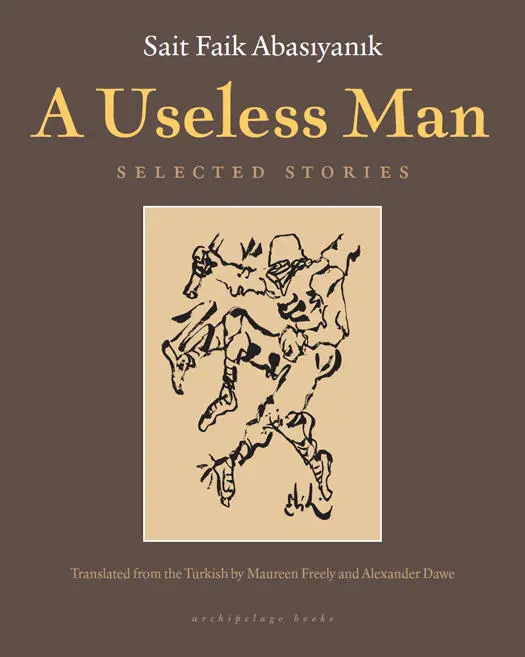
- Название:A Useless Man
- Автор:
- Издательство:Archipelago
- Жанр:
- Год:2015
- ISBN:нет данных
- Рейтинг книги:3 / 5. Голосов: 1
-
Избранное:Добавить в избранное
- Отзывы:
-
Ваша оценка:
A Useless Man: краткое содержание, описание и аннотация
Предлагаем к чтению аннотацию, описание, краткое содержание или предисловие (зависит от того, что написал сам автор книги «A Useless Man»). Если вы не нашли необходимую информацию о книге — напишите в комментариях, мы постараемся отыскать её.
Sait Faik donated his estate to the Daruşafaka foundation for orphans, and this foundation has since been committed to promoting his work. His former family home on Burgazada was recently restored, and now functions as a museum honoring his life and work. He is still greatly revered: Turkey's most prestigious short story award carries his name and nearly every Turk knows by heart a line or a story by Sait Faik.
A Useless Man — читать онлайн бесплатно полную книгу (весь текст) целиком
Ниже представлен текст книги, разбитый по страницам. Система сохранения места последней прочитанной страницы, позволяет с удобством читать онлайн бесплатно книгу «A Useless Man», без необходимости каждый раз заново искать на чём Вы остановились. Поставьте закладку, и сможете в любой момент перейти на страницу, на которой закончили чтение.
Интервал:
Закладка:
Sinağrit Baba hovers beside the corner of his cavern, watching the sea palace sparkle, lit by the mercury bait and the hooks shimmering soft as moonlight in the deep blue sea. More lines drop down and soon fifteen mercury lamps are swinging softly in the center of the land of Sinağrit and Çüpra … One after the other red bream dart out from their hollows and attack the lamps, foolishly snagging themselves on the hooks. Pulled up to the surface, their eyes wide as they turn and look down, unsure if they should give in and see the world above them or struggle back down into theirs. Their eyes grow wider still as they look down at Sinağrit Baba, as if to say, “save us from this horrible fate.” Sinağrit Baba takes a moment’s pause. He only has to swim over to the shimmering line and bite through it, nothing more. But he stays still and decides not to save them. He knows it would be an easy thing to do, but he knows something else, too: that reason can’t fix these things, that it makes no difference if you are animal, vegetable or human being, if you live in the water, on land or in the air. His good deed would only have a real and lasting effect when all the other fish in the sea understand that severing the shimmering line meant saving all the others. The Mighty Sinağrit might bite through the line, but then who would save him when his own time came? Who would ever think of biting the line for him?
A brightly shimmering hook falls into the sea. Hopeful, the Mighty Sinağrit swims toward it and sniffs. The owner’s vaguely familiar. Nibbling a little on the bait, he thinks for a moment that this is the very man he is looking for. Then suddenly he’s caught. Tumbling into the boat, the Mighty Sinağrit stares up at the fisherman with wide and joyful eyes. Again and again, he looks up through his luminous, red-rimmed black eyes. Then he flaps his body up and down on the bottom of the boat like a furious young girl pounding her foot on the floor. Maybe he sees something in the man we can’t see: that this man has failed the test. Yes, he has led a brave and generous life. And he lives as a proud man, something the Mighty Sinağrit thinks is good. But somehow now he knows that this man is a wretched dog; he sees what no one else can see. This man who just fished him out of the sea has never put his courage, his bravery, his pride to the test over the years; he’s been that lucky. But who is he? What is he? Sinağrit Baba doesn’t know. But he’s understood that, despite having lived a generous, proud, and courageous life, this man has failed the test. And might never have been tested at all, he might end his days like that. Sinağrit Baba has never encountered anything like it. Just before he dies, he looks up at the man again. From his forehead alone, he knows the man to be the most dishonorable of all dishonorable men, the most cowardly of all cowards. But he will die a brave and honorable and generous man. He has been so fortunate throughout life that he never once considered his duplicity. Would Sinağrit Baba have surrendered willingly to him if he had? So he flails desperately about in the boat again, his mouth fixed in a silent scream. Then it closes. It was with regret and a swell of defeat that the Mighty Sinağrit gives his dying breath in that rowboat, watching humanity fail the test.
Four Plusses

You want to light up but you don’t have a match. Where will you go for a light? You need directions. Who to ask? You see a crowd gathering. You wonder what’s going on. Who will you turn to? A man like me. And while I do like being the one people are more likely to turn to when they’ve lost their way, or need a match, there are times when I don’t. But I can’t say I have never assumed an arrogant air to discourage the poor souls who walk over to me with a question, or who look at me as if they might spring one on me … but who knows, I was so very low that day. So many times I’ve had to ask myself why I’ve acted that way when I usually disliked being the one picked out of the crowd. It also annoys me when young boys ask me to light their cigarettes. They stand there, some distance away, sizing me up. And then the strange way they come up to me. There have been times when I’ve let them down. And it was on those occasions that I came to understand what a terrible thing it is, to be wrong about someone. There is not a soul on earth who can bear it. I’ve seen quite a few of them give up on the idea of asking me for a light. Some people make sure never to risk losing hope.
I myself can recall a number of times when I have faltered while trying to find the right person to ask for directions. After which I lost patience and went straight over to the man closest to me. Some didn’t show me the way even if they knew, while others were so delighted to have the chance to offer me a cigarette that they couldn’t stop smiling. How wonderful it is, not to know how to thank a man who has shown fellowship at the moment you least expected it; first you say, merci beaucoup , then, thanks so much, then, I can’t thank you enough; then you translate the French: you explain to the man that it means “thank you very much.”
But I know this, too: if a stranger asks you a question, if he’s picked you out of twenty people, he’s already made a number of calculations. These are calculations of a psychological nature.
And then, if he’s mixed in some hollow, inscrutable theories about physiognomy … This reminds me of the professor who did all that research on the science of the face. How carefully he studied his faces. And what outlandish things the poor doctor read into them. Oh, that intense gaze, that wrinkled face, those evenly aligned strands of dark hair that framed the beauty of a face. But he got them all wrong. There was nothing in that wise and intense gaze, bar stupidity, nothing in that lined face but the idiotic fancies of a young girl. Beneath that broad forehead framed by that mane of black hair, there was nothing but lost memories of an empty life.
Most of us cannot make heads or tails of psychology or face-reading; rather, we proceed as amateurs, knowing nothing about these sciences, lighting our cigarettes, inquiring after ferries, asking for directions, or whatever else we need to know. Our habits take over — we lose all sense of shame. So why is it that they’ll pick me out of a crowd of young men? Is it because yours truly is a good man? I doubt it … They don’t choose me because I’m a good person. They choose me because I seem to be just the right man to ask. Does that mean I have a compelling face? What a fine thing that would be! There must be another reason. Are we shabbily dressed? Are our boots unpolished? Did they catch a foolish glint in our eyes? Forbearance in our manner? A kink in our nose? Something slack about our cheeks? Or is the knot in our tie a touch too shiny? It has to be something. It could just be that I have something of the vagabond in me. If you saw a man jumping out of a car and dashing for the ferry — would you even think of asking him a question? If you saw a gentleman frowning as he drew deeply from his cigarette outside a restaurant he had evidently just left, would you even think of asking him for a light? If you saw a traveler dripping with elegance, would you ask him directions? Could you ever find the courage to approach a man wearing polished boots, to ask him why the crowd?
Things being as they are, I rarely get angry when people ask me for directions, or if they come to me for a light. And when I am coming to see you, my love, and someone asks for directions, I even take the time to have my boots shined.
I hate it, though, when an immaculately dressed city type asks me for a light. If you want to know why, it’s because he couldn’t find the courage to ask all those other men, and so this man … Though when you think about it, this has nothing to do with courage. He was embarrassed by all those others, but not by me. Truth is, this sort of thing annoys me. Because even if it isn’t rude, it’s a bit strange. You can’t ask just anyone. Why am I the one they choose? Here’s my answer: I like it when a villager asks for directions without thinking about it first, or making any calculations — without knowing the first thing about psychology or physiognomy. Let them come to me with their questions. They aren’t seething with secret thoughts or clever schemes. And how could these poor creatures ever dare approach that fat man oozing with pride, his every pore scrubbed clean? I’m just someone who happens to be there — a man like any other.
Читать дальшеИнтервал:
Закладка:
Похожие книги на «A Useless Man»
Представляем Вашему вниманию похожие книги на «A Useless Man» списком для выбора. Мы отобрали схожую по названию и смыслу литературу в надежде предоставить читателям больше вариантов отыскать новые, интересные, ещё непрочитанные произведения.









Обсуждение, отзывы о книге «A Useless Man» и просто собственные мнения читателей. Оставьте ваши комментарии, напишите, что Вы думаете о произведении, его смысле или главных героях. Укажите что конкретно понравилось, а что нет, и почему Вы так считаете.