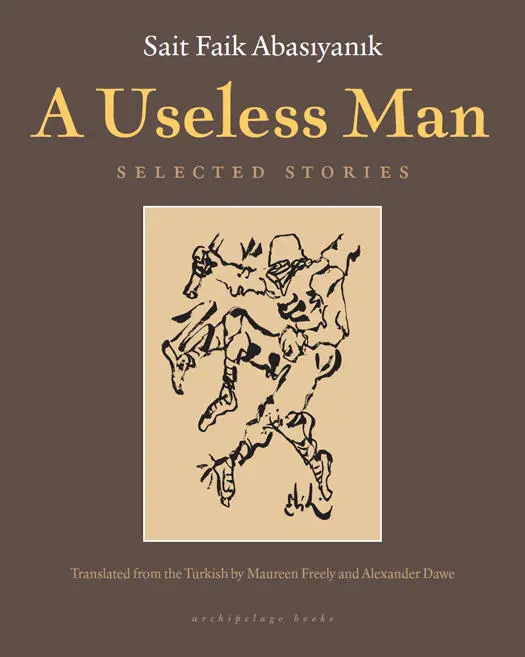
Sait Abasiyanik - A Useless Man
Здесь есть возможность читать онлайн «Sait Abasiyanik - A Useless Man» весь текст электронной книги совершенно бесплатно (целиком полную версию без сокращений). В некоторых случаях можно слушать аудио, скачать через торрент в формате fb2 и присутствует краткое содержание. Год выпуска: 2015, Издательство: Archipelago, Жанр: Классическая проза, на английском языке. Описание произведения, (предисловие) а так же отзывы посетителей доступны на портале библиотеки ЛибКат.
- Название:A Useless Man
- Автор:
- Издательство:Archipelago
- Жанр:
- Год:2015
- ISBN:нет данных
- Рейтинг книги:3 / 5. Голосов: 1
-
Избранное:Добавить в избранное
- Отзывы:
-
Ваша оценка:
A Useless Man: краткое содержание, описание и аннотация
Предлагаем к чтению аннотацию, описание, краткое содержание или предисловие (зависит от того, что написал сам автор книги «A Useless Man»). Если вы не нашли необходимую информацию о книге — напишите в комментариях, мы постараемся отыскать её.
Sait Faik donated his estate to the Daruşafaka foundation for orphans, and this foundation has since been committed to promoting his work. His former family home on Burgazada was recently restored, and now functions as a museum honoring his life and work. He is still greatly revered: Turkey's most prestigious short story award carries his name and nearly every Turk knows by heart a line or a story by Sait Faik.
A Useless Man — читать онлайн бесплатно полную книгу (весь текст) целиком
Ниже представлен текст книги, разбитый по страницам. Система сохранения места последней прочитанной страницы, позволяет с удобством читать онлайн бесплатно книгу «A Useless Man», без необходимости каждый раз заново искать на чём Вы остановились. Поставьте закладку, и сможете в любой момент перейти на страницу, на которой закончили чтение.
Интервал:
Закладка:
So there you have it. Mustafa the Blind. On one side of his face, an eye with the soul of a hunchback, beckoning and rejoicing, while the eye on the other side of his face is plain and old. It puts on airs. It cowers with shame. But there is never any light in it.
Mustafa the Blind tends gardens. He takes daily jobs: he plasters cisterns, fixes roofs, digs wells, that kind of work.
Few people live on the southern side of our village. It’s really no more than a great tangle of briar, wild oak, arbutus, and shrubs that think they’re trees. The unruly patch belongs to the Fino Church. A wild-eyed and unshaven giant of a priest makes a great show of claiming the land as his. He could, I imagine, have rented it out for some pittance, but he never got around to it. In the meantime a forestry administrator has registered the land as a protected site. So there it sits inside that copse of pines, a tangle of weeds, shrubs, and branches too wiry to burn. Saved by the Forest Code.
And Mustafa the Blind. I don’t know how he did it. But somehow he managed to tame a part of it — the part that went down to the sea. He paid a price, of course. Do you know how he paid? With the nails on his fingers. That’s how. Dig under that tangle of briars and all you’ll find is stone … Nothing but stone. All the way down to the sea. And meanwhile, there was Mustafa, who had no choice but to spend his days working elsewhere.
But in the evenings he would retrieve his shovel from the brambles and dig and hack and weed until the sun came up the next day. He dug out one stone after another. For one winter and one summer he battled the arbutus, laurel, wild oak, and brambles, the roots and thorns and weeds, and the meddling forestry administrator. I don’t think there’s any other man in the village who would engage in such a savage struggle for just three furrows of land.
Cracking through a stone, he would pull out a handful of dark pink heather humus to uncover the root of a wild oak that looked like a terrifying snake. He would yank it out to find the forestry administrator standing over him. After seeing him off, he would notice that his index finger was swollen, pricked by a venomous thorn. His pickaxe would go blunt. His shovel would crack. But on he went, piling up the stones. On the soft earth next to him was a massive stone the size of a man. A mossy-faced man … But Mustafa gave it everything he had. His shoulders, his chest, his back, his feet, his fingernails. Mustering all his power, he vanquished the stone, smashing it to pieces. When his shovel failed, he used his hands, his fingers and his nails, scratching at the earth …
And then, one autumn day, we looked, and the tangle of briars was gone. The pine tree saplings were the only survivors, along with three or four arbutus bushes. Sunlight filtered through the berries and the pine needles, casting shadows over the naked earth. Some of it was olive-brown. But here and there were patches of pink and grey. Those who saw it, said:
“Tend an orchard, or accept a savage vine.”
And that is how we learned that to triumph over nature, you had to fight tooth and nail, and with your blood and guts. With my own eyes I witnessed the battle unfold. I remember days when his blind eye was red with rage. I would sit myself under a pine tree at some distance and watch the cruel battle. And under my breath I’d cheer him on. Mustafa the Lion. That’s what I called him. It was like watching a Roman slave pit himself against a lion, except for this: a slave could slay a lion in the quarter of an hour, but Mustafa took an entire year to conquer this beast, fueled by hope and despair.
One morning I had just settled into my usual place under the pine tree when I saw a village woman and three half-dressed children building something with a strange collection of boards, rocks, and sheet metal. It was a house. A house exposed to all the winds! The poyraz , and the lodos , and the gündoğusu , the keşişleme , the yıldız , and the karayel . Standing behind Mustafa as he divided up the three parcels of land into gardens and seedbeds was that sturdy woman, dressed in green.
“Mustafa the Lion,” I said. “Did you find water?”
“There’s a well down by the shore. It’s salty, but it’ll do. If only I could dig out a cistern here …”
He paused to catch his breath. I paused, in love and admiration and respect. I thought about all the millions of others like him, tilling our fields. Tilling fields the world over. Fighting the dragon with their calluses and their nails, rough-faced, one-eyed, one-armed …
Young ladies, one day, your future husband will send you a dark red carnation. Look at it closely, because it might be one of Mustafa’s. Young men, you know those sweet and sugary tomatoes at the village market, the ones that smell like pullet apples. Slice them open and their seeds will shine like gold. Drink the bottled tomato juice at the local restaurant one day. If you find the taste divine, like the nectar that gives Greek gods eternal life, know that one of Mustafa’s tomatoes was thrown into the mix.
By the Beyazıt Fountain

I’m waiting for you on one of the benches by the Beyazıt Fountain. I’m thinking what it means when someone my age feels the joyful anguish of a twenty-year-old man. It might just be that I came so late to these things. Then again, it could all be in my imagination: a heartache has its own delights, it can make a man feel young again. But that is not to say that a long summer can banish winter forever. Winter will be spectacular, burying the roads in snow. Burying the world itself under pure white meadows of death.
I’m waiting for you to come to me. When I see you at last, I will feel my heart flutter. But you will pass by without even seeing me, and I will sink back into myself, despairing, but at the same time, oddly hopeful. And there I shall stay, shut up inside myself, until all I can see is a world drenched in misery. And then I shall leave this place, to seek solace in the voices of others. I shall wander from one street market to the next, through a city you and I have made together.
Everyone in the world has passed by this fountain by now, everyone except for you. Your face was the only one I didn’t see. Tears filled my eyes. You might have thought I was a child, crying because it was a holiday, and he wanted to go on a swing.
Was it the cold that was making me shiver? Was it my nerves or was it grief? I couldn’t tell. The water in the fountain was murky. The clock on the gate told me it was a few minutes past noon. The benches by the fountain were empty. What a terrible screech from the tram! I thought I recognized someone on the tram. Why did he turn around and look at me like that? Or is it just that at this hour no one ever really sits on these benches except those who have nowhere else to go. Isn’t anyone in this city in love? Am I the only man in the city who is sitting on a park bench, waiting, waiting, just to catch a glimpse of his beloved?
They sat down on the bench next to mine. A woman and a man. The man turned to smile at me. I didn’t feel like smiling, but a smile this warm deserved a response; he was that kind of man. So why had I refused to smile at anyone else that morning? I was waiting for you. I was still waiting for you. I was wondering why you weren’t passing this way, today, at this hour … I was wondering, even, if you might be unwell …
Then I saw someone with hair like yours, and the same way of walking; and when I saw it wasn’t really you, I began to worry about the real you; I began to fear the worst. Then I fell to thinking that you knew full well that I was sitting here waiting for you, and so had chosen to go out through the other gate. But I quickly dispelled the paranoia. How important could I be?
Читать дальшеИнтервал:
Закладка:
Похожие книги на «A Useless Man»
Представляем Вашему вниманию похожие книги на «A Useless Man» списком для выбора. Мы отобрали схожую по названию и смыслу литературу в надежде предоставить читателям больше вариантов отыскать новые, интересные, ещё непрочитанные произведения.





Обсуждение, отзывы о книге «A Useless Man» и просто собственные мнения читателей. Оставьте ваши комментарии, напишите, что Вы думаете о произведении, его смысле или главных героях. Укажите что конкретно понравилось, а что нет, и почему Вы так считаете.