Derek Robinson - Damned Good Show
Здесь есть возможность читать онлайн «Derek Robinson - Damned Good Show» весь текст электронной книги совершенно бесплатно (целиком полную версию без сокращений). В некоторых случаях можно слушать аудио, скачать через торрент в формате fb2 и присутствует краткое содержание. Город: New York, Год выпуска: 2013, ISBN: 2013, Издательство: MacLehose Press, Жанр: Историческая проза, prose_military, на английском языке. Описание произведения, (предисловие) а так же отзывы посетителей доступны на портале библиотеки ЛибКат.
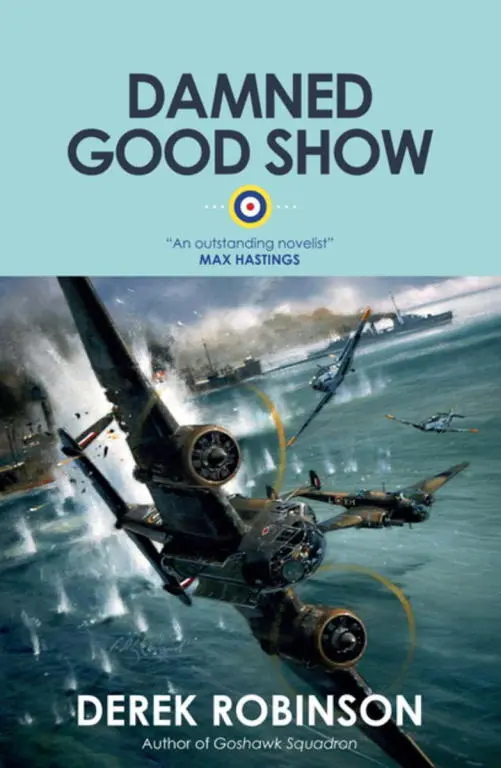
- Название:Damned Good Show
- Автор:
- Издательство:MacLehose Press
- Жанр:
- Год:2013
- Город:New York
- ISBN:978-1-62365-322-4
- Рейтинг книги:3 / 5. Голосов: 1
-
Избранное:Добавить в избранное
- Отзывы:
-
Ваша оценка:
Damned Good Show: краткое содержание, описание и аннотация
Предлагаем к чтению аннотацию, описание, краткое содержание или предисловие (зависит от того, что написал сам автор книги «Damned Good Show»). Если вы не нашли необходимую информацию о книге — напишите в комментариях, мы постараемся отыскать её.
Robinson’s crooked salute to the dogged heroes of the R.A.F.’s early bombing campaign is a wickedly humourous portrait of men doing their duty in flying death traps, fully aware, in those dark days of war, there was nothing else to do but dig in and hang on.
Damned Good Show — читать онлайн бесплатно полную книгу (весь текст) целиком
Ниже представлен текст книги, разбитый по страницам. Система сохранения места последней прочитанной страницы, позволяет с удобством читать онлайн бесплатно книгу «Damned Good Show», без необходимости каждый раз заново искать на чём Вы остановились. Поставьте закладку, и сможете в любой момент перейти на страницу, на которой закончили чтение.
Интервал:
Закладка:
“Skelton.”
“Of course. You’re Skull. I’m called Bins. Right, I’m off.” He got into his tunic; Skull saw an Observer’s half-wing, much faded. “Final briefing, seventeen hundred hours.” The door banged behind him.
Skull , thought Skull. How did he know about Skull? One of the mysteries of RAF life was the way nicknames went ahead of a posting. “What’s the target?” he asked.
“Mannheim, sir,” Corporal Hawkins said.
Everywhere Skull looked there were telephones. Some were labeled with initials that meant nothing to him. “You’d better start explaining—” he began, when a phone rang. Hawkins answered it. Mannheim , Skull thought. Where the devil is Mannheim? A map of Germany covered half a wall and he began searching. Another phone rang. The Sergeants’ Mess wanted to know when the aircrew sandwiches should be ready. Skull said Corporal Hawkins would call them back. He fended off the next two calls in the same way and then got a brisk Scotsman on the red phone. Instinctively, Skull knew it would be a mistake to offer him a corporal; on the other hand the man spoke too fast and used strange words. “Say again, please,” Skull said. “This is an awfully bad line. I missed half of that. Who are you?”
“NLO.”
“Still not good. Perhaps if—”
“NLO. Naval Liaison Officer, for Christ’s sake. Can you hear me now? Can you write? Then write this: convoy three seven green new position…” Skull wrote hard.
Phones kept ringing. When Bins returned, Skull had a small stack of messages to give him. “Anything crucial here?” Bins asked. Skull thought. “Um…” he said. He couldn’t remember what half the messages were about. Bins turned to Corporal Hawkins. “Got the target file? Good. Let’s go.”
The squadron was sending six Wellingtons to Mannheim; there were thirty-six aircrew in the Briefing Room. Skull listened carefully to the squadron commander’s description of the target, what it manufactured, and precisely where, and just how it helped the German war effort. Other officers took over. A stream of information came thick and fast—petrol load, bombload, takeoff time, diversion airfields, signal codes, recognition signals, alternative targets—until Skull let it wash over him. He looked at the crews. He had expected them to be older than fighter pilots; instead they seemed younger. Many gunners and wireless ops were twenty at most; probably only eighteen or nineteen. He saw pilots with schoolboy faces. He glanced back at the squadron commander: awfully young to be a Wingco. Three rings on his sleeve went halfway to his elbow. Skull felt curiously remote from this scene. He was nearly forty: a very old man to the crews. They laughed at something Bins was saying about searchlight concentrations. Skull missed the joke but he smiled anyway.
“Any questions?” Bins said.
“Who else is on this raid?” someone asked.
“Only Wellingtons. Thirty-odd kites. If you see something over Germany that’s not a Wimpy, shoot it down.”
“What about convoys? Can we shoot at them?” a pilot asked. There was groaning and whistling.
“Only one convoy,” Bins said. “Northbound off Cromer, so it should be well away from you. Anything else? No? Then it’s weather time.” He handed his pointer to the Met man.
“Thank you. The predicted winds,” the Met man began, and paused.
“Are wrong,” the crews all said, and laughed. He smiled sadly and waited for their chatter to fade.
“Old squadron tradition,” Bins murmured to Skull. “Brings them luck.”
“About convoys,” Skull said softly. “There may be more up-to-date gen in one of those messages I gave you.”
“Nothing crucial, you said.” Bins was searching the notes. “God damn it all to hell. A new convoy. Bloody damn and buggery.”
“Surely it’s not too late—”
“Not the point. Corrections are bad form. The chaps don’t like them.”
“Oh dear.”
“You’ve put up a black, old boy.”
When the Met man finished, Bins announced new convoy information: on the outward flight it would be northward, off The Maze; returning, northward off Thorpeness. “Avoid it,” he said. Nobody laughed at that. “A final reminder: beware of intruders. The Hun likes to prowl around East Anglia. You’re never home until you’re home.”
A voice at the back said, “Pity the bloody convoys can’t shoot down the bloody intruders.” That won a rumble of approval.
Briefing ended. A group captain wished them luck. The crews stood up and waited while the briefing officers left.
Outside, the Wingco paused to look at the sky. Two layers of broken cloud, at greatly different heights, were moving in slightly different directions. “A spot of fog early on, to keep the intruders away,” he said, “then clearing in time to let our chaps get down. That would suit me nicely.”
“Alas, fog is not normally so obliging,” the Met man said.
“It’s been some time since an intruder got a kite, sir,” Bins said.
“Is it? I’m not so sure. If we find a German cannon-shell in a wreck, does that mean the Wimpy got hit over Germany, staggered home and fell to bits in the air? Or did an intruder clobber it over King’s Lynn just as the crew relaxed?” Nobody had an answer. “Jerry’s bloody cunning. I wish I knew what his tactics are.”
“We use intruders, too, sir,” Skull said.
The Wingco’s head rotated like a hawk locating a sparrow. “What’s that got to do with the price of apples?”
“If our intruders are successful over France, sir, perhaps we should ask them to tell us their tactics.”
The Wingco grunted. He pointed to the Operations Officer, who had kept himself in the background, “Some fool has parked a Lagonda in my space outside the Mess. Tell the adjutant, would you?” He strode away.
The Ops Officer said softly, “Nobody on the squadron owns a Lagonda.”
“I do,” Skull said.
“Well, you’ve just put up a black. Move the bloody thing, fast.” He hurried after the Wingco.
“How was I to know?” Skull asked.
“Well, you know now,” the Met man said.
“A Lagonda,” Bins said. “That’s a bit rich, for a flight lieutenant.”
“My aunt gave it to me. She can’t get the petrol, Lagondas being large and thirsty.”
“Pug Duff drives an MG,” the Met man said. “Not large. Quite small, in fact. Like him. Lots of zip. Also like him. I’d say you’ve put up a considerable black.”
“Nothing new,” Skull said. “When’s dinner?”
By sunset, the sky had cleared, with just a few faint scribbles of yellow cloud at great height. The air was mild. A breeze barely ruffled the grass. Skull and the Ops Officer stood outside the Operations Block and watched time pass.
The Ops Officer’s name was Bellamy. He stood as if he were at ease on a parade ground: shoulders squared, hands linked behind his back, feet at ten-to-two, calves braced. He was a squadron leader with a pilot’s wings, and he was twenty-six. Bellamy had been in the RAF since he was sixteen, and he would have felt uncomfortable standing in any other way. He was lean and spruce, and he always looked alert.
“Curious, sir, isn’t it?” Skull said. Unlike Bellamy, he was slightly round-shouldered, and he wore his uniform as if he were looking after it for a friend. “Here we are, doing this, and they’re over there, doing exactly the same. Wouldn’t it be odd if one day both sets of bombers met in the middle?”
“Highly unlikely,” Bellamy said. “They usually cross the Channel from bases in France, Belgium maybe. We nearly always go out over the North Sea.” He stopped. What he had said sounded like an arrangement, even an agreement. “Not on the cards.” End of discussion.
Читать дальшеИнтервал:
Закладка:
Похожие книги на «Damned Good Show»
Представляем Вашему вниманию похожие книги на «Damned Good Show» списком для выбора. Мы отобрали схожую по названию и смыслу литературу в надежде предоставить читателям больше вариантов отыскать новые, интересные, ещё непрочитанные произведения.





Обсуждение, отзывы о книге «Damned Good Show» и просто собственные мнения читателей. Оставьте ваши комментарии, напишите, что Вы думаете о произведении, его смысле или главных героях. Укажите что конкретно понравилось, а что нет, и почему Вы так считаете.