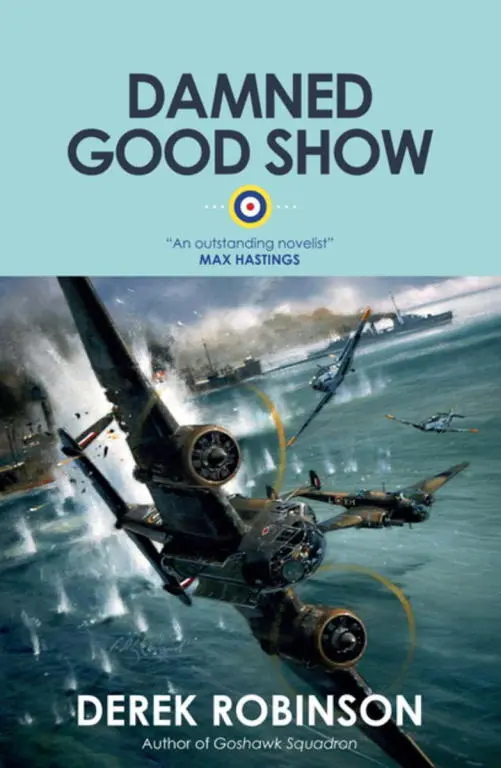
Derek Robinson - Damned Good Show
Здесь есть возможность читать онлайн «Derek Robinson - Damned Good Show» весь текст электронной книги совершенно бесплатно (целиком полную версию без сокращений). В некоторых случаях можно слушать аудио, скачать через торрент в формате fb2 и присутствует краткое содержание. Город: New York, Год выпуска: 2013, ISBN: 2013, Издательство: MacLehose Press, Жанр: Историческая проза, prose_military, на английском языке. Описание произведения, (предисловие) а так же отзывы посетителей доступны на портале библиотеки ЛибКат.
- Название:Damned Good Show
- Автор:
- Издательство:MacLehose Press
- Жанр:
- Год:2013
- Город:New York
- ISBN:978-1-62365-322-4
- Рейтинг книги:3 / 5. Голосов: 1
-
Избранное:Добавить в избранное
- Отзывы:
-
Ваша оценка:
Damned Good Show: краткое содержание, описание и аннотация
Предлагаем к чтению аннотацию, описание, краткое содержание или предисловие (зависит от того, что написал сам автор книги «Damned Good Show»). Если вы не нашли необходимую информацию о книге — напишите в комментариях, мы постараемся отыскать её.
Robinson’s crooked salute to the dogged heroes of the R.A.F.’s early bombing campaign is a wickedly humourous portrait of men doing their duty in flying death traps, fully aware, in those dark days of war, there was nothing else to do but dig in and hang on.
Damned Good Show — читать онлайн бесплатно полную книгу (весь текст) целиком
Ниже представлен текст книги, разбитый по страницам. Система сохранения места последней прочитанной страницы, позволяет с удобством читать онлайн бесплатно книгу «Damned Good Show», без необходимости каждый раз заново искать на чём Вы остановились. Поставьте закладку, и сможете в любой момент перейти на страницу, на которой закончили чтение.
Интервал:
Закладка:
“Don’t preach to me, flight lieutenant.”
Skull twitched his nose and made his spectacles bounce. “Preaching assumes moral alternatives, sir. War allows us no such choice. We cannot award a fighter pilot his kill just because we feel he deserves it. The truth—”
“Get out.” Thurgood sounded sick, and looked even sicker. Skelton hesitated. The air vice-marshal grabbed the nearest weapon and hurled it at Skelton’s head. It was a half-pint bottle of ink, government issue, short and chunky, and it should have cracked his skull. It missed by an inch and smashed a framed portrait of the King in RAF uniform. Ink drenched the wall. Squadron Leader Perry seized Skelton and hustled him out and kicked the door shut behind them. “You maniac,” he said. “Bugger off and hide! Understand? Hide.”
Skelton could not move. “Luther,” he said. “Martin Luther chucked his ink-horn at the devil and missed.” He saw the look in Perry’s eyes and he turned and trotted off.
Next day the air vice-marshal picked up the telephone and had an amiable chat with an old friend in Air Ministry.
“Chap doesn’t strike me as Fighter Command material,” Thurgood said. “Too long-winded. Beats about the bush. Full of waffle.”
Skelton was posted as an instructor in Intelligence to a Flying Training School in Aberdeenshire. It was called RAF Feck. “What’s it near?” the adjutant asked him.
“Absolutely nothing.” Skelton was examining a map. “Unless you count a village called Nether Feck.”
“Come on, Skull. It’s got to be near somewhere exciting.”
“Germany seems closest.”
The adjutant came over and looked. “Mmm,” he said. “Slightly off the beaten track.”
“It’s Siberia, Uncle. I’ll die up there.”
“Nonsense. The Scots are great fun. You wait and see.”
Skull went off to pack. The adjutant telephoned his opposite number at Feck, supposedly to confirm Skull’s posting but actually to find out something about the place. “What can I tell you?” the other man said. “Nine months of fog and three months of snow. That’s Feck.”
“Doesn’t sound very thrilling.”
“We make our own entertainment. Ping-pong and funerals, mainly.”
RAF Feck trained pilots to fly twin-engined aircraft. Mostly these were Blenheims.
In the fighting over France, Blenheims got shot down by the score. Clearly, something better was needed. Large numbers of Blenheims were made available for training units. This was just as well. At Feck, a day without a crash was cause for mild surprise.
At first, the scale of these losses shocked Skull. After a while he got to know a senior instructor, and he asked what caused them.
“Usually we never know,” the man said. He looked tired. “I have a few theories. For instance, power is intoxicating. We give these boys an airplane. Last year they were riding a bike. Now they’ve got fifteen hundred horsepower at their fingertips. They go solo, they can’t resist flying too fast or too low, or banking too hard. Power seduces them, you see. But one tiny mistake gets magnified by all that power. It only takes a second to lose control.”
“Can’t you weed out the dare-devil types?” Skull asked.
“All pilots have a streak of dare-devil. Otherwise they wouldn’t be pilots, would they?”
Skull remembered the sober and experienced pilots he had known who had chosen to fly underneath bridges for no sane reason that anyone could identify. Some had died. “It seems such an idiotic waste,” he said.
“Well, there are other reasons for crashes,” the senior instructor said. “Some pilots lack faith. They don’t trust their instruments. They fly by the seat of their pants, and the physical sensations they feel, or think they feel, tell them they’re climbing when the instruments show they’re diving. Or they’re convinced the airplane is turning when the instruments show otherwise. And so they kill themselves.”
Skull was beginning to be sorry he’d asked.
“Flying is a very unnatural affair,” the senior instructor said.
Skull could not blot out the dull thump of a distant explosion, the klaxon summoning the crash crew, the hammering bell of the blood wagon; but he did his best to ignore them. They weren’t his business. His business was in the lecture room, explaining the why and how of Intelligence. The trainees were not especially interested. They were eager to fly, to qualify, to get to an operational squadron before something went horribly wrong and the war ended. So he lectured them as he used to do at Cambridge, speaking to a crowd of bored undergraduates who were as relieved as he was when they were free to go off and play games.
In his spare time he went bird-watching, as far as possible from Feck. He took his leave allowance one day at a time, drove to St. Andrews, browsed the university library and indulged in an orgy of reading. When spring came, he went into the hills and did some trout fishing. It was an odd life. The newspapers told him about the Blitz. Heavy bombing had reached as far north as Glasgow. But Skull’s war was confined to RAF Feck, and there seemed no reason why Air Ministry should find a need for his services anywhere else; until one day a signal curtly ordered him to proceed to London. No explanation.
“They’ve bombed the Sheldrake,” Champion said. “The bastards.” For a moment the shock left him breathless.
“I’m surprised that you’re surprised,” Skelton said. “The rest of London’s been blitzed. Why not your club?”
Champion recovered and strode forward. ARP barriers shut off Pall Mall but his wing commander’s rings got him through. Skelton, only a flight lieutenant, followed.
“Just look,” Champion said. “Some idiot Kraut pilot hasn’t the wit to find the docks, so he drops his stupid bomb on the Sheldrake. I mean, just look. I’m on the wine committee.”
“Past tense, surely.”
“Bastards. Absolute bastards.”
A man approached them, an elderly man made to seem older by a covering of dust and a smear of dried blood on his temple. He had a soldierly bearing. “Mr. Champion, sir,” he said.
“Good Lord, it’s Tizard. Are you hurt, man?” To Skelton he said: “One of the club servants… This is a sad sight, Tizard.”
“Indeed it is, sir. But we’ve saved the club silver. And two can play at this game, sir. I served in the last show, and take it from me, sir, the Huns haven’t got our backbone. You know me, sir, I’m not a vindictive man, but I hope the RAF blows Berlin to smithereens.”
Champion patted his shoulder. “Good man, Tizzard… Well, we shan’t get any lunch here, shall we?”
“The Army and Navy Club has offered our members its hospitality during the emergency, sir.”
They walked to the Army and Navy.
It was springtime, but the air smelled of bonfires: city bonfires, stinking not of dead leaves but of charred linoleum and half-burned mattresses, tinged with the harsh aroma of dead fireworks. It was eight months since the Blitz had first introduced Londoners to this smell. Now they scarcely noticed it.
The two officers said little until they sat down to lunch.
Ten years before, Champion had been an undergraduate at Cambridge and Skelton had been his tutor. They had disliked each other. Skelton was a youngish history don; his special interest was Tudor Puritan sects. Champion did not take the Puritans seriously. He was not stupid but he was lazy. Sometimes his essays manipulated facts in order to suit his views. Skelton found that intolerable. What made it worse was Champion’s bland indifference when he got found out. “If you were an accountant,” Skelton told him, “you’d be in prison.”
“Quite a few Puritans went to jail.”
Читать дальшеИнтервал:
Закладка:
Похожие книги на «Damned Good Show»
Представляем Вашему вниманию похожие книги на «Damned Good Show» списком для выбора. Мы отобрали схожую по названию и смыслу литературу в надежде предоставить читателям больше вариантов отыскать новые, интересные, ещё непрочитанные произведения.






Обсуждение, отзывы о книге «Damned Good Show» и просто собственные мнения читателей. Оставьте ваши комментарии, напишите, что Вы думаете о произведении, его смысле или главных героях. Укажите что конкретно понравилось, а что нет, и почему Вы так считаете.