Derek Robinson - Damned Good Show
Здесь есть возможность читать онлайн «Derek Robinson - Damned Good Show» весь текст электронной книги совершенно бесплатно (целиком полную версию без сокращений). В некоторых случаях можно слушать аудио, скачать через торрент в формате fb2 и присутствует краткое содержание. Город: New York, Год выпуска: 2013, ISBN: 2013, Издательство: MacLehose Press, Жанр: Историческая проза, prose_military, на английском языке. Описание произведения, (предисловие) а так же отзывы посетителей доступны на портале библиотеки ЛибКат.
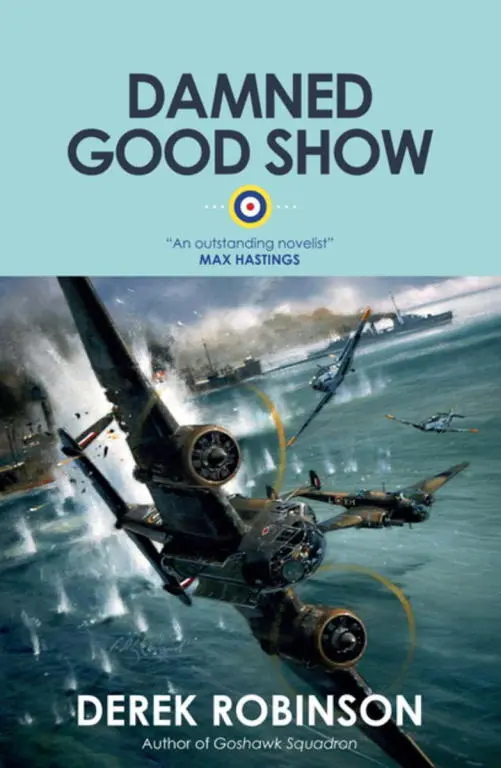
- Название:Damned Good Show
- Автор:
- Издательство:MacLehose Press
- Жанр:
- Год:2013
- Город:New York
- ISBN:978-1-62365-322-4
- Рейтинг книги:3 / 5. Голосов: 1
-
Избранное:Добавить в избранное
- Отзывы:
-
Ваша оценка:
Damned Good Show: краткое содержание, описание и аннотация
Предлагаем к чтению аннотацию, описание, краткое содержание или предисловие (зависит от того, что написал сам автор книги «Damned Good Show»). Если вы не нашли необходимую информацию о книге — напишите в комментариях, мы постараемся отыскать её.
Robinson’s crooked salute to the dogged heroes of the R.A.F.’s early bombing campaign is a wickedly humourous portrait of men doing their duty in flying death traps, fully aware, in those dark days of war, there was nothing else to do but dig in and hang on.
Damned Good Show — читать онлайн бесплатно полную книгу (весь текст) целиком
Ниже представлен текст книги, разбитый по страницам. Система сохранения места последней прочитанной страницы, позволяет с удобством читать онлайн бесплатно книгу «Damned Good Show», без необходимости каждый раз заново искать на чём Вы остановились. Поставьте закладку, и сможете в любой момент перейти на страницу, на которой закончили чтение.
Интервал:
Закладка:
“Yes, I know. Silko told me last night. I mean yesterday. Some time, anyway.”
“Good type, Tubby.”
He chopped up a tin of corned beef with a handful of broken biscuits. Handyman wolfed it down and fell asleep. Now there was no reason to stay, so reluctantly he drove back to camp. His front wheels carved up the puddles and flung them aside.
Silk was, at first, astonished. “Three hours?” he said. Then he was skeptical. “I don’t see how that’s physically possible,” he said. Finally he offered his congratulations. “It makes a nice change to hear some good news,”
“And she’s bought a puppy to play with when I’m not there. Bliss reigns.”
“Damn good show.” Silk nodded and smiled, and kept nodding. “Yes. I suppose this means your… um… offer, proposition, solution, you know what I mean, is now…”
“Stone dead.”
“I would never have gone ahead with it, anyway.”
“Yes, you would, you liar.”
“Well, only for your sake.”
“Have you no shame?”
“Three hours,” Silk said. “It makes you think, doesn’t it?”
That afternoon the rain cleared and Silk went up for a night-flying test. His Hampden flew perfectly until he came to enter the landing circuit and the undercarriage refused to go down. The hydraulic system had a fault, obviously. The back-up system was a bottle of compressed air. It didn’t work either. The pilot could pump the undercarriage down, by hand. The pump handle was locked solid.
Silk flew out to sea, burned up some fuel, came back and used up most of the rest. The control tower cleared the circuit. He got the crew into their crash positions. He made his final approach as slowly as possible. Everything felt normal; he found it hard to believe there were no wheels waiting to take the bomber’s weight. Then he was skimming the ground, and the belly plowed into the turf, he heard the scream of tearing metal, the propellers sent up a green blizzard that turned brown, and Silk’s head got flung violently, savagely, from side to side.
Everybody escaped. The next thing Silk knew, he was in the MO’s office, talking to both of them. If he looked at only one MO, that man drifted away and there were two again. It went on for hours. The MO thought he might have concussion. Double vision could be a symptom. Silk got packed off to a hospital in Cambridge. They specialized in this stuff.
His eyesight cleared up after two days but they kept him for a week. When he got back to Kindrick he reported to his Flight Commander, who was not Tom Stuart but a new squadron leader called Frank Fender. “I’ve just taken over,” he said. “Stuart caught a packet coming back from Hanover, night fighter probably, badly wounded. I believe he made a forced landing on a fighter field in Kent. We shan’t see him in a hurry.”
“Good God,” Silk said. “Fancy old Tom… Anybody else?”
Fender opened a file. “As I said, I’ve just arrived. Let’s see… Tony Langham bought it over Osnabruck. Flak. That’s all.”
Silk went to the adjutant’s office. His legs felt like stilts. “Why didn’t anyone tell me, Uncle?” he said.
“Don’t be bloody silly, Silko,” the adjutant said, gently. He reached for the whisky bottle he kept in a desk drawer for occasions like this. There was always one chap that you thought would never get the chop. It had been the same in the First War. One chap would always come back, and when he didn’t, it was worse than dying. Uncle had seen it a dozen times. Silk looked stunned, like a boy who had walked slap-bang into a telegraph pole.
PART TWO
Risk Creates Optimism
BEWARE INTRUDERS
409 Squadron’s death toll was typical. During the summer and autumn of 1940, more aircrew were killed in Bomber Command than in Fighter Command. But it was Fighter Command that gripped the attention of the British people, because summer 1940 was the time of the Battle of Britain. When it came to newspaper space, Hampdens bombing Germany could not compete with Spitfires and Hurricanes clashing with the Luftwaffe over England.
At the height of the Battle of Britain, a bus came down from London to RAF Bodkin Hazel, a fighter aerodrome in Kent.
The bus brought Air Vice-Marshal Thurgood and an aide, Squadron Leader Perry, plus foreign correspondents from the United States, Scandinavia, Switzerland, Brazil, Canada, Russia, Spain. They were there because, increasingly, foreign newspapers and magazines were skeptical of British claims that Fighter Command was defeating the Luftwaffe. Some said that Air Ministry press releases were pure propaganda, written to boost morale, not to be taken seriously, especially when it came to claims of enemy aircraft destroyed.
Well, Bodkin Hazel was at the sharpest end of the fighting, and Thurgood introduced the journalists to squadron and flight commanders. Fortunately, there was a scramble to intercept raiders and the visitors saw a mass takeoff. Not all the fighters returned. “They probably landed elsewhere to refuel,” Thurgood said. “Happens all the time.”
When he had debriefed the pilots, the Intelligence Officer joined the journalists. Flight Lieutenant Skelton was in his thirties, tall, with a beaky nose supporting horn-rim glasses. His forehead was domed, his cheekbones were wide, his jaws narrow. His nickname was Skull. “Any luck?” someone asked.
“One Heinkel 111 definitely destroyed,” Skelton said. “One possible.”
The journalists made notes, but they were disappointed. Twelve Hurricanes took off. All they got was one lousy Heinkel.
“To reach the bombers, our chaps often have to smash through the German fighter screen,” Thurgood pointed out.
“Any losses?” an American asked.
“One Hurricane,” Skelton said. “The pilot baled out.”
“Even Steven, then.”
For a final question-and-answer session, the correspondents assembled in a lecture room. Thurgood brought Skelton along for good measure.
Everyone had been impressed by what they saw; nevertheless, their questions were still very pointed. What Was the proof that the Air Ministry’s scores were right? If so many German planes had been shot down, where were all the wrecks? According to the RAF, most of the Luftwaffe had been destroyed, but the raids seemed to be getting bigger, didn’t they? Thurgood did his best but the longer it went on the more his answers sounded like excuses, which annoyed him. He resented having to deny allegations of false accounting at a time when the very survival of his country was under threat from a foreign dictator who had made a trade of dishonesty.
The meeting dragged to an end. He knew he had not convinced them. The room emptied until only a couple of the correspondents remained, asking the same old questions in different words. Thurgood forced a smile. “If you think so little of our claims,” he said, “why not go to Berlin and check theirs? The Lufwaffe’s scores are absolutely preposterous!”
One of the journalists looked at Skelton. “D’you have an opinion?” he asked.
“Undoubtedly the Luftwaffe’s claims are inflated,” Skelton said. “It’s a natural phenomenon. High-speed combat invariably has that effect. Airmen are not ideal witnesses. Risk creates optimism, and optimism creates—”
“Wait outside, Skelton,” Thurgood said stonily. When the journalists had gone, he recalled Skelton and blasted him for his interfering stupidity. The Intelligence Officer was unmoved. “I’m sorry if I embarrassed you, sir,” he said. “But what the Luftwaffe claims is beside the point. Proving them wrong doesn’t prove us right. If we believe our own lies we merely deceive ourselves and, by so doing, we aid the enemy. Surely that’s self-evident.”
Читать дальшеИнтервал:
Закладка:
Похожие книги на «Damned Good Show»
Представляем Вашему вниманию похожие книги на «Damned Good Show» списком для выбора. Мы отобрали схожую по названию и смыслу литературу в надежде предоставить читателям больше вариантов отыскать новые, интересные, ещё непрочитанные произведения.







Обсуждение, отзывы о книге «Damned Good Show» и просто собственные мнения читателей. Оставьте ваши комментарии, напишите, что Вы думаете о произведении, его смысле или главных героях. Укажите что конкретно понравилось, а что нет, и почему Вы так считаете.