Derek Robinson - Damned Good Show
Здесь есть возможность читать онлайн «Derek Robinson - Damned Good Show» весь текст электронной книги совершенно бесплатно (целиком полную версию без сокращений). В некоторых случаях можно слушать аудио, скачать через торрент в формате fb2 и присутствует краткое содержание. Город: New York, Год выпуска: 2013, ISBN: 2013, Издательство: MacLehose Press, Жанр: Историческая проза, prose_military, на английском языке. Описание произведения, (предисловие) а так же отзывы посетителей доступны на портале библиотеки ЛибКат.
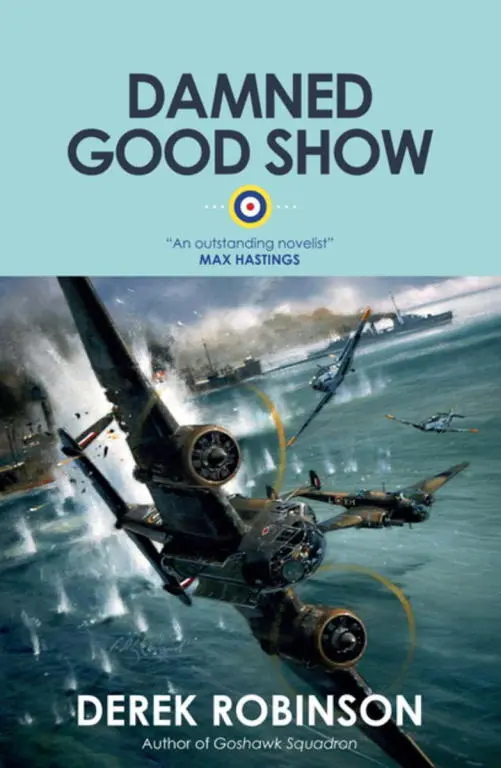
- Название:Damned Good Show
- Автор:
- Издательство:MacLehose Press
- Жанр:
- Год:2013
- Город:New York
- ISBN:978-1-62365-322-4
- Рейтинг книги:3 / 5. Голосов: 1
-
Избранное:Добавить в избранное
- Отзывы:
-
Ваша оценка:
Damned Good Show: краткое содержание, описание и аннотация
Предлагаем к чтению аннотацию, описание, краткое содержание или предисловие (зависит от того, что написал сам автор книги «Damned Good Show»). Если вы не нашли необходимую информацию о книге — напишите в комментариях, мы постараемся отыскать её.
Robinson’s crooked salute to the dogged heroes of the R.A.F.’s early bombing campaign is a wickedly humourous portrait of men doing their duty in flying death traps, fully aware, in those dark days of war, there was nothing else to do but dig in and hang on.
Damned Good Show — читать онлайн бесплатно полную книгу (весь текст) целиком
Ниже представлен текст книги, разбитый по страницам. Система сохранения места последней прочитанной страницы, позволяет с удобством читать онлайн бесплатно книгу «Damned Good Show», без необходимости каждый раз заново искать на чём Вы остановились. Поставьте закладку, и сможете в любой момент перейти на страницу, на которой закончили чтение.
Интервал:
Закладка:
The first hour was simple. They crossed the North Sea at five thousand because there was cloud at six thousand and the pilot wanted to get a good pin-point fix on the Dutch coast.
The fix was positive: Walcheren, on the point of the Zeeland peninsula. It placed them twenty miles east of track: twenty miles off course. That might mean several things. Maybe the predicted winds had changed. Maybe a weather front was late. Or early. Maybe the navigator’s threes looked like his eights.
Or maybe the compass wasn’t feeling very well.
The pilot was Gilchrist, the ex-actor. It was a long time since he had put Rafferty straight about Shakespeare. Now he was a veteran, on his twenty-sixth op. Soon colored beads of flak began reaching for the Wellington. The pilot climbed into cloud and out of it, and kept climbing to fourteen thousand feet, by which time everyone was breathing oxygen.
Twenty minutes later the wireless op spoke on the intercom. “Something’s wrong with the nav, skipper.”
“See what it is,” Gilchrist told the second pilot.
He went back and found the navigator lying beside his chair, with the wireless op kneeling beside him, fixing his oxygen tube to a fresh bottle, turning the supply up to maximum. No effect. The second pilot squeezed the tube and found a blockage: ice crystals. He crushed them, and within seconds the navigator stirred. They got him back on his seat. They had to hold him: he was as limp as a pillow. He stared at the chart on his table. The course he had been plotting became a wobbly line that trailed to the edge and fell off.
Gilchrist went down to eight thousand, where they could all breathe normally. The navigator drank some coffee.
“How d’you feel?” the second pilot asked.
“Better.” There was dried blood on his face. He must have banged his head when he blacked out.
“Can you take a star shot?” Gilchrist asked.
“I can try.”
“Flak behind, skip,” the rear gunner said.
“Thank you. And searchlights ahead.” A small forest of lights had sprung up, restlessly slicing the night. “No loitering here, I think.” He banked the bomber through a quarter-circle and climbed away. In five minutes they were all back on oxygen.
“New course, skip,” the navigator said. “Steer one seven five degrees.”
“One seven five. How far to target?”
“Couple of hundred miles. I’m working on it.”
“Good show. Everybody else, watch out for fixes.”
But the German blackout was total. The navigator went to the astrodome and tried to take star shots. He took so long that Gilchrist told him to forget it. “Damn stars keep jumping about,” the navigator said. He went back to his charts, and saw tiny sparks wandering at the edge of his vision. He decided not to tell the pilot.
The wireless op moved to the astrodome and searched for fighters. An hour passed: an hour of steady, battering noise and broken cloud. By dead reckoning they were over Mannheim. But nothing had changed: empty sky above, deep blackness below, patchy cloud between.
“Bugger this for a lark,” Gilchrist said. “Can’t anybody see the Rhine?” Mannheim was on the Rhine. “Bloody great river, full of water. It’s got to be down there somewhere.” Nobody answered. “We’ll go down and take a dekko,” he said. As he began a wide spiral the wireless op said: “Bombs exploding, starboard.” The yellow splashes were very small. Mannheim turned out to be thirty-five miles away. Thirty-five miles off course.
“Bloody winds,” the navigator said. By then he was in the nose, squinting through the bombsight. His tiny sparks were still wandering.
Later the RAF called it debriefing. In 1941 it was interrogation. The station commander and the CO attended but the Intelligence Officer did the work.
Skull stood behind Bins and watched him work. The first crew home was J-Jig, at 0120. After more than six hours in the air they were both weary and chirpy, glad to get a mug of coffee with a slug of rum in it.
The first questions were the crucial ones. “Did you reach Mannheim?” Yes. “Did you identify the target?” The navigator (and bomb-aimer) said it was as plain as day. “Did you bomb the target?” Absolutely. Right on the nose. Piece of cake. “I saw the bombs go in,” said the rear gunner. “Bull’s-eye.” Bins wanted more detail: time on target, color of explosions, any secondary explosions, any fires, color of fires… Then he whizzed through a dozen items: flak, fighters, searchlights, sightings of other bombers going down, decoy fires, any technical problems, weather, winds…
“Predicted winds were wrong,” the pilot said. “We got blown east until we got a fix on the Rhine south of Mainz. Then it was easy.”
They were restless. Bacon and eggs waited: best meal of the day. Bins said, “Anything else I should know? No? Thanks. Well done.”
“Damn good show,” the group captain said.
Bins took care of M-Mother, then F-Fox and E-Easy. Everyone was pleased: all the Wellingtons had landed. The crews of B-Baker and R-Robert came in together. There was a rush to get to Bins’ table. B-Baker won. R-Robert went to an empty table and dragged out the chairs as noisily as possible. “Shop!” the pilot called. He pounded the table.
“You know the drill,” Bins said to Skull. “Keep it brief, make it snappy.” He gave him an interrogation form.
Gilchrist didn’t wait to be questioned. “Found Mannheim. Recognized the target. Bombed the AP.” Skull looked puzzled. “The what?” he asked. “Aiming Point,” the pilot said. The others put on expressions of comic disbelief: the bloody IO didn’t know what an AP was! “Rear gunner saw our bombs straddle the target,” Gilchrist said.
“Two d’s in ‘straddle,’” the rear gunner said.
“You’re very kind,” Skull said.
“No fighters. Usual flak. Nothing special at all,” Gilchrist said. “Whole trip was a doddle.” Some of the crew were standing up.
“I suppose the Rhine helped,” Skull said. “It runs dead straight out of Mannheim for about two miles, is that right? The perfect landmark.”
“Perfect,” the navigator said. He was feeling much better. “Coming out, we flew straight up the Rhine.”
“Interesting.” Skull made a note. “And the oil tanks beside the river: were they on fire?”
“Not half. Burning like blazes.”
“Flames reflected in the water?”
“That’s right.”
The crew of B-Baker were clumping out of the hut.
“I’ll finish off here,” Bins said. “Anything else you want to tell me? No? Thanks. Well done.”
“Damn good show,” the group captain said. Gilchrist and his men hurried out. Rafferty and Duff followed them, leaving the Intelligence Officers to write up the operational report.
“Don’t gossip with the chaps,” Bins told Skull. “Ask your questions, get the gen, finish.”
“I wasn’t gossiping.”
“I heard you chattering about flames reflected in the Rhine. Nobody gives a damn. The chaps want their meal. God knows they’ve earned it.”
“I was curious to know if they remembered seeing burning oil tanks alongside the river north of Mannheim, that’s all.”
Bins put down his fountain-pen and looked at him. “There are no oil tanks on the Rhine north of Mannheim.”
“R-Robert saw them burning like blazes.”
Bins found a bit of blotting paper and cleaned the nib. He drew a perfect circle to make sure it worked. “Look,” he said. “First day on the squadron and you’ve put up three large blacks. For Christ’s sake don’t do any more damage. This job is tricky enough already.”
“Shall I make us some cocoa? At RAF Feck my cocoa-making was highly commended.”
Читать дальшеИнтервал:
Закладка:
Похожие книги на «Damned Good Show»
Представляем Вашему вниманию похожие книги на «Damned Good Show» списком для выбора. Мы отобрали схожую по названию и смыслу литературу в надежде предоставить читателям больше вариантов отыскать новые, интересные, ещё непрочитанные произведения.







Обсуждение, отзывы о книге «Damned Good Show» и просто собственные мнения читателей. Оставьте ваши комментарии, напишите, что Вы думаете о произведении, его смысле или главных героях. Укажите что конкретно понравилось, а что нет, и почему Вы так считаете.