Michael Shaara - The Killer Angels
Здесь есть возможность читать онлайн «Michael Shaara - The Killer Angels» весь текст электронной книги совершенно бесплатно (целиком полную версию без сокращений). В некоторых случаях можно слушать аудио, скачать через торрент в формате fb2 и присутствует краткое содержание. Жанр: Историческая проза, на английском языке. Описание произведения, (предисловие) а так же отзывы посетителей доступны на портале библиотеки ЛибКат.
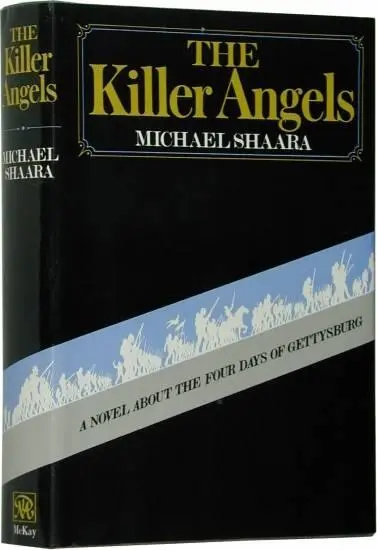
- Название:The Killer Angels
- Автор:
- Жанр:
- Год:неизвестен
- ISBN:нет данных
- Рейтинг книги:5 / 5. Голосов: 1
-
Избранное:Добавить в избранное
- Отзывы:
-
Ваша оценка:
The Killer Angels: краткое содержание, описание и аннотация
Предлагаем к чтению аннотацию, описание, краткое содержание или предисловие (зависит от того, что написал сам автор книги «The Killer Angels»). Если вы не нашли необходимую информацию о книге — напишите в комментариях, мы постараемся отыскать её.
Reading about the past is rarely so much fun as on these pages.
The Killer Angels — читать онлайн бесплатно полную книгу (весь текст) целиком
Ниже представлен текст книги, разбитый по страницам. Система сохранения места последней прочитанной страницы, позволяет с удобством читать онлайн бесплатно книгу «The Killer Angels», без необходимости каждый раз заново искать на чём Вы остановились. Поставьте закладку, и сможете в любой момент перейти на страницу, на которой закончили чтение.
Интервал:
Закладка:
”That was to be expected. Tell General Hood that General Meade might have saved himself the trouble. We’ll have that hill before night.”
The courier put his hat back on and rode off. They rode on for a while in silence. Then Lee halted abruptly in the center of the road. He said, “I suppose I should be getting back. I’ll only be in your way.”
”Not at all,” Longstreet said. But it was Lee’s practice to back off, once the fight had begun, and let the commanders handle it. He could see that Lee was reluctant to go. Gradually it dawned on him that Lee was worried for him.
”You know,” Lee said slowly, looking eastward again, toward the heights, “when I awoke this morning I half thought he’d be gone, General Meade, that he would not want to fight here. When I woke up I thought, yes, Meade will be gone, and Longstreet will be happy, and then I can please Old Pete, my war-horse.”
”We’ll make him sorry he stayed.” Longstreet grinned.
”They fought well yesterday. Meredith’s brigade put up a fine fight. They will fight well again today.”
Longstreet smiled. “We’ll see,” he said.
Lee put out a hand. Longstreet took it. The grip no longer quite so firm, the hand no longer quite so large.
”God go with you,” Lee said. It was like a blessing from a minister. Longstreet nodded. Lee rode off.
Now Longstreet was alone. And now he felt a cold depression. He did not know why. He chewed another cigar.
The army ahead halted. He rode past waiting men, gradually began to become annoyed. He looked up and saw Captain Johnston riding back, his face flushed and worried.
”General,” Johnston said, “I’m sorry, but if we go on down this road the enemy will view us.”
Longstreet swore. He began to ride ahead, saw Joe Kershaw ahead, on horseback, waiting with his South Carolina Brigade. Longstreet said, “Come on, Joe, let’s see what’s up.”
They rode together, Johnston following, across a road crossing from east to west. On the north comer there was a tavern, deserted, the door open into a black interior. Beyond the tavern was a rise-Herr Ridge, Johnston said, a continuation of the ridge leading out from town, facing Seminary Ridge about a mile away, not two miles from the Rocky Hill. Longstreet rode up from under a clump of trees into the open. In front of him was a broad green field at least half a mile wide, spreading eastward. To the south loomed the Rocky Hill, gray boulders clearly visible along the top, and beyond it the higher eminence of the Round Hill. Any march along here would be clearly visible to troops on that hill. Longstreet swore again.
”Damn!” he roared, then abruptly shut his mouth.
Johnston said worriedly, “General, I’m sorry.”
Longstreet said, “But you’re dead right. We’ll have to find another road.” He turned to Kershaw. “Joe, we’re turning around. I’m taking over as guide. Send somebody for my staff.”
Sorrel and Goree were coming up, then Osmun Latrobe.
Longstreet outlined the change: both Divisions would have to stop where they were and turn around. Longstreet rode gloomily back along the line. God, how long a delay would there be? It was after one now. Lee’s attack was en echelon.
That took a long time. Well, we’ll get this right in a hurry.
He sent Sorrel to Lee with word of the change of direction.
Then he scouted for a new path. He rode all the way back to the Cashtown Road, getting madder and madder as he rode.
If Stuart had appeared at that moment Longstreet would have arrested him.
To save time, he ordered the brigades to double the line of march. But time was passing. There was a flurry over near the center. Longstreet sent Goree to find out what was happening and it turned out to be nothing much-skirmish of pickets in Anderson’s front.
They marched, seventeen thousand men, their wagons, their artillery. Captain Johnston was shattered; it was all his fault. Longstreet propped him up. If it was anybody’s fault, it was Stuart’s. But it was maddening. He found a new route along Willoughby Run, followed it down through the dark woods. At least it was out of the sun. Most of these men had marched all the day before and all the night and they were fading visibly, lean men, hollow-eyed, falling out to stare whitely at nothing as you passed, and they were expected to march now again and fight at the end of it. He moved finally out through the woods across country in the general direction he knew had to be right and so came at last within sight of that gray tower, that damned rocky hill, but they were under cover of the trees along Seminary Ridge and so there ought to be at least some semblance of surprise. Sorrel rode back and forth with reports to Lee, who was becoming steadily more unnerved, and Sorrel had a very bad habit of being a bit too presumptuous on occasion, and finally Longstreet turned in his saddle and roared, “Sorrel, God damn it! Everybody has his pace. This is mine.”
Sorrel retreated to a distance. Longstreet would not be hurried. He placed Hood to the right, then McLaws before him. Anderson’s Division of Hill’s Corps should be next in line. The soldiers were still moving into line when McLaws was back. He was mildly confused.
”General, I understood General Lee to say that the enemy would be up on the ridge back there and we would attack across the road and up the ridge.”
Longstreet said, “That’s correct.”
McLaws hummed, scratched his face.
”Well?” Longstreet said ominously.
”Well, the enemy’s right in front of me. He’s dug in just across that road. He’s all over that peach orchard.”
Longstreet took out his glasses, rode that way, out into the open, looked. But this was a poor point, low ground; there was brush country ahead and he could not see clearly.
He began to ride forward. He heard the popping of rifle fire to the north. Nothing much, not yet. But then there was the whine of a bullet in the air, here and past, gone away, death sliding through the air a few feet above him, disappearing behind him. Longstreet grunted. Sniper? From where? He scanned the brush. God knows. Can’t worry now. He rode to a rail fence, stared down a slope, saw a battery a long way off, down in flat ground beyond the peach orchard.
Blue troops, speckled a long fence. He could see them moving rails.
Behind him, McLaws said, “Lot of them.”
Longstreet looked up toward the ridge. But he could make out nothing at all. You don’t suppose… they moved down here? Forward, off the ridge? How many? You don’t suppose a whole Corps?
He looked around, spied Fairfax, sent him off with word to Lee.
McLaws said, “What now?”
”Same plan. You hit them. Hood goes first. You key on his last Brigade. That will be G. T. Anderson.”
”Right.”
Longstreet was running low on aides. He found Goree, sent him off to Hood, telling him to send vedettes ahead to scout the ground. There was not a cavalryman near, not one horse. Longstreet swore. But he was feeling better. Any minute now it would all begin. All hell would break loose and then no more worrying and fretting and fuming; he’d hit straight up that road with everything he had. Never been afraid of that. Never been afraid to lose it all if necessary.
Longstreet knew himself. There was no fear there. The only fear was not of death, was not of the war, was of blind stupid human frailty, of blind proud foolishness that could lose it all. He was thinking very clearly now. Mind seemed to uncloud like washed glass. Everything cool and crystal.
He glanced at his watch. Getting on toward four o’clock.
Good God. Lee’s echelon plan would never work. Send messenger to Lee. Let’s all go in together. The hell with a plan.
But no messenger was available. A moment later one of Hood’s boys found him, riding slowly forward, watching McLaws moving into position.
Читать дальшеИнтервал:
Закладка:
Похожие книги на «The Killer Angels»
Представляем Вашему вниманию похожие книги на «The Killer Angels» списком для выбора. Мы отобрали схожую по названию и смыслу литературу в надежде предоставить читателям больше вариантов отыскать новые, интересные, ещё непрочитанные произведения.





Обсуждение, отзывы о книге «The Killer Angels» и просто собственные мнения читателей. Оставьте ваши комментарии, напишите, что Вы думаете о произведении, его смысле или главных героях. Укажите что конкретно понравилось, а что нет, и почему Вы так считаете.