Michael Shaara - The Killer Angels
Здесь есть возможность читать онлайн «Michael Shaara - The Killer Angels» весь текст электронной книги совершенно бесплатно (целиком полную версию без сокращений). В некоторых случаях можно слушать аудио, скачать через торрент в формате fb2 и присутствует краткое содержание. Жанр: Историческая проза, на английском языке. Описание произведения, (предисловие) а так же отзывы посетителей доступны на портале библиотеки ЛибКат.
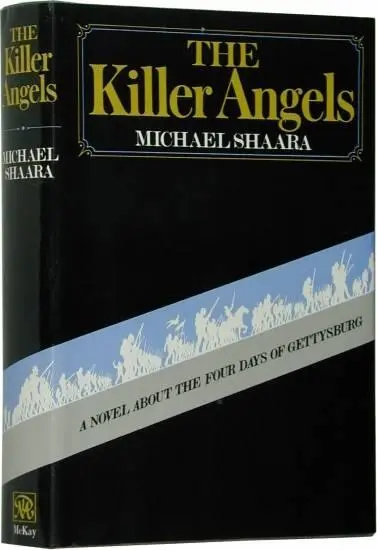
- Название:The Killer Angels
- Автор:
- Жанр:
- Год:неизвестен
- ISBN:нет данных
- Рейтинг книги:5 / 5. Голосов: 1
-
Избранное:Добавить в избранное
- Отзывы:
-
Ваша оценка:
The Killer Angels: краткое содержание, описание и аннотация
Предлагаем к чтению аннотацию, описание, краткое содержание или предисловие (зависит от того, что написал сам автор книги «The Killer Angels»). Если вы не нашли необходимую информацию о книге — напишите в комментариях, мы постараемся отыскать её.
Reading about the past is rarely so much fun as on these pages.
The Killer Angels — читать онлайн бесплатно полную книгу (весь текст) целиком
Ниже представлен текст книги, разбитый по страницам. Система сохранения места последней прочитанной страницы, позволяет с удобством читать онлайн бесплатно книгу «The Killer Angels», без необходимости каждый раз заново искать на чём Вы остановились. Поставьте закладку, и сможете в любой момент перейти на страницу, на которой закончили чтение.
Интервал:
Закладка:
Chamberlain turned, saw Tom’s white grinning face, saw him flick rock dust from his uniform, blinking it out of his eyes, grinning bleakly. Chamberlain grimaced, gestured.
Tom said, “Whee.”
Chamberlain said, “Listen, another one a bit closer and it will be a hard day for Mother. You get back to the rear and watch for stragglers. Keep your distance from me.”
”Right, fine.” Tom touched his cap, a thing he rarely did, and moved off thoughtfully Chamberlain felt an easing in his chest, a small weight lifted. Vincent trotted coolly into the open, reined his horse. Chamberlain saw through a break in the trees, blue hills very far away, hazy ridges miles to the west, not ridges, mountains; he was on high ground. Vincent paused, looked back, saw the Regiment coming up the road, shook his head, violently “That damn fool Sickles, you know him?”
”Know of him.”
Another shell passed close, fifty yards to the left, clipped a limb, ricocheted up through the leaves. Vincent glanced that way, then back, went on.
”The Bully Boy You know the one. The politician from New York. Fella shot his wife’s lover. The Barton Key affair. You’ve heard of it?”
Chamberlain nodded.
”Well, the damn fool was supposed to fall in on the left of Hancock, right there.” Vincent pointed up the ridge to the right. “He should be right here, as a matter of fact, where we’re standing. But he didn’t like the ground.”
Vincent shook his head, amazed. “He didn’t like the ground. So he just up and moved his whole Corps forward, hour or so ago. I saw them go. Amazing. Beautiful. Full marching line forward, as if they were going to pass in review. Moved right on out to the road down there. Leaving his hill uncovered. Isn’t that amazing?” Vincent grimaced.
”Politicians. Well, let’s go.”
The road turned upward, into dark woods. Shells were falling up there. Chamberlain heard the wicked hum of shrapnel in leaves.
Vincent said, “Don’t mean to rush you people, but perhaps we better double-time.”
The men began to move, running upward into the dark.
Chamberlain followed Vincent up the rise. The artillery was firing at nothing; there was no one ahead at all. They passed massive boulders, the stumps of newly sawed trees, splinters of shattered ones. Chamberlain could begin to see out across the valley: mass of milky smoke below, yellow flashes. Vincent said, raising his voice to be heard, “Whole damn Rebel army hitting Sickles down there, coming up around his flank. Be here any minute. Got to hold this place. This way.”
He pointed. They crossed the crown of the hill, had a brief glimpse all the way out across Pennsylvania, woods far away, a line of batteries massed and firing, men moving in the smoke and rocks below. Chamberlain thought: Bet you could see Gettysburg from here. Look at those rocks, marvelous position.
But they moved down the hill, down into dark woods.
Shells were passing over them, exploding in the dark far away. Vincent led them down to the left, stopped in the middle of nowhere, rocks and small trees, said to Chamberlain, “All right, I place you here.” Chamberlain looked, saw a dark slope before him, rock behind him, ridges of rock to both sides. Vincent said, “You’ll hold here. The rest of the Brigade will form on your right. Looks like you’re the flank. Colonel.”
”Right,” Chamberlain said. He looked left and right, taking it all in. A quiet place in the woods. Strange place to fight. Can’t see very far. The Regiment was moving up.
Chamberlain called in the company commanders, gave them the position. Right by file into line. Vincent walked down into the woods, came back up. An aide found him with a message. He sent to the rest of the Brigade to form around the hill to the right, below the crown. Too much artillery on the crown. Rebs liked to shoot high. Chamberlain strode back and forth, watching the Regiment form along the ridge in the dark. The sun was behind the hill, on the other side of the mountain. Here it was dark, but he had no sense of temperature; he felt neither hot nor cold. He heard Vincent say, “Colonel?”
”Yes.” Chamberlain was busy.
Vincent said, “You are the extreme left of the Union line. Do you understand that?”
”Yes,” Chamberlain said.
”The line runs from here all the way back to Gettysburg. But it stops here. You know what that means.”
”Of course.”
”You cannot withdraw. Under any conditions. If you go, the line is flanked. If you go, they’ll go right up the hilltop and take us in the rear. You must defend this place to the last.”
”Yes,” Chamberlain said absently.
Vincent was staring at him.
”I’ve got to go now.”
”Right,” Chamberlain said, wishing him gone.
”Now we’ll see how professors fight,” Vincent said.
”I’m a Harvard man myself.”
Chamberlain nodded patiently, noting that the artillery fire had slackened. Could mean troops coming this way. Vincent’s hand was out. Chamberlain took it, did not notice Vincent’s departure. He turned, saw Ruel Thomas standing there with his horse. Chamberlain said, “Take that animal back and tie it some place. Sergeant, then come back.”
”You mean leave it, sir?”
”I mean leave it.”
Chamberlain turned back. The men were digging in, piling rocks to make a stone wall. The position was more than a hundred yards long. Chamberlain could see the end of it, saw the 83rd Pennsylvania forming on his right. On his left there was nothing, nothing at all. Chamberlain called Kilrain, told him to check the flank, to see that the joint between Regiments was secure. Chamberlain took a short walk. Hold to the last. To the last what? Exercise in rhetoric. Last man? Last shell? Last foot of ground? Last Reb?
The hill was shaped like a comma, large and round with a spur leading out and down: The Twentieth Maine was positioned along the spur, the other regiments curved around to the right. At the end of the spur was a massive boulder. Chamberlain placed the colors there, backed off. To the left of his line there was nothing.
Empty ground. Bare rocks. He peered off into the darkness.
He was used to fighting with men on each side of him. He felt the emptiness to his left like a pressure, a coolness, the coming of winter. He did not like it.
He moved out in front of his line. Through the trees to his right he could see the dark bulk of a larger hill. If the Rebs get a battery there. What a mess. This could be messy indeed. He kept turning to look to the vacant left, the dark emptiness. No good at all. Morrill’s B Company was moving up. Chamberlain signaled. Morrill came up. He was a stocky man with an angular mustache, like a messy inverted U. Sleepy-eyed, he saluted.
”Captain, I want you to take your company out there.”
Chamberlain pointed to the left. “Go out a ways, but stay within supporting distance. Build up a wall, dig in. I want you there in case somebody tries to flank us. If I hear you fire I’ll know the Rebs are trying to get round. Go out a good distance. I have no idea what’s out there. Keep me informed.”
Company B was fifty men. Alone out in the woods.
Chamberlain was sorry. They’d all rather be with the Regiment. Messy detail. Well, he thought philosophically, so it goes. He moved on back up the hill, saw Morrill’s men melt into the trees. Have I done all I can? Not yet, not yet.
Artillery was coming in again behind him. All down the line, in front of him, the men were digging, piling rocks. He thought of the stone wall at Fredericksburg. Never, forever.
This could be a good place to fight. Spirits rose. Left flank of the whole line. Something to tell the grandchildren. Nothing happening here. He hopped up the rocks, drawn toward the summit for a better look, saw an officer: Colonel Rice of the 44th New York, with the same idea.
Читать дальшеИнтервал:
Закладка:
Похожие книги на «The Killer Angels»
Представляем Вашему вниманию похожие книги на «The Killer Angels» списком для выбора. Мы отобрали схожую по названию и смыслу литературу в надежде предоставить читателям больше вариантов отыскать новые, интересные, ещё непрочитанные произведения.






Обсуждение, отзывы о книге «The Killer Angels» и просто собственные мнения читателей. Оставьте ваши комментарии, напишите, что Вы думаете о произведении, его смысле или главных героях. Укажите что конкретно понравилось, а что нет, и почему Вы так считаете.