Michael Shaara - The Killer Angels
Здесь есть возможность читать онлайн «Michael Shaara - The Killer Angels» весь текст электронной книги совершенно бесплатно (целиком полную версию без сокращений). В некоторых случаях можно слушать аудио, скачать через торрент в формате fb2 и присутствует краткое содержание. Жанр: Историческая проза, на английском языке. Описание произведения, (предисловие) а так же отзывы посетителей доступны на портале библиотеки ЛибКат.
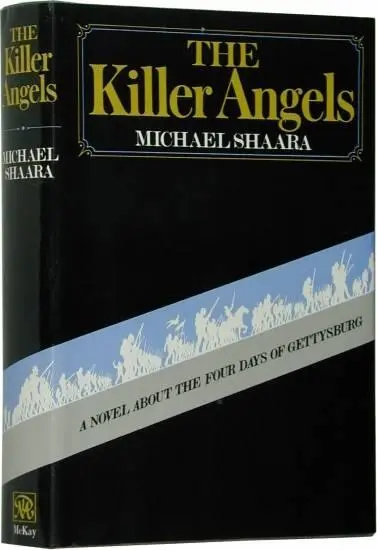
- Название:The Killer Angels
- Автор:
- Жанр:
- Год:неизвестен
- ISBN:нет данных
- Рейтинг книги:5 / 5. Голосов: 1
-
Избранное:Добавить в избранное
- Отзывы:
-
Ваша оценка:
The Killer Angels: краткое содержание, описание и аннотация
Предлагаем к чтению аннотацию, описание, краткое содержание или предисловие (зависит от того, что написал сам автор книги «The Killer Angels»). Если вы не нашли необходимую информацию о книге — напишите в комментариях, мы постараемся отыскать её.
Reading about the past is rarely so much fun as on these pages.
The Killer Angels — читать онлайн бесплатно полную книгу (весь текст) целиком
Ниже представлен текст книги, разбитый по страницам. Система сохранения места последней прочитанной страницы, позволяет с удобством читать онлайн бесплатно книгу «The Killer Angels», без необходимости каждый раз заново искать на чём Вы остановились. Поставьте закладку, и сможете в любой момент перейти на страницу, на которой закончили чтение.
Интервал:
Закладка:
Strange thing, I’m not a clever man meself, but I know it when I run across it. The strange and marvelous thing about you. Colonel darlin’, is that you believe in mankind, even preachers, whereas when you’ve got my great experience of the world you will have learned that good men are rare, much rarer than you think. Ah-“ he raised his hands, smiling-“don’t you worry about ministers. The more you kill, the more you do the world a service.” He chuckled, rubbing his face. His nose was fat and soft, rippling under his fingers.
Chamberlain said, “What has been done to the black is a terrible thing.”
”True. From any point of view. But your freed black will turn out no better than many the white that’s fighting to free him. The point is that we have a country here where the past cannot keep a good man in chains, and that’s the nature of the war. It’s the aristocracy I’m after. All that lovely, plumed, stinking chivalry. The people who look at you like a piece of filth, a coachroach, ah.” His face twitched to stark bitterness. “I tell you. Colonel, we got to win this war.” He brooded. “What will happen, do you think, if we lose? Do you think the country will ever get back together again?”
”Doubt it. Wound it too deep. The differences… If they win there’ll be two countries, like France and Germany in Europe, and the border will be armed. Then there’ll be a third country in the West, and that one will be the balance of power.” Kilrain sat moodily munching on a blade of grass. More cannons thumped; the dull sound rolled among the hills.
Kilrain said, “They used to have signs on tavern doors: Dogs and Irishmen keep out. You ever see them signs, Colonel?”
”They burned a Catholic church up your way not long ago. With some nuns in it.”
”Yes.”
”There was a divine spark.”
Chamberlain grinned, shook his head. Kilrain turned away. Chamberlain sat for a while silently and then took out a copy of Harper’s Weekly he’d carried up with him and began to look through it. There was an article by a general from Argentina concerning the use of Negro troops. He said that they fought very well, with training.
Chamberlain’s nose wrinkled. The world around him grew silent; there was something in the air. The odor of dead meat came down on the wind, drifting through the trees. Soft and sour, the smell of distant death. It passed like an invisible cloud. Kilrain said, “Make you a little wager, Colonel. We’ll sit here all day and in the evening we’ll march away again.” He lay back. “So I might’s well get some rest.”
Chamberlain moved back against a tree. He was not tired. He closed his eyes, saw a sudden shocking memory of death, torn flaps of skin, the black rotted meat of muscle.
Kilrain said sleepily, “I bet nothing happens today.”
But Chamberlain knew. He was certain. He looked toward the odor of death. Still early in the day. Long time until nightfall. They’ll come. He could not relax. But what if it is you who are wrong? But I am not wrong. Thank God for that. If I were an officer for them, on the other side, what would I be feeling now?
The cannon had stilled. The old soldier was popping corn: pop pop poppity pop.
Chamberlain put down the paper, folded his arms.
Waited.
3. LONGSTREET.
They had taken a door from its hinges at the Thompson house and placed it across fence rails to serve as a map table. Lee stood above it with his arms folded behind him, staring down. Although the morning was warm and humid his coat was buttoned at the throat, his face pale. He put one hand down, drummed on the map, shook his head, then turned abruptly and walked off to the edge of the trees to look toward Cemetery Hill.
Longstreet sat gazing at the map, fixing it in his mind.
Johnston and Clarke had scouted the Union position and it was drawn now on the map in blue ink. Longstreet looked down at the map and then up at the hazy blue ridge in the east, trying to orient himself.
There were two hills beyond Gettysburg: first Cemetery Hill and beyond that Gulp’s Hill. The Union Army had dug in along the crest of both hills, in a crescent. From the two hills ran a long ridge, like the shaft of a fishhook, Cemetery Ridge, sloping gradually down to the south to two more hills, one rocky and bare, the other high and thickly wooded. Meade had put troops along the ridge so that his position was shaped like the fishhook, but there were no troops yet on the rocky hills.
Longstreet sat alone, a forbidding figure. He was thinking: Lee has made up his mind; there’s nothing you can do.
Well. Then there will be a scrap. He took a deep breath.
Ought to get something to eat.
”General?”
He looked down, saw the handsome face of Taylor, Lee’s aide.
”General Lee wishes to speak to you, sir.”
Lee was up on the rise by the Seminary, walking back and forth under the shade trees. Officers sat quietly by, joking softly, respectfully with each other, keeping an eye on the old man walking back and forth, back and forth, stopping to stare at the eastern hills, the eastern haze. Longstreet came up.
”General,” Lee said.
Longstreet grunted. There was bright heat in Lee’s eyes, like fever. Longstreet felt a shudder of alarm.
Lee said, “I like to go into battle with the agreement of my commanders, as far as possible, as you know. We are all members of his army, in a common cause.”
Longstreet waited.
”I understand your position,” Lee said. “I did not want this fight but I think it was forced upon us. As the war was.” He added, “As the war was.” He stopped and frowned, put up his fingers and rubbed the bridge of his nose. “Well,” he said. He gestured toward the north, toward Ewell. “General Ewell has changed his mind about attacking to the left. He insists the enemy is too firmly entrenched and has been heavily reinforced in the night.
I’ve been over there personally. I tend to agree with him.
There are elements of at least three Union corps occupying those hills.”
Longstreet waited. Lee had been over to the left, through Gettysburg, to inspect Ewell’s position, but he had not been to the right to check on Longstreet. It was a measure of his trust, and Longstreet knew it.
”I spoke to Ewell of your suggestion that he move around to the right. Both he and Early were opposed.”
”Early.” Longstreet grimaced, spat.
”Yes.” Lee nodded. “Both Generals were of the opinion that an attack on the right would draw off Union forces and that they would then be able to take the hills. They insist that withdrawing from Gettysburg, giving it back to the enemy, would be bad for morale, is unnecessary, and might be dangerous.”
Lee looked at him, the deep-set eyes still bright, still hot, still questing. Longstreet said nothing.
”You disagree,” Lee said.
Longstreet shrugged. He had disagreed last night, had argued all morning, but now he was setting his mind to it.
The attack would come.
”We must attack,” General Lee said forcefully. “We must attack. I would rather not have done it upon this ground, but every moment we delay the enemy uses to reinforce himself. We cannot support ourselves in this country. We cannot let him work around behind us and cut us off from home. We must hit him now. We pushed him yesterday; he will remember it. The men are ready. I see no alternative.”
”Yes, sir,” Longstreet said. He wants me to agree. But I cannot agree. Let’s get on with it.
Lee waited for a moment, but Longstreet said nothing, and the silence lengthened until at last Lee said, “You will attack on the right with the First Corps.”
Longstreet nodded. He took off his hat and wiped the sweat from his brow. He was beginning to relax inside, like an unclenching fist. Now that you knew for sure it was coming a man could rest a bit.
Читать дальшеИнтервал:
Закладка:
Похожие книги на «The Killer Angels»
Представляем Вашему вниманию похожие книги на «The Killer Angels» списком для выбора. Мы отобрали схожую по названию и смыслу литературу в надежде предоставить читателям больше вариантов отыскать новые, интересные, ещё непрочитанные произведения.




Обсуждение, отзывы о книге «The Killer Angels» и просто собственные мнения читателей. Оставьте ваши комментарии, напишите, что Вы думаете о произведении, его смысле или главных героях. Укажите что конкретно понравилось, а что нет, и почему Вы так считаете.