Michael Shaara - The Killer Angels
Здесь есть возможность читать онлайн «Michael Shaara - The Killer Angels» весь текст электронной книги совершенно бесплатно (целиком полную версию без сокращений). В некоторых случаях можно слушать аудио, скачать через торрент в формате fb2 и присутствует краткое содержание. Жанр: Историческая проза, на английском языке. Описание произведения, (предисловие) а так же отзывы посетителей доступны на портале библиотеки ЛибКат.
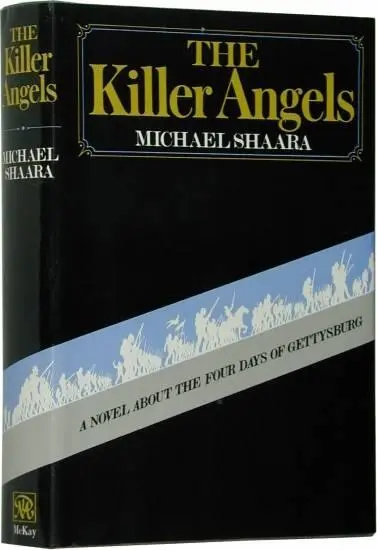
- Название:The Killer Angels
- Автор:
- Жанр:
- Год:неизвестен
- ISBN:нет данных
- Рейтинг книги:5 / 5. Голосов: 1
-
Избранное:Добавить в избранное
- Отзывы:
-
Ваша оценка:
The Killer Angels: краткое содержание, описание и аннотация
Предлагаем к чтению аннотацию, описание, краткое содержание или предисловие (зависит от того, что написал сам автор книги «The Killer Angels»). Если вы не нашли необходимую информацию о книге — напишите в комментариях, мы постараемся отыскать её.
Reading about the past is rarely so much fun as on these pages.
The Killer Angels — читать онлайн бесплатно полную книгу (весь текст) целиком
Ниже представлен текст книги, разбитый по страницам. Система сохранения места последней прочитанной страницы, позволяет с удобством читать онлайн бесплатно книгу «The Killer Angels», без необходимости каждый раз заново искать на чём Вы остановились. Поставьте закладку, и сможете в любой момент перейти на страницу, на которой закончили чтение.
Интервал:
Закладка:
He remembered her letter, the misspelled words: “I lie here dreamyly.” Even the misspelling is lovely.
A mass of men was coming down the road, unarmed, unspiked, no rifles visible: prisoners. They stopped near a long rock ledge, which walled the road. Some of his own troops began drifting over that way, to stare, to chat. They were usually polite to prisoners. The accents fascinated them. Although some of the Regiment were sailing men, most of them had never been out of Maine. Chamberlain thought vaguely of the South. She had loved it. She had been at home. Heat and Spanish moss. Strange hot land of courtly manners and sudden violence, elegance and anger.
A curious mixture: the white-columned houses high on the green hills, the shacks down in the dark valleys. Land of black and white, no grays. The South was a well-bred, well-mannered, highly educated man challenging you to a duel.
She loved it. Dreamyly. She had liked being a professor’s wife. She had been outraged when he went oif to war.
Square-headed Kilrain: “Is the Colonel awake?”
Chamberlain nodded, looking up.
”I have found me a John Henry, sir.”
”John who?”
”A John Henry, sir. A black man. A darky. He’s over thataway.” Kilrain gestured. Chamberlain started to rise.
”I heard him a-groanin’,” Kilrain said, “just before dawn. Would the Colonel care to see him?”
”Lead on.”
Kilrain walked down a grassy slope away from the road, across the soft field, marshy with heavy rain, up a rise of granite to a gathering of boulders along the edge of a grove of dark trees. Chamberlain saw two men standing on a rock ledge, men of the Regiment. Kilrain sprang lightly up the rock. The two men-one was the newcomer, Bucklin- touched their caps and wished him “morning” and grinned and pointed.
The black man lay in the shadow between two round rocks. He was very big and very black. His head was shaved and round and resting on mossy granite. He was breathing slowly and deeply, audibly; his eyes were blinking. He wore a faded red shirt, ragged, dusty, and dark pants ragged around his legs. There were no sleeves in the shirt, and his arms had muscles like black cannonballs. His right arm was cupped across his belly. Chamberlain saw a dark stain, a tear, realized mat the man had been bleeding.
Bucklin was bending over him with a tin cup of coffee in his hand. The black man took a drink. He opened his eyes and the whites of his eyes were red-stained and ugly.
Chamberlain pointed to the wound.
”How bad is that?”
”Oh, not bad,” Kilrain said. “I think he’s bled a lot, but you know, you can’t really tell.”
Bucklin chuckled. “That’s a fact.”
”Bullet wound,” Kilrain said. “Just under the ribs.”
Chamberlain knelt. The black man’s face was empty, inscrutable. The red eyes looked up out of a vast darkness.
Then the man blinked and Chamberlain realized that there was nothing inscrutable here; the man was exhausted.
Chamberlain had rarely seen black men; he was fascinated.
”We’ll get him something to eat, then we’ll get him to a surgeon. Is the bullet still in?”
”Don’t know. Don’t think so. Haven’t really looked.”
Kilrain paused. “He sure is black, and that’s a fact.”
”Did you get his name?”
”He said something I couldn’t understand. Hell, Colonel, I can’t even understand them Johnnies, and I’ve been a long time in this army “ The black man drank more of the coffee, put out both hands and took the cup, drank, nodded, said something incomprehensible.
”Guess he was a servant on the march, took a chance to run away. Guess they shot at him.”
Chamberlain looked at the bald head, the ragged dress. Impossible to tell the age. A young man, at least. No lines around the eyes. Thick-lipped, huge jaw. Look of animal strength. Chamberlain shook his head.
”He wouldn’t be a house servant. Look at his hands.
Field hands.” Chamberlain tried to communicate. The man said something weakly, softly. Chamberlain, who could speak seven languages, recognized nothing. The man said a word that sounded like Baatu, Baatu, and closed his eyes.
”God,” Kilrain said. “He can’t even speak English.”
Bucklin grunted. “Maybe he’s just bad wounded.”
Chamberlain shook his head. “No. I think you’re right. I don’t think he knows the language.”
The man opened his eyes again, looked directly at Chamberlain, nodded his head, grimaced, said again, Baatu, Baatu. Chamberlain said, “Do you suppose that could be ‘thank you’?”
The black man nodded strongly. “Tang oo, tang oo, baas.”
”That’s it.” Chamberlain reached out, patted the man happily on the arm. “Don’t worry, fella, you’ll be all right.” He gestured to Kilrain. “Here, let’s get him up.”
They carried the man down out of the rocks, lay him on open grass. A knot of soldiers gathered. The man pulled himself desperately up on one elbow, looked round in fear.
Kilrain brought some hardtack and bacon and he ate with obvious hunger, but his teeth were bad; he had trouble chewing the hardtack. The soldiers squatted around him curiously. You saw very few black men in New England.
Chamberlain knew one to speak to: a silent round-headed man with a white wife, a farmer, living far out of town, without friends. You saw black men in the cities but they kept to themselves. Chamberlain’s curiosity was natural and friendly, but there was a reserve in it, an unexpected caution. The man was really very black. Chamberlain felt an oddness, a crawly hesitation, not wanting to touch him.
He shook his head, amazed at himself. He saw: palm of the hand almost white; blood dries normally, skin seems dusty.
But he could not tell whether it was truly dust or only a natural sheen of light on hair above black skin. But he felt it again: a flutter of unmistakable revulsion. Fat lips, brute jaw, red-veined eyeballs. Chamberlain stood up. He had not expected this feeling. He had not even known this feeling was there. He remembered suddenly a conversation with a Southerner a long time ago, before the war, a Baptist minister. White complacent face, sense of bland enormous superiority: my dear man, you have to live among them, you simply don’t understand.
Kilrain said, “And this is what it’s all about.”
A soldier said softly, “Poor bastard.”
”Hey, Sarge. How much you figure he’s worth, this one, on the hoof?”
”Funny. Very funny. But they’d give a thousand dollars for him, I bet. Nine hundred for sure.”
”Really? Hell.” It was Bucklin, grinning. “Whyn’t we sell him back and buy outen this army.”
Chamberlain said to Kilrain, “He can’t have been long in this country.”
”No. A recent import, you might say.”
”I wonder how much he knows of what’s happening.”
Kilrain shrugged. A crowd was gathering. Chamberlain said, “Get a surgeon to look at that wound.”
He backed off. He stared at the palm of his own hand. A matter of thin skin. A matter of color. The reaction is instinctive. Any alien thing. And yet Chamberlain was ashamed; he had not known it was there. He thought: If I feel this way, even I, an educated man… what was in God’s mind?
He remembered the minister: and what if it is you who are wrong, after all?
Tom came bubbling up with a message from Vincent: the Corps would move soon, on further orders. Tom was chuckling.
” Lawrence, you want to hear a funny thing? We were talking to these three Reb prisoners, trying to be sociable, you know? But mainly trying to figure ‘ em out. They were farm-type fellers. We asked them why they were fighting this war, thinkin’ on slavery and all, and one fella said they was fightin’ for their ‘rats.’ Hee. That’s what he said.” Tom giggled, grinned. “We all thought they was crazy, but we hadn’t heard a-right. They kept on insistin’ they wasn’t fightin’ for no slaves, they were fighting for their ‘rats.’ It finally dawned on me that what the feller meant was their ‘rights,’ only, the way they talk, it came out ‘rats.’ Hee. Then after that I asked this fella what rights he had that we were offendin’, and he said, well, he didn’t know, but he must have some rights he didn’t know nothin’ about. Now, aint that something?”
Читать дальшеИнтервал:
Закладка:
Похожие книги на «The Killer Angels»
Представляем Вашему вниманию похожие книги на «The Killer Angels» списком для выбора. Мы отобрали схожую по названию и смыслу литературу в надежде предоставить читателям больше вариантов отыскать новые, интересные, ещё непрочитанные произведения.





Обсуждение, отзывы о книге «The Killer Angels» и просто собственные мнения читателей. Оставьте ваши комментарии, напишите, что Вы думаете о произведении, его смысле или главных героях. Укажите что конкретно понравилось, а что нет, и почему Вы так считаете.