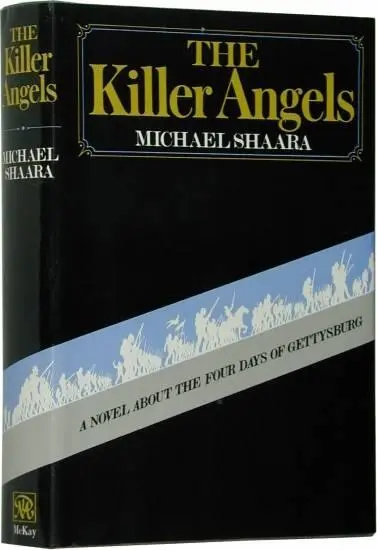
Michael Shaara - The Killer Angels
Здесь есть возможность читать онлайн «Michael Shaara - The Killer Angels» весь текст электронной книги совершенно бесплатно (целиком полную версию без сокращений). В некоторых случаях можно слушать аудио, скачать через торрент в формате fb2 и присутствует краткое содержание. Жанр: Историческая проза, на английском языке. Описание произведения, (предисловие) а так же отзывы посетителей доступны на портале библиотеки ЛибКат.
- Название:The Killer Angels
- Автор:
- Жанр:
- Год:неизвестен
- ISBN:нет данных
- Рейтинг книги:5 / 5. Голосов: 1
-
Избранное:Добавить в избранное
- Отзывы:
-
Ваша оценка:
The Killer Angels: краткое содержание, описание и аннотация
Предлагаем к чтению аннотацию, описание, краткое содержание или предисловие (зависит от того, что написал сам автор книги «The Killer Angels»). Если вы не нашли необходимую информацию о книге — напишите в комментариях, мы постараемся отыскать её.
Reading about the past is rarely so much fun as on these pages.
The Killer Angels — читать онлайн бесплатно полную книгу (весь текст) целиком
Ниже представлен текст книги, разбитый по страницам. Система сохранения места последней прочитанной страницы, позволяет с удобством читать онлайн бесплатно книгу «The Killer Angels», без необходимости каждый раз заново искать на чём Вы остановились. Поставьте закладку, и сможете в любой момент перейти на страницу, на которой закончили чтение.
Интервал:
Закладка:
”I mean, ah, I don’t see that you have bothered to entrench,” Fremantle went on.
Longstreet grinned. Hood grinned.
”An interesting thought.” Longstreet smiled. “I confess, it had not occurred to me.”
”Me neither,” Hood said.
”But I suppose it’s possible,” Longstreet said.
”You really think so?”
”Well,” Longstreet hedged. He grinned, reached up along the edge of his hat, scratched his head. “I guess not.”
More soberly, he turned to Fremantle. “It would be most unlike General Meade to attack. For one thing, he is General Meade. For another, he has just arrived on the field and it will take some time to understand the position, like perhaps a week. Also, he has not yet managed to gather the entire Army of the Potomac, all two hundred thousand men, and he will be reluctant to move without his full force. Then again, he will think of reasons.” Longstreet shook his head, and Fremantle saw that he had again lost his humor. “No, Meade will not do us the favor, the great favor. We will have to make him attack. We will have to occupy dangerous grounds between him and Washington and let the politicians push him to the assault. Which they will most certainly do. Given time. We need time.”
He paused, shook his head. They rode on in silence.
Fremantle began to realize how remarkably still it was.
Down in the valley the fields were open and still, the breeze had slowed, there was no movement of smoke. A few cows grazed in the shade, rested in dark pools of shade under the trees. Fremantle could feel the presence of that vast army; he knew it was there, thousands of men, thousands of horses, miles of cannon, miles of steel. And spread out beyond him and around him Lee’s whole army in the dark shade, moving, settling, lining up for the assault, and yet from this point on the ridge under the tree he could look out across the whole valley and see nothing, hear nothing, feel nothing, not even a trembling of the earth, not even one small slow rumble of all those feet and wheels moving against the earth, moving in together like two waves meeting in a great ocean, like two avalanches coming down together down facing sides of a green mountain. The day had dawned clear, but now there were clouds beginning to patch the sky with hazy blots of cottony white, and not even any motion there, just the white silence against the blue. It was beginning to be very hot, hotter even than before, and Fremantle noticed perspiration on all the faces. He had not slept well, and suddenly the silence and the heat began to get to him. He was a man from a northern clime and England did not have this sort of weather, and when you have not slept…
He was most anxious to move on with Longstreet, but he saw Lawley and Ross pull off into an open field and sit down, and so he bade Longstreet goodbye and rode off to join his fellow Europeans. He let his horse roam with the others in a fenced field and found himself a grassy place under a charming tree and lay flat on his back, gazing up serenely into the blue, watching those curious flecks that you can see if you stare upward against the vacant blue, the defects of your own eye.
They chatted, telling stories of other wars. They discussed the strategy of Napoleon, the theories of Jomini, the women of Richmond. Fremantle was not that impressed by Napoleon. But he was impressed by the women of Richmond. He lay dreamily remembering certain ladies, a ball, a rose garden…
This land was huge. England had a sense of compactness, like a garden, a lovely garden, but this country was without borders. There was this refreshing sense of space, of blowing winds, too hot, too cold, too huge, raw in a way raw meat is raw-and yet there were the neat farms, the green country, so much like Home. The people so much like Home. Southern Home. Couldn’t grow flowers, these people. No gardens. Great weakness. And yet. They are Englishmen. Should I tell Longstreet? Would it annoy him?
He thinks, after all, that he is an American.
Um. The great experiment. In democracy. The equality of rabble. In not much more than a generation they have come back to class. As the French have done. What a tragic thing, that Revolution. Bloody George was a bloody fool.
But no matter. The experiment doesn’t work. Give them fifty years, and all that equality rot is gone. Here they have the same love of the land and of tradition, of the right form, of breeding, in their horses, their women. Of course slavery is a bit embarrassing, but that, of course, will go. But the point is they do it all exactly as we do in Europe. And the North does not. That’s what the war is really about. The North has those huge bloody cities and a thousand religions, and the only aristocracy is the aristocracy of wealth. The Northerner doesn’t give a damn for tradition, or breeding, or the Old Country. He hates the Old Country. Odd. You very rarely hear a Southerner refer to “the Old Country.” In that painted way a German does. Or an Italian. Well, of course, the South is the Old Country. They haven’t left Europe. They’ve merely transplanted it. And that’s what the war is about.
Fremantle opened an eye. It occurred to him that he might have come across something rather profound, something to take back to England. The more he thought about it, the more clear it seemed. In the South there was one religion, as in England, one way of life. They evEn allowed the occasional Jew-like Longstreet’s Major Moses, or Judah Benjamin, back in Richmond -but by and large they were all the same nationality, same religion, same customs.
A little rougher, perhaps, but… my word.
Fremantle sat up. Major Clarke was resting, back against a tree. Fremantle said, “I say. Major, Longstreet is an English name, I should imagine.”
Clarke blinked.
”No, as a matter of fact, I don’t think it is.” He pondered. “Dutch, I think. Yes, come to think of it. Dutch all right. Comes from New Jersey, the old Dutch settlements up there.”
”Oh.” Fremantle’s theory had taken a jolt. Well. But Longstreet was an exception. He was not a Virginian.
Fremantle again relaxed. He even began to feel hungry.
The morning moved toward noon.
2. CHAMBERLAIN.
The regiment sat in an open field studded with boulders like half-sunken balls. Small fires burned under a steam-gray sky. Chamberlain wandered, watching, listening. He did not talk; he moved silently among them, hands clasped behind his back, wandering, nodding, soaking in the sounds of voices, tabulating the light in men’s eyes, moving like a forester through a treasured grove, noting the condition of the trees. All his life he had been a detached man, but he was not detached any more. He had grown up in the cold New England woods, the iron dark, grown in contained silence like a lone house on a mountain, and now he was no longer alone; he had joined not only the army but the race, not only the country but mankind. His mother had wanted him to join the church. Now he had his call. He wandered, sensing. Tired men. But ready. Please, God, do not withdraw them now. He saw illness in one face, told the man to report to sick call. One man complained. “Colonel, it keeps raining, these damn Enfields gonna clog on us.
Whyn’t we trade ‘ em for Springfields first chance we get?”
Chamberlain agreed. He saw Bucklin, together with a cold-eyed group from the old Second Maine, nodded good morning, did not stop to talk. A young private asked him, “Sir, is it true that General McClellan is in command again?” Chamberlain had to say no. The private swore.
Chamberlain finished the walk, went back alone to sit under a tree.
He had dreamed of her in the night, dreamed of his wife in a scarlet robe, turning witchlike to love him. Now when he closed his eyes she was suddenly there, hot candy presence. Away from her, you loved her more. The only need was her, she the only vacancy in the steamy morning.
Читать дальшеИнтервал:
Закладка:
Похожие книги на «The Killer Angels»
Представляем Вашему вниманию похожие книги на «The Killer Angels» списком для выбора. Мы отобрали схожую по названию и смыслу литературу в надежде предоставить читателям больше вариантов отыскать новые, интересные, ещё непрочитанные произведения.







Обсуждение, отзывы о книге «The Killer Angels» и просто собственные мнения читателей. Оставьте ваши комментарии, напишите, что Вы думаете о произведении, его смысле или главных героях. Укажите что конкретно понравилось, а что нет, и почему Вы так считаете.