Michael Shaara - The Killer Angels
Здесь есть возможность читать онлайн «Michael Shaara - The Killer Angels» весь текст электронной книги совершенно бесплатно (целиком полную версию без сокращений). В некоторых случаях можно слушать аудио, скачать через торрент в формате fb2 и присутствует краткое содержание. Жанр: Историческая проза, на английском языке. Описание произведения, (предисловие) а так же отзывы посетителей доступны на портале библиотеки ЛибКат.
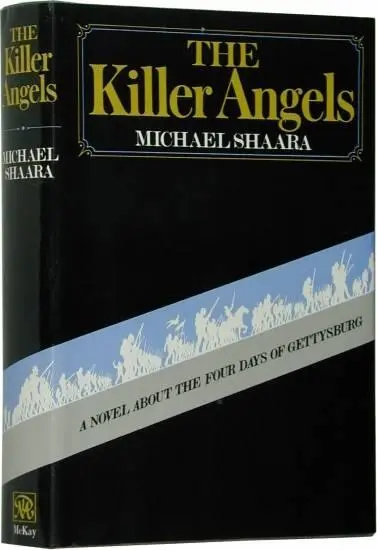
- Название:The Killer Angels
- Автор:
- Жанр:
- Год:неизвестен
- ISBN:нет данных
- Рейтинг книги:5 / 5. Голосов: 1
-
Избранное:Добавить в избранное
- Отзывы:
-
Ваша оценка:
The Killer Angels: краткое содержание, описание и аннотация
Предлагаем к чтению аннотацию, описание, краткое содержание или предисловие (зависит от того, что написал сам автор книги «The Killer Angels»). Если вы не нашли необходимую информацию о книге — напишите в комментариях, мы постараемся отыскать её.
Reading about the past is rarely so much fun as on these pages.
The Killer Angels — читать онлайн бесплатно полную книгу (весь текст) целиком
Ниже представлен текст книги, разбитый по страницам. Система сохранения места последней прочитанной страницы, позволяет с удобством читать онлайн бесплатно книгу «The Killer Angels», без необходимости каждый раз заново искать на чём Вы остановились. Поставьте закладку, и сможете в любой момент перейти на страницу, на которой закончили чтение.
Интервал:
Закладка:
No finer gentlemen in England than Lee. Well, of course, here and there, possibly one exception. Or two.
Nevertheless, they are our people. Proud to have them.
And perhaps they will rejoin the Queen and it will be as it was, as it always should have been.
They had talked of that the evening before. Every one of the officers had insisted that the South would be happier under the Queen than under the Union. Of course, hard to say what they meant. But if England came to help now, would it not be possible? That this soil would once again be English soil?
He had borrowed glasses from Sorrel, was looking at the Union lines. He could see the cannon now, rolled out in front of the trees. He could see men moving among the caissons, men on horseback moving in the trees; here and there a pennant blew. He saw a flash of gold. Breastworks were going up, twisted sticks, small, very far away. There was an open valley below him, partly cultivated, then a long bare rise to the Union line. To the left was the high hill, Cemetery Hill, that Ewell had failed to take the day before, the hill that had worried Longstreet. To the center was a wooded ridge. To the right were two round hills, one rocky, the other wooded. The Union position was approximately three miles in length, or so it seemed from here. All this Fremantle saw with continually rising excitement.
He looked down, saw Longstreet rise, move off, shoulders bowed, wandering head down and lumbering, like a bearded stump, to stare out at the lines. Hood joined him.
Once more Longstreet shook his head. Lee came back to a small table, stared at a map, looked up, back toward the Union lines, keeping his hand on the map. Fremantle had a good look at that extraordinary face. Lee looked weary, more pale than before. The sun was climbing; it was noticeably hotter. Fremantle felt a familiar rumble in his own stomach. Oh God, not the soldier’s disease. Those damned cherries.
There seemed no point in remaining in the tree. Soldiers had observed him, hanging in the air like a plump gray fruit, were beginning to point and grin. Fremantle descended with dignity, joined the other foreigners. He heard, for the first time that day, music: a polka. He listened with surprise. He could not identify the sound but he knew the beat. It was followed by a march.
Ross said, “They play even during an attack. Not very good. But inspiring. Have you heard the Rebel yell?”
Fremantle nodded. “Godawful sound. I expect they learned it from Indians.”
Ross opened wide his eyes. “Never thought of that,” he said. His silver helmet shifted. Sweat was all over his brow.
”I say, old friend, you really aren’t going to wear that thing all day, are you? In this charming climate?”
”Well,” Ross said. He tweaked his mustache. “One must be properly dressed. Teach these fellas respect.”
Fremantle nodded. Understandable. One tried to be neat.
But that helmet. And Ross did tend to look a bit ridiculous.
Like some sort of fat plumed duck. These chaps all looked so natural, so… earthy. Not the officers. But the troops. Hardly any uniform at all. Brown and yellow Americans. Odd. So near, yet so far.
He saw Moxley Sorrel, walking briskly off on a mission, “corralled him,” as the Americans would put it.
Sorrel said, “We’ve sent out engineers to inspect the ground to our right. We’ll be attacking later in the day Don’t know where yet, so you can relax, I should say, for two hours or so at least.”
”Have you heard from General Stuart?”
”Not a word. General Lee has sent out scouts to find him.” Sorrel chuckled. “Cheer up, you may have your charge.”
”I hope to have a good position today.”
”We’ll do all we can. I suggest you stay close to Longstreet. There’ll be action where he is.”
Sorrel moved off. Through the trees Fremantle saw Longstreet mounting his horse. Fremantle led his own horse that way Longstreet had Goree with him, the aide from Texas. The greeting was friendly, even warm. Fremantle thought, startled, he likes me, and flushed with unexpected pride. He asked if he could ride with the General; Longstreet nodded. They rode down to the right, along the spine of the ridge, in under the trees. Most of Longstreet’s staff had joined them.
Longstreet said to Hood, “I’ll do what I can. His mind seems set on it.”
Hood shrugged. He seemed smaller now when you were close. He had extraordinary eyes. The eyebrows were shaggy and tilted and the eyes were dark as coal so that he seemed very sad. Fremantle had a sudden numbing thought: by evening this man could be dead. Fremantle stared at him, transfixed, trying to sense a premonition. He had never had a premonition, but he had heard of them happening, particularly on the battlefield. Men often knew when their time had come. He stared at Hood, but truthfully, except for the sadness in the eyes, which may have been only weariness, for Hood had marched all night, there was no extra sensation, nothing at all but a certain delicious air of impending combat which was with them all. Longstreet most of all, sitting round and immobile on the black horse, gazing eastward.
Hood said, “Well, if he’s right, then the war is over by sundown.”
Longstreet nodded.
”We’ll see. But going in without Pickett is like going in with one boot off. I’ll wait as long as I can.”
Hood cocked his head toward the Union lines. “Do you have any idea of the force?”
Longstreet ticked off the corps so far identified: five, counting the two involved in the first day’s action. He thought there would be more very soon, that perhaps even now the entire army was up. Lee did not think so. But yesterday he had not thought the Yankees would be there at all, and they were there in force, and now today the Yankees were on the high ground and with Stuart gone there was no way of knowing just how many corps lay in wait beyond the haze of that far ridge.
Fremantle rode along politely, silently, listening. He had developed a confidence that was almost absolute. He knew that Longstreet was tense and that there was a certain gloom in the set of his face, but Fremantle knew with the certainty of youth and faith that he could not possibly lose this day, not with these troops, not with Englishmen, the gentlemen against the rabble. He rode along with delight blossoming in him like a roseate flower, listening. Longstreet looked at him vacantly, saw him, then looked at him.
”Colonel,” he said abruptly, “how are you?”
”By George, sir, I am fine, I must say.”
”You slept well?”
Fremantle thought: everyone seems concerned that I sleep well.
”Oh, very well.” He paused. “Not long, mind you, but well.”
Longstreet smiled. There seemed to be something about Fremantle that amused him. Fremantle was oddly flattered; he did not know why.
”I would like someday to meet the Queen,” Longstreet said.
”I’m sure that could be arranged. Sir, you would be considered most welcome in my country, a most distinguished visitor.”
There was firing below, a sharp popping, a scattering of shots, a bunch, another bunch, then silence. Longstreet put on his glasses, looked down into the valley. “Pickets,” he said.
Fremantle, who did not know what to expect, started, gulped, stared. But he was delighted. He saw puffs of white smoke start up down in the valley, like vents in the earth, blow slowly lazily to his left, to the north. He looked up at the ridge, but he could see only a few black cannon, a single flag. He said abruptly, “I say, sir, you say you won’t be attacking for a bit?”
Longstreet shook his head.
”Then, ah, if I may be so bold, what’s to prevent the Yankees from attacking you?”
Longstreet looked at Hood.
Читать дальшеИнтервал:
Закладка:
Похожие книги на «The Killer Angels»
Представляем Вашему вниманию похожие книги на «The Killer Angels» списком для выбора. Мы отобрали схожую по названию и смыслу литературу в надежде предоставить читателям больше вариантов отыскать новые, интересные, ещё непрочитанные произведения.



Обсуждение, отзывы о книге «The Killer Angels» и просто собственные мнения читателей. Оставьте ваши комментарии, напишите, что Вы думаете о произведении, его смысле или главных героях. Укажите что конкретно понравилось, а что нет, и почему Вы так считаете.