Michael Shaara - The Killer Angels
Здесь есть возможность читать онлайн «Michael Shaara - The Killer Angels» весь текст электронной книги совершенно бесплатно (целиком полную версию без сокращений). В некоторых случаях можно слушать аудио, скачать через торрент в формате fb2 и присутствует краткое содержание. Жанр: Историческая проза, на английском языке. Описание произведения, (предисловие) а так же отзывы посетителей доступны на портале библиотеки ЛибКат.
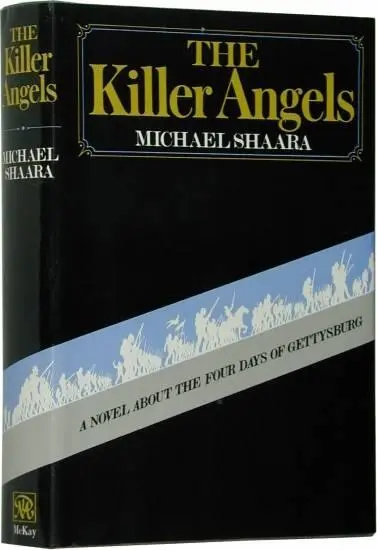
- Название:The Killer Angels
- Автор:
- Жанр:
- Год:неизвестен
- ISBN:нет данных
- Рейтинг книги:5 / 5. Голосов: 1
-
Избранное:Добавить в избранное
- Отзывы:
-
Ваша оценка:
The Killer Angels: краткое содержание, описание и аннотация
Предлагаем к чтению аннотацию, описание, краткое содержание или предисловие (зависит от того, что написал сам автор книги «The Killer Angels»). Если вы не нашли необходимую информацию о книге — напишите в комментариях, мы постараемся отыскать её.
Reading about the past is rarely so much fun as on these pages.
The Killer Angels — читать онлайн бесплатно полную книгу (весь текст) целиком
Ниже представлен текст книги, разбитый по страницам. Система сохранения места последней прочитанной страницы, позволяет с удобством читать онлайн бесплатно книгу «The Killer Angels», без необходимости каждый раз заново искать на чём Вы остановились. Поставьте закладку, и сможете в любой момент перейти на страницу, на которой закончили чтение.
Интервал:
Закладка:
”Yes, sir. Sir, I told him. General Ewell, I said to him, ‘Sir, give me one division and I will take that hill.’ And he said nothing at all. He stood there! He stared at me! I said, ‘General Ewell, give me one brigade, and I will take that hill.’ I was becoming disturbed, sir. And General Ewell put his arms behind him and blinked. So I said, ‘General, give me one regiment and I will take that hill.’ And he said nothing; he just shook his head, and I threw my sword down.” Trimble gestured helplessly, actually close to tears, “Down on the ground in front of him.” He raised both |t arms. “We could have done it, sir. A blind man should have seen it. Now they are working, up there, you can hear the axes. Now in the morning many a good boy will die.”
He wiped his face. It was all out of him. The fire died. He slumped forward in the saddle.
”General, sir, I request another assignment.”
Lee said softly, “Thank you. General. You will be of great service, thank you.”
Now that Trimble was quieter Lee could question him.
Dick Ewell had frozen; he had deferred to Early. Lee thought: I must look into this. He told Trimble to rest and he rode back to his headquarters in the dark. He was becoming increasingly tired, but there was much to do. Food. Get some fuel. The ancient body had no reserve. His chest was stuffed, a feeling of cool bleakness there, no strength in him. He thought of that and of Stuart off somewhere, possibly dead, and of Ewell’s weakness and Hill’s illness and the Union Army growing now in the night on that hill, blossoming darkly across the filed like a fungus, a bristly fungus.
The headquarters was in a small stone house on Seminary Ridge. An elderly woman, the resident, was cooking for him. Lee chatted with her politely, his mind on other things, while aides came and went. Generals pushed in and out, reporters and artists and the Prussian and the Austrian passed in and out. There was a rocking chair for Lee; it received him like an enfolding arm. Taylor appeared with a squad of men, led by a man named Walters, a Marylander. Now late at night it was becoming difficult to recognize people, to remember their names. Lee prepared sealed orders to be given to each of Walters’ men; they were to scatter out over the countryside and find Stuart and get him back to Gettysburg with all possible speed. When that was done Lee looked for Longstreet, but the stubborn face was not there. Lee closed his eyes. The uproar of jokes and joy went on around him. Must see Ewell now, without Early. He motioned to Marshall, sent for Ewell. The room gradually cleared. Lee signed orders. I do too much myself. He was thinking: retreat is not even an option; we must assault or maneuver. If we assault, Longstreet must bear the load.
Lee took a quick nap. He was awakened by the arrival of Ewell. He rose and went out into the night. The strange beaked figure waited with deference. Lee said, “How are you, sir?”
”I am fine, sir. The leg troubles me a bit.”
Lee suggested a doctor. Ewell shook his head. “Drugs injure a man’s thinking. The leg is minor. Sir?”
”Johnson’s men are in position now. He is very optimistic, much more than Early. I believe we ought to attack there, sir.”
”Attack the hill?”
”Yes, sir. Gulp’s Hill or Cemetery Hill, or both, sir.”
There was a new certainty in his voice. Lee was very glad to hear it. A small relief blossomed like a flower. Lee said only, “I have made no decision yet. But in your opinion, we should attack on your flank.”
”Yes, sir.”
Lee nodded. “I will consider it. I am glad to hear you are well.”
”General,” Ewell said. His face was not clear in the evening light, the lamplight from inside, the moon from the heavens, but there was a sadness in his voice, regret apparent in the motion of his head, the beak above the wild mustache bobbing. “I think I was too slow today, sir. I regret that very much. I was trying to be… careful. I may have been too careful.”
Lee was moved. My good old soldier. He was embarrassed. He said quickly, “You won a victory, General.”
Ewell looked up. His eyes were strained. “It was not a large victory, it might have been larger, we might have pushed harder. But it was a victory. I am satisfied. The men fought well. This was your first day. It is not as easy as it sometimes appears.”
”No, sir,” Ewell said.
”Now get some rest.” Lee sent him off. He went back into the house feeling much better. The old man had been a good soldier for too long; you cannot worry about Ewell.
And then Lee thought: but sometimes I have seen it happen.
A man loses part of himself, an arm, a leg, and though he has been a fine soldier he is never quite the same again; he has lost nothing else visible, but there is a certain softness in the man thereafter, a slowness, a caution. I did not expect it with Ewell. I do not understand it. Very little of a man is in a hand or a leg. A man is in his spirit and he has that in full no matter what part of his body dies, or all of it. But, Lee thought, you may not understand. It has not happened to you, so you don’t understand. So don’t judge. He was a good soldier. He is not Jackson. Jackson is gone-not entirely gone; Jackson was there today watching, and Ewell sees his eyes-but you cannot blame him for not being Jackson. You must make do with the tools God has given for the job. Richard Ewell, old Baldy… and his ridiculous horse.
Lee went back to the rocker. Midnight came, and he had not yet slept. Headquarters grew steadily more still. Lee thought again of Rooney Lee, wounded, and prayed for him. There was no time for a letter to his wife, that troubled woman. He closed his eyes and thought of Meade, out there, gathering the army. John Reynolds was dead. He prayed for the soul of Reynolds. And in the morning?
This is the great battle. Tomorrow or the next day. This will determine the war. Virginia is here, all the South is here. What will you do tomorrow?
No orders were out. Now he was alone. It was cooler.
Taylor came and tucked a blanket around his knees and Lee did not argue. He was drifting off. Longstreet would be up in the morning. Pickett would be up by late afternoon. In the afternoon all the army will be here. And we will hit them. We will hit them with everything and drive them right off that hill and send them running back down the road to Washington. If Stuart’s cavalry…
He woke briefly. Without cavalry in the rear no victory would be complete. Should we attack before Stuart comes?
And if he comes with tired horses and weary men? If he comes at all…
Don’t think on that. Lee closed his eyes. And let himself fall into the bright dark. For Thine be the Kingdom, and the Power…
7. BUFORD.
He came back at last to the cemetery on the hill. All down the ridge they were digging in, all around the crest of the hill. He sat on the horse and watched the picks swinging in the moonlight, listened to the sound of shovels in the earth. The army was still coming in, marching by moonlight. It was almost two o’clock in the morning.
He rode slowly along the ridge, looking for headquarters.
He had been hit once in the left arm and the bleeding had stopped but the genuine pain was just beginning. They had wrapped the arm and put his coat back on and he did not show the injury. He rode stiffly, dizzily, looking for someone to give him orders for what was left of his cavalry.
He found a small farmhouse, center of many lights, many horses tethered outside. The musk of cigar smoke was heavy in the warm air. He remembered an old Indian joke: follow cigar smoke; fat men there. Bright moonlight, a warm and cloudless night. They were posting cannon along the ridge by moonlight: pleasant looming shapes, rolling caissons. Buford thought: I need a drink. Whisky stiffens.
Читать дальшеИнтервал:
Закладка:
Похожие книги на «The Killer Angels»
Представляем Вашему вниманию похожие книги на «The Killer Angels» списком для выбора. Мы отобрали схожую по названию и смыслу литературу в надежде предоставить читателям больше вариантов отыскать новые, интересные, ещё непрочитанные произведения.







Обсуждение, отзывы о книге «The Killer Angels» и просто собственные мнения читателей. Оставьте ваши комментарии, напишите, что Вы думаете о произведении, его смысле или главных героях. Укажите что конкретно понравилось, а что нет, и почему Вы так считаете.