Thomas Keneally - Schindler's Ark
Здесь есть возможность читать онлайн «Thomas Keneally - Schindler's Ark» весь текст электронной книги совершенно бесплатно (целиком полную версию без сокращений). В некоторых случаях можно слушать аудио, скачать через торрент в формате fb2 и присутствует краткое содержание. Город: London, Год выпуска: 1982, ISBN: 1982, Издательство: Hodder and Stoughton, Жанр: Историческая проза, на английском языке. Описание произведения, (предисловие) а так же отзывы посетителей доступны на портале библиотеки ЛибКат.
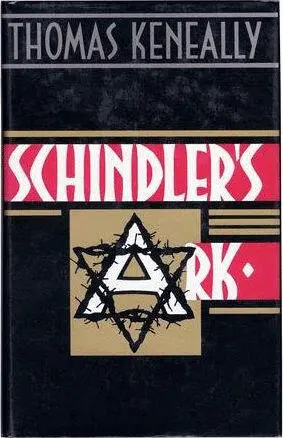
- Название:Schindler's Ark
- Автор:
- Издательство:Hodder and Stoughton
- Жанр:
- Год:1982
- Город:London
- ISBN:0-340-27838-2
- Рейтинг книги:4 / 5. Голосов: 1
-
Избранное:Добавить в избранное
- Отзывы:
-
Ваша оценка:
Schindler's Ark: краткое содержание, описание и аннотация
Предлагаем к чтению аннотацию, описание, краткое содержание или предисловие (зависит от того, что написал сам автор книги «Schindler's Ark»). Если вы не нашли необходимую информацию о книге — напишите в комментариях, мы постараемся отыскать её.
Schindler’s List
Working with the actual testimony of Schindler’s Jews, Thomas Keneally artfully depicts the courage and shrewdness of an unlikely savior, a man who is a flawed mixture of hedonism and decency and who, in the presence of unutterable evil, transcends the limits of his own humanity. From From
A mesmerizing novel based on the true story of Oskar Schindler, a German industralist who saved and succored more than 1000 Jews from the Nazis at enormous financial and emotional expense. How the German Oskar Schindler came to save more than one thousand Polish Jews during the Holocaust is one of the most fascinating stories of the century. Although millions are now learning about Schindler through Steven Spielberg’s recent Academy Award-winning film, his achievement first gained prominence with Keneally’s 1982 “facticious” novel (which is also the basis for the film). Keneally’s account is less melodramatic than the motion picture, and although he does not fully explain how a hedonistic German could have been so altered by the plight of the Jewish workers in his factory, he does make Schindler less enigmatic than the big-screen version. Ben Kingsley, one of the film's stars, reads in a calculatedly matter-of-fact tone, letting the story's power alone convey its complicated emotions. Highly recommended.
Michael Adams, Fairleigh Dickinson Univ. Lib., Madison, N.J.
Schindler's Ark — читать онлайн бесплатно полную книгу (весь текст) целиком
Ниже представлен текст книги, разбитый по страницам. Система сохранения места последней прочитанной страницы, позволяет с удобством читать онлайн бесплатно книгу «Schindler's Ark», без необходимости каждый раз заново искать на чём Вы остановились. Поставьте закладку, и сможете в любой момент перейти на страницу, на которой закончили чтение.
Интервал:
Закладка:
The recital took place in Oskar’s office. No one attended except Oskar. It was as if he were tired of company.
When the Ukrainian went to the lavatory, Oskar revealed his depression to Henry. He was upset about the war news. His birthday had come in a hiatus. The Russian armies had halted behind the Pripet Marshes in Belorussia and in front of Lwów. Oskar’s fears puzzled Henry. Doesn’t he understand, he wondered, that if the Russians aren’t held off, it’s the end of his operation here?
“I’ve often asked Amon to let you come here permanently,” Oskar told Rosner. “You and your wife and child. He won’t hear of it. He appreciates you too much. But eventually…” Henry was grateful. But he felt he had to point out that his family might be as safe as any in Płaszów. His sister-in-law, for example, had been discovered by Goeth smoking at work, and he had ordered her execution. But one of the NCO’S had begged to put before the Herr Commandant’s notice the fact that this woman was Mrs. Rosner, wife of Rosner the accordionist. “Oh,” Amon had said, pardoning her. “Well, remember, girl, I won’t have smoking on the job.”
Henry told Oskar that night that it had been this attitude of Amon’s—that the Rosners were immune because of their musical talent—which had persuaded him and Manci to bring their eight-year-old son, Olek, into the camp. He had been hiding with friends in Cracow, but that was becoming a less and less secure business every day. Once inside, Olek could blend into that small crowd of children, many unregistered in the prison records, whose presence in Płaszów was connived at by prisoners and tolerated by some of the junior camp officials. Getting Olek into the place, however, had been the risky part.
Poldek Pfefferberg, who’d had to drive a truck to town to pick up toolboxes, had smuggled the boy in. The Ukrainians had nearly discovered him at the gate, while he was still an outsider and living in contravention of every racial statute of the Reich Government General. His feet had burst out of the end of the box that lay between Pfefferberg’s ankles. “Mr. Pfefferberg, Mr. Pfefferberg,” Poldek had heard while the Ukrainians searched the back of the truck. “My feet are sticking out.”
Henry could laugh at that now, though warily, since there were still rivers to be crossed. But Schindler reacted dramatically, with a gesture that seemed to grow from the slightly alcoholic melancholy which had beset him on this evening of his birthday. He lifted his office chair by its back and raised it to the portrait of the Führer. It seemed for a second that he was about to lash into the icon. But he spun again on his heel, lowered the chair deliberately until its four legs hung equidistant from the floor, and rammed them into the carpet, shaking the wall. Then he said, “They’re burning bodies out there, aren’t they?”
Henry grimaced as if the stench were in the room.
“They’ve started,” he admitted.
Now that Płaszów was—in the language of the bureaucrats—a Concentration Camp, its inmates found that it was safer to encounter Amon. The chiefs in Oranienburg did not permit summary execution. The days when slow potato-peelers could be expunged on the spot were gone. They could now be destroyed only by due process. There had to be a hearing, a record sent in triplicate to Oranienburg. The sentence had to be confirmed not only by General Glücks’s office but also by General Pohl’s Department W (economic Enterprises). For if a commandant killed essential workers, Department W could find itself hit with claims for compensation. Allach-Munich, Ltd., for example, porcelain manufacturers using slave labor from Dachau, had recently filed a claim for 31,800 RM. because “as a result of the typhoid epidemic which broke out in January 1943, we had no prison labor at our disposal from January 26, 1943, until March 3, 1943. In our opinion we are entitled to compensation under Clause 2 of the Businesses Compensation Settlement Fund…”
Department W was all the more liable for compensation if the loss of skilled labor arose from the zeal of a trigger-happy SS officer.
So, to avoid the paperwork and the departmental complications, Amon held his hand on most days.
The people who appeared within his range in the spring and early summer of ’44 somehow understood it was safer, though they knew nothing of Department W and Generals Pohl and Glücks. It was to them a remission as mysterious as Amon’s madness itself.
Yet, as Oskar had mentioned to Henry Rosner, they were now burning bodies at Płaszów. In preparation for the Russian offensive, the SS was abolishing its institutions in the East. Treblinka, Sobibor, and Bełżec had been evacuated the previous autumn. The Waffen SS who had run them had been ordered to dynamite the chambers and the crematoria, to leave no recognizable trace, and had then been posted to Italy to fight partisans. The immense complex at Auschwitz, in its safe ground in Upper Silesia, would complete the great task in the East, and once that was concluded, the crematoria would be plowed under the earth. For without the evidence of the crematoria, the dead could offer no witness, were a whisper behind the wind, an inconsequential dust on the aspen leaves.
Płaszów was not as simple a case, for its dead lay everywhere around it. In the enthusiasm of the spring of 1943, bodies—notably the bodies of those killed in the ghetto’s last two days— were thrown randomly into mass graves in the woods. Now Department D charged Amon with finding them all.
Estimates of the numbers of bodies vary widely. Polish publications, based on the work of the Main Commission for the Investigation of Nazi Crimes in Poland and on other sources, claim that 150,000 prisoners, many of them in transit to other places, went through Płaszów and its five subcamps. Of these, the Poles believe that 80,000 died there, mainly in mass executions inside Chujowa Górka or else in epidemics.
These figures baffle the surviving Płaszów inmates who remember the fearsome work of burning the dead. They say the number they exhumed was somewhere between 8,000 and 10,000—1 multitude frightful in itself and which they have no desire to exaggerate. The distance between the two estimates looks narrower when it is remembered that executions of Poles, Gypsies, and Jews would continue at Chujowa Górka and at other points around Płaszów throughout most of that year, and that the SS themselves took up the practice of burning bodies immediately after mass killings in the Austrian hill fort. Besides, Amon would not succeed in his intention of removing all bodies from the woods. Some thousands more would be found in postwar exhumations, and today, as the suburbs of Cracow close Płaszów in, bones are still discovered during the digging of foundations. Oskar saw the line of pyres on the ridge above the workshops during a visit just before his birthday. When he came back a week later, the activity had increased. The bodies were dug up by male prisoners who worked masked and gagging. On blankets and barrows and litters the dead were brought to the burning site and laid on log frames. So the pyre was built, layer by layer, and when it reached the height of a man’s shoulder, was doused in fuel and lit. Pfefferberg was horrified to see the temporary life the flames gave to the dead, the way the corpses sat forward, throwing the burning logs away, their limbs reaching, their mouths opening for a last cry. A young SS man from the delousing station ran among the pyres waving a pistol and roaring frenetic orders. The dust of the dead fell in hair and on the clothing hung in the back gardens of junior officers’ villas. Oskar was bemused to see the way the personnel took the smoke as if the grit in the air were some sort of honest and inevitable industrial fallout. And through the fogs, Amon went riding with Majola, both of them calm in the saddle. Leo John took his twelve-year-old son off to catch tadpoles in the marshy ground in the wood. The flames and the stench did not distract them from their daily lives.
Читать дальшеИнтервал:
Закладка:
Похожие книги на «Schindler's Ark»
Представляем Вашему вниманию похожие книги на «Schindler's Ark» списком для выбора. Мы отобрали схожую по названию и смыслу литературу в надежде предоставить читателям больше вариантов отыскать новые, интересные, ещё непрочитанные произведения.










Обсуждение, отзывы о книге «Schindler's Ark» и просто собственные мнения читателей. Оставьте ваши комментарии, напишите, что Вы думаете о произведении, его смысле или главных героях. Укажите что конкретно понравилось, а что нет, и почему Вы так считаете.