Thomas Keneally - Schindler's Ark
Здесь есть возможность читать онлайн «Thomas Keneally - Schindler's Ark» весь текст электронной книги совершенно бесплатно (целиком полную версию без сокращений). В некоторых случаях можно слушать аудио, скачать через торрент в формате fb2 и присутствует краткое содержание. Город: London, Год выпуска: 1982, ISBN: 1982, Издательство: Hodder and Stoughton, Жанр: Историческая проза, на английском языке. Описание произведения, (предисловие) а так же отзывы посетителей доступны на портале библиотеки ЛибКат.
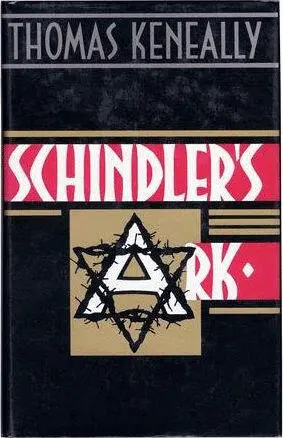
- Название:Schindler's Ark
- Автор:
- Издательство:Hodder and Stoughton
- Жанр:
- Год:1982
- Город:London
- ISBN:0-340-27838-2
- Рейтинг книги:4 / 5. Голосов: 1
-
Избранное:Добавить в избранное
- Отзывы:
-
Ваша оценка:
Schindler's Ark: краткое содержание, описание и аннотация
Предлагаем к чтению аннотацию, описание, краткое содержание или предисловие (зависит от того, что написал сам автор книги «Schindler's Ark»). Если вы не нашли необходимую информацию о книге — напишите в комментариях, мы постараемся отыскать её.
Schindler’s List
Working with the actual testimony of Schindler’s Jews, Thomas Keneally artfully depicts the courage and shrewdness of an unlikely savior, a man who is a flawed mixture of hedonism and decency and who, in the presence of unutterable evil, transcends the limits of his own humanity. From From
A mesmerizing novel based on the true story of Oskar Schindler, a German industralist who saved and succored more than 1000 Jews from the Nazis at enormous financial and emotional expense. How the German Oskar Schindler came to save more than one thousand Polish Jews during the Holocaust is one of the most fascinating stories of the century. Although millions are now learning about Schindler through Steven Spielberg’s recent Academy Award-winning film, his achievement first gained prominence with Keneally’s 1982 “facticious” novel (which is also the basis for the film). Keneally’s account is less melodramatic than the motion picture, and although he does not fully explain how a hedonistic German could have been so altered by the plight of the Jewish workers in his factory, he does make Schindler less enigmatic than the big-screen version. Ben Kingsley, one of the film's stars, reads in a calculatedly matter-of-fact tone, letting the story's power alone convey its complicated emotions. Highly recommended.
Michael Adams, Fairleigh Dickinson Univ. Lib., Madison, N.J.
Schindler's Ark — читать онлайн бесплатно полную книгу (весь текст) целиком
Ниже представлен текст книги, разбитый по страницам. Система сохранения места последней прочитанной страницы, позволяет с удобством читать онлайн бесплатно книгу «Schindler's Ark», без необходимости каждый раз заново искать на чём Вы остановились. Поставьте закладку, и сможете в любой момент перейти на страницу, на которой закончили чтение.
Интервал:
Закладка:
There were other desperate romances in Płaszów, even among the SS, but they proceeded less sunnily than this very proper romance between Josef Bau and the manicurist. Oberscharführer Albert Hujar, for example, who had shot Dr. Rosalia Blau in the ghetto and Diana Reiter after the foundations of the barracks collapsed, had fallen in love with a Jewish prisoner. Madritsch’s daughter had been captivated by a Jewish boy from the Tarnow ghetto—he had, of course, worked in Madritsch’s Tarnow plant until the expert ghetto-liquidator Amon had been brought in at the end of the summer to close down Tarnow as he had Cracow. Now he was in the Madritsch workshop inside Płaszów; the girl could visit him there. But nothing could come of it. The prisoners themselves had niches and shelters where lovers and spouses could meet. But everything—the law of the Reich and the strange code of the prisoners—resisted the affair between Fraulein Madritsch and her young man.
Similarly, honest Raimund Titsch had fallen in love with one of his machinists. That too was a gentle, secretive, and largely abortive love. As for Oberscharführer Hujar, he was ordered by Amon himself to stop being a fool. So Albert took the girl for a walk in the woods and with fondest regrets shot her through the nape of the neck.
It seemed, in fact, that death hung over the passions of the SS. Henry Rosner, the violinist, and his brother Leopold, the accordionist, spreading Viennese melodies around Goeth’s dinner table, were aware of it. One night a tall, slim, gray officer in the Waffen SS had visited Amon for dinner and, drinking a lot, had kept asking the Rosners for the Hungarian song “Gloomy Sunday.” The song is an emotional outpouring in which a young man is about to commit suicide for love. It had exactly the sort of excessive feeling which, Henry had noticed, appealed to SS men at their leisure. It had, in fact, enjoyed notoriety in the Thirties—governments in Hungary, Poland, and Czechoslovakia had considered banning it because its popularity had brought on a rash of thwarted-love suicides. Young men about to blow their heads off would sometimes quote its lyrics in their suicide notes. It had long been a song proscribed by the Reich Propaganda Office. Now this tall, elegant guest, old enough to have teen-age sons and daughters, themselves caught up in the excesses of puppy love, kept walking up to the Rosner boys and saying, “Play “Gloomy Sunday.”” And though Dr. Goebbels would not have permitted it, no one in the wilds of southern Poland was going to argue with an SS field officer with unhappy memories of an affair.
After the guest had demanded the song four or five times, an unearthly conviction took hold of Henry Rosner. In its tribal origins, music was always magic. And no one in Europe had a better sense of the potency of the violin than a Cracovian Jew like Henry, who came from the sort of family in which music is not so much learned as inherited, in the same way as the status of cohen, or hereditary priest. It came to Henry now that, as he would say later—“God, if I have the power, maybe this son-of-a-bitch will kill himself.”
The proscribed music of “Gloomy Sunday” had gained legitimacy in Amon’s dining room through being repeated, and now Henry declared war with it, Leopold playing with him and reassured by the stares of almost grateful melancholy the handsome officer directed at them.
Henry sweated, believing that he was so visibly fiddling up the SS man’s death that at any moment Amon would notice and come and take him out behind the villa for execution. As for Henry’s performance, it is not relevant to ask was it good or bad. It was possessed. And only one man, the officer, noticed and assented and, across the hubbub of drunken Bosch and Scherner, Czurda and Amon, continued to look up from his chair directly into Henry’s eyes, as if he were going to jump up at any second and say, “Of course, gentlemen. The violinist is absolutely right. There’s no sense in enduring a grief like this.”
The Rosners went on repeating the song beyond the limit at which Amon would normally have shouted, “Enough!” At last the guest stood up and went out onto the balcony. Henry knew at once that everything he could do to the man had been done. He and his brother slid into some Von Suppé and Lehar, covering their tracks with full-bodied operetta. The guest remained alone on the balcony and after half an hour interrupted a good party by shooting himself through the head.
Such was sex in Płaszów. Lice, crabs, and urgency inside the wire; murder and lunacy on its fringes. And in its midst Josef Bau and Rebecca Tannenbaum pursued their ritual dance of courtship.
In the midst of the snows that year, Płaszów underwent a change of status adverse to all lovers inside the wire. In the early days of January 1944, it was designated a Konzentrationslager (concentration Camp) under the central authority of General Oswald Pohl’s SS Main Economic and Administrative Office in Oranienburg, on the outskirts of Berlin. Subcamps of Płaszów—such as Oskar Schindler’s Emalia—now also came under Oranienburg’s control. Police chiefs Scherner and Czurda lost their direct authority. The labor fees of all those prisoners employed by Oskar and Madritsch no longer went to Pomorska Street, but to the office of General Richard Glücks, head of Pohl’s Section D (concentration Camps). Oskar, if he wanted favors now, had not only to drive out to Płaszów and sweeten Amon, not only to have Julian Scherner to dinner, but also to reach certain officials in the grand bureaucratic complex of Oranienburg.
Oskar made an early opportunity to travel to Berlin and meet the people who would be dealing with his files. Oranienburg had begun as a concentration camp. Now it had become a sprawl of administrative barracks. From the offices of Section D, every aspect of prison life and death was regulated. Its chief, Richard Glücks, had responsibility as well, in consultation with Pohl, for establishing the balance between laborers and candidates for the chambers, for the equation in which X represented slave labor and y represented the more immediately condemned. Glücks had laid down procedures for every event, and from his department came memos drafted in the anesthetic jargon of the planner, the paper shuffler, the detached specialist.
SS Main Office of Economics and Administration Section Chief D (concentration Camps)
D1-AZCC14fl-Ot-S
GEH TGB No 453-44
To the Commandants of Concentration Camps Da, Sah, Bu, Mau, Slo, Neu, Au 1-III, Gr-Ro, Natz, Stu, Rav, Herz, A-Like-Bels, Gruppenl.
D.Riga, Gruppenl. D.Cracow (Płaszów).
Applications from Camp Commandants for punishment by flogging in cases of sabotage by prisoners in the war production industries are increasing.
I request that in future in all proved cases of sabotage (a report from the management must be enclosed), an application for execution by hanging should be made. The execution should take place before the assembled members of the work detachment concerned. The reason for the execution is to be made known so as to act as a deterrent.
(signed) SS ObersturmführerIn this eerie chancellory, some files discussed the length a prisoner’s hair should be before it was considered of economic use for “the manufacture of hair-yarn socks for U-boat crews and hair-felt footwear for the Reichs railway,” while others debated whether the form registering “death cases” should be filed by eight departments or merely covered by letter and appended to the personnel records as soon as the index card had been brought up to date. And here Herr Oskar Schindler of Cracow came to talk about his little industrial compound in Zablocie. They appointed someone of middle status to handle him, a personnel officer of field rank.
Oskar wasn’t distressed. There were larger employers of Jewish prison labor than he. There were the megaliths, Krupp, of course, and I. G. Farben. There was the Cable Works at Płaszów. Walter C. Toebbens, the Warsaw industrialist whom Himmler had tried to force into the Wehrmacht, was a heavier employer of labor than Herr Schindler. Then there were the steelworks at Stalowa Wola, the aircraft factories at Budzyn and Zakopane, the Steyour-Daimler-Puch works at Radom.
Читать дальшеИнтервал:
Закладка:
Похожие книги на «Schindler's Ark»
Представляем Вашему вниманию похожие книги на «Schindler's Ark» списком для выбора. Мы отобрали схожую по названию и смыслу литературу в надежде предоставить читателям больше вариантов отыскать новые, интересные, ещё непрочитанные произведения.











Обсуждение, отзывы о книге «Schindler's Ark» и просто собственные мнения читателей. Оставьте ваши комментарии, напишите, что Вы думаете о произведении, его смысле или главных героях. Укажите что конкретно понравилось, а что нет, и почему Вы так считаете.