Thomas Keneally - Schindler's Ark
Здесь есть возможность читать онлайн «Thomas Keneally - Schindler's Ark» весь текст электронной книги совершенно бесплатно (целиком полную версию без сокращений). В некоторых случаях можно слушать аудио, скачать через торрент в формате fb2 и присутствует краткое содержание. Город: London, Год выпуска: 1982, ISBN: 1982, Издательство: Hodder and Stoughton, Жанр: Историческая проза, на английском языке. Описание произведения, (предисловие) а так же отзывы посетителей доступны на портале библиотеки ЛибКат.
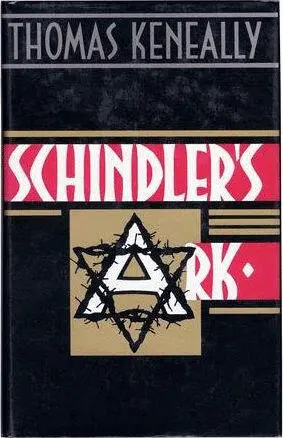
- Название:Schindler's Ark
- Автор:
- Издательство:Hodder and Stoughton
- Жанр:
- Год:1982
- Город:London
- ISBN:0-340-27838-2
- Рейтинг книги:4 / 5. Голосов: 1
-
Избранное:Добавить в избранное
- Отзывы:
-
Ваша оценка:
Schindler's Ark: краткое содержание, описание и аннотация
Предлагаем к чтению аннотацию, описание, краткое содержание или предисловие (зависит от того, что написал сам автор книги «Schindler's Ark»). Если вы не нашли необходимую информацию о книге — напишите в комментариях, мы постараемся отыскать её.
Schindler’s List
Working with the actual testimony of Schindler’s Jews, Thomas Keneally artfully depicts the courage and shrewdness of an unlikely savior, a man who is a flawed mixture of hedonism and decency and who, in the presence of unutterable evil, transcends the limits of his own humanity. From From
A mesmerizing novel based on the true story of Oskar Schindler, a German industralist who saved and succored more than 1000 Jews from the Nazis at enormous financial and emotional expense. How the German Oskar Schindler came to save more than one thousand Polish Jews during the Holocaust is one of the most fascinating stories of the century. Although millions are now learning about Schindler through Steven Spielberg’s recent Academy Award-winning film, his achievement first gained prominence with Keneally’s 1982 “facticious” novel (which is also the basis for the film). Keneally’s account is less melodramatic than the motion picture, and although he does not fully explain how a hedonistic German could have been so altered by the plight of the Jewish workers in his factory, he does make Schindler less enigmatic than the big-screen version. Ben Kingsley, one of the film's stars, reads in a calculatedly matter-of-fact tone, letting the story's power alone convey its complicated emotions. Highly recommended.
Michael Adams, Fairleigh Dickinson Univ. Lib., Madison, N.J.
Schindler's Ark — читать онлайн бесплатно полную книгу (весь текст) целиком
Ниже представлен текст книги, разбитый по страницам. Система сохранения места последней прочитанной страницы, позволяет с удобством читать онлайн бесплатно книгу «Schindler's Ark», без необходимости каждый раз заново искать на чём Вы остановились. Поставьте закладку, и сможете в любой момент перейти на страницу, на которой закончили чтение.
Интервал:
Закладка:
The dogs were craning toward him through their collars. They expected, on the basis of their black training and the rhythm of today’s Aktion, to be let fly at Pfefferberg’s wrist and groin. Their snarls were not simply feral, but full of a frightful confidence in the outcome, and the question was whether the SS man on the Herr Commandant’s left had enough strength to restrain them. Pfefferberg didn’t expect much. He would not be surprised to be buried by dogs and after a time to be delivered from their ravages by a bullet. If the woman hadn’t got away with pleading her motherhood, he stood little chance with stories of bundles, of clearing a street in which human traffic had in any case been abolished.
But the Commandant was more amused by Pfefferberg than he had been by the mother. Here was a Ghettomensch playing soldier in front of three SS officers and making his report, servile if true, and almost endearing if not. His manner was, above all, a break in style for a victim. Of all today’s doomed, not one other had tried heel-clicking. The Herr Commandant could therefore exercise the kingly right to show irrational and unexpected amusement. His head went back; his long upper lip retracted. It was a broad, honest laugh, and his colleagues smiled and shook their heads at its extent.
In his excellent baritone, Untersturmführer Goeth said, “We’re looking after everything. The last group is leaving the ghetto. Verschwinde!” That is, Disappear, little Polish clicking soldier!
Pfefferberg began to run, not looking back, and it would not have surprised him if he had been felled from behind. Running, he got to the corner of Wegierska and turned it, past the hospital yard where some hours ago he had been a witness. The dark came down as he neared the gate, and the ghetto’s last familiar alleys faded. In Podgórze Square, the last official huddle of prisoners stood in a loose cordon of SS men and Ukrainians.
“I must be the last one out alive,” he told people in that crowd.
Or if not he it was Wulkan the jeweler and his wife and son. Wulkan had been working these past months in the Progress factory and, knowing what was to happen, had approached Treuhänder Unkelbach with a large diamond concealed for two years in the lining of a coat. “Herr Unkelbach,” he told the supervisor, “I’ll go wherever I’m sent, but my wife isn’t up to all that noise and violence.”
Wulkan and his wife and son would wait at the OD police station under the protection of a Jewish policeman they knew, and then perhaps during the day Herr Unkelbach would come and convey them bloodlessly to Płaszów.
Since this morning they had sat in a cubicle in the police station, but it had been as frightful a wait as if they’d stayed in their kitchen, the boy alternately terrified and bored, and his wife continuing to hiss her reproaches. Where is he? Is he going to come at all? These people, these people! Early in the afternoon, Unkelbach did in fact appear, came into the Ordnungsdienst to use the lavatory and have coffee. Wulkan, emerging from the office in which he’d been waiting, saw a Treuhänder Unkelbach he had never known before: a man in the uniform of an SS NCO, smoking and exchanging animated conversation with another SS man; using one hand to take hungry mouthfuls of coffee, to bite off mouthfuls of smoke, to savage a lump of brown bread while his pistol, still held in the left hand, lay like a resting animal on the police-station counter and dark spatters of blood ran across the breast of his uniform. The eyes he turned to meet Wulkan’s did not see the jeweler. Wulkan knew at once that Unkelbach was not backing out of the deal, he simply did not remember it. The man was drunk, and not on liquor. If Wulkan had called to him, the answer would have been a stare of ecstatic incomprehension. Followed, very likely, by something worse.
Wulkan gave it up and returned to his wife. She kept saying, “Why don’t you talk to him? I’ll talk to him if he’s still there.” But then she saw the shadow in Wulkan’s eyes and sneaked a look around the edge of the door. Unkelbach was getting ready to leave. She saw the unaccustomed uniform, the blood of small traders and their wives splashed across its front. She uttered a whimper and returned to her seat. Like her husband, she now fell into a well-founded despair, and the waiting became somehow easier. The OD man they knew restored them to the usual pulse of hope and anxiety. He told them that all the OD, apart from Spira’s praetorians, had to be out of the ghetto by 6 P.M. and on the Wieliczka Road to Płaszów. He would see if there was a way of getting the Wulkans into one of the vehicles. After dark had fallen in the wake of Pfefferberg’s passage up Wegierska, after the last party of prisoners had assembled at the gate into Podgórze Square, while Dr. H and his wife were moving eastward in the company and under the cover of a group of rowdy Polish drunks, and while the squads of the Sonderkommando were resting and taking a smoke before the last search of the tenements, two horse-drawn wagons came to the door of the police station. The Wulkan family were hidden by the OD men under cartons of paperwork and bundles of clothing. Symche Spira and his associates were not in sight, were on the job somewhere in the streets, drinking coffee with NCO’S, celebrating their permanence within the system.
But before the wagons had turned out of the ghetto gate, the Wulkans, flattened to the boards, heard the nearly continuous sound of rifle and small-arms fire from the streets behind them. It meant that Amon Goeth and Willi Haase, Albert Hujar, Horst Pilarzik, and some hundreds of others were bursting into the attic niches, the false ceilings, the crates in cellars, and finding those who all day had maintained a hopeful silence.
More than 4,000 such people were discovered overnight and executed in the streets. In the next two days their bodies were taken to Płaszów on open-platform trucks and buried in two mass graves in the woods beyond the new camp.
CHAPTER 22
We do not know in what condition of soul Oskar Schindler spent March 13, the ghetto’s last and worst day. But by the time his workers returned to him under guard from Płaszów, he was back in the mood for collecting data to pass on to Dr. Sedlacek on the dentist’s next visit. He found out from the prisoners that Zwangsarbeitslager Płaszów—as it was known in SS bureaucratese—was to be no rational kingdom. Goeth had already pursued his passion against engineers by letting the guards beat Zygmunt Grünberg into a coma and bring him so late to the clinic up near the women’s camp that his death was assured. From the prisoners who ate their hearty noonday soup at DEF, Oskar heard also that Płaszów was being used not only as a work camp but as a place of execution as well. Though all the camp could hear the executions, some of the prisoners had been witnesses.
The prisoner M, for example, who had had a prewar decorating business in Cracow.
In the first days of the camp he was in demand to decorate the houses of the SS, the few small country villas that flanked the lane on the north side of the camp. Like any especially valued artisan he had more freedom of movement, and one afternoon that spring he had been walking from the villa of Untersturmführer Leo John up the track toward the hill called Chujowa Górka, on whose crest stood the Austrian fort. Before he was ready to turn back down the slope to the factory yard, he had to pause to let an Army truck grind past him uphill. M had noticed that beneath its canopy were women under the care of white-coveralled Ukrainian guards. He had hidden between stacks of lumber and got an incomplete view of the women, disembarked and marched inside the fort, refusing to undress. The man yelling the orders in there was the SS man Edmund Sdrojewski. Ukrainian NCO’S marched among the women hitting them with whip handles. M presumed they were Jewish, probably women caught with Aryan papers, brought here from Montelupich prison. Some cried out at the blows, but others were silent, as if to refuse the Ukrainians that much satisfaction. One of them began to intone the Shema Yisroel, and the others took it up. The verses rose vigorously above the mound, as if it had just occurred to the girls—who till yesterday had played straight Aryans—that now the pressure was off, they were freer than anyone to celebrate their tribal difference in the faces of Sdrojewski and the Ukrainians. Then, huddling for modesty and the bite of the spring air, they were all shot. At night the Ukrainians took them away in wheelbarrows and buried them in the woods on the far side of Chujowa Górka.
Читать дальшеИнтервал:
Закладка:
Похожие книги на «Schindler's Ark»
Представляем Вашему вниманию похожие книги на «Schindler's Ark» списком для выбора. Мы отобрали схожую по названию и смыслу литературу в надежде предоставить читателям больше вариантов отыскать новые, интересные, ещё непрочитанные произведения.











Обсуждение, отзывы о книге «Schindler's Ark» и просто собственные мнения читателей. Оставьте ваши комментарии, напишите, что Вы думаете о произведении, его смысле или главных героях. Укажите что конкретно понравилось, а что нет, и почему Вы так считаете.