Thomas Keneally - Schindler's Ark
Здесь есть возможность читать онлайн «Thomas Keneally - Schindler's Ark» весь текст электронной книги совершенно бесплатно (целиком полную версию без сокращений). В некоторых случаях можно слушать аудио, скачать через торрент в формате fb2 и присутствует краткое содержание. Город: London, Год выпуска: 1982, ISBN: 1982, Издательство: Hodder and Stoughton, Жанр: Историческая проза, на английском языке. Описание произведения, (предисловие) а так же отзывы посетителей доступны на портале библиотеки ЛибКат.
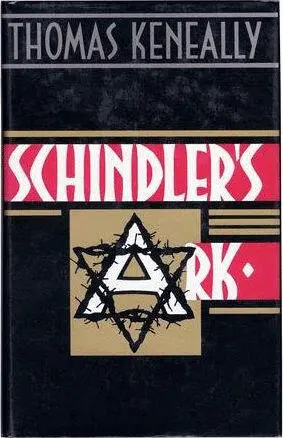
- Название:Schindler's Ark
- Автор:
- Издательство:Hodder and Stoughton
- Жанр:
- Год:1982
- Город:London
- ISBN:0-340-27838-2
- Рейтинг книги:4 / 5. Голосов: 1
-
Избранное:Добавить в избранное
- Отзывы:
-
Ваша оценка:
Schindler's Ark: краткое содержание, описание и аннотация
Предлагаем к чтению аннотацию, описание, краткое содержание или предисловие (зависит от того, что написал сам автор книги «Schindler's Ark»). Если вы не нашли необходимую информацию о книге — напишите в комментариях, мы постараемся отыскать её.
Schindler’s List
Working with the actual testimony of Schindler’s Jews, Thomas Keneally artfully depicts the courage and shrewdness of an unlikely savior, a man who is a flawed mixture of hedonism and decency and who, in the presence of unutterable evil, transcends the limits of his own humanity. From From
A mesmerizing novel based on the true story of Oskar Schindler, a German industralist who saved and succored more than 1000 Jews from the Nazis at enormous financial and emotional expense. How the German Oskar Schindler came to save more than one thousand Polish Jews during the Holocaust is one of the most fascinating stories of the century. Although millions are now learning about Schindler through Steven Spielberg’s recent Academy Award-winning film, his achievement first gained prominence with Keneally’s 1982 “facticious” novel (which is also the basis for the film). Keneally’s account is less melodramatic than the motion picture, and although he does not fully explain how a hedonistic German could have been so altered by the plight of the Jewish workers in his factory, he does make Schindler less enigmatic than the big-screen version. Ben Kingsley, one of the film's stars, reads in a calculatedly matter-of-fact tone, letting the story's power alone convey its complicated emotions. Highly recommended.
Michael Adams, Fairleigh Dickinson Univ. Lib., Madison, N.J.
Schindler's Ark — читать онлайн бесплатно полную книгу (весь текст) целиком
Ниже представлен текст книги, разбитый по страницам. Система сохранения места последней прочитанной страницы, позволяет с удобством читать онлайн бесплатно книгу «Schindler's Ark», без необходимости каждый раз заново искать на чём Вы остановились. Поставьте закладку, и сможете в любой момент перейти на страницу, на которой закончили чтение.
Интервал:
Закладка:
So it was not that Springmann and Kastner were unmanned by Schindler’s testimony as much as that their minds were painfully expanding. Their resources seemed minute now that they knew what they were set against—not just any average and predictable Philistine giant, but Behemoth itself. Perhaps already they were reaching for the idea that as well as individual bargaining—some extra food for this camp, rescue for this intellectual, a bribe to temper the professional ardor of this SS man—some vaster rescue scheme would have to be arranged at breathtaking expense.
Schindler threw himself into a chair. Samu Springmann looked across at the exhausted industrialist. He had made an enormous impression on them, said Springmann. They would, of course, send a report to Istanbul on all Oskar had told them. It would be used to stir the Palestinian Zionists and the Joint Distribution Committee to greater action. At the same time it would be transmitted to the governments of Churchill and Roosevelt. Springmann said that he thought Oskar was right to worry about people’s belief in what he’d say; he was right to say it was all incredible. ”Therefore,” said Samu Springmann, “I urge you to go to Istanbul yourself and speak to the people there.” After a little hesitation—whether to do with the demands of the enamelware business or with the dangers of crossing so many borders—Schindler agreed. Toward the end of the year, said Springmann. “In the meantime you will see Dr. Sedlacek in Cracow regularly.”
They stood up, and Oskar could see that they were changed men. They thanked him and left, becoming simply, on the way downstairs, two pensive Budapest professional men who’d heard disturbing news of mismanagement in the branch offices.
That night Dr. Sedlacek called at Oskar’s hotel and took him out into the brisk streets to dinner at the Hotel Gellert. From their table they could see the Danube, its illuminated barges, the city glowing on the far side of the water. It was like a prewar city, and Schindler began to feel like a tourist again. After his afternoon’s temperance, he drank the dense Hungarian burgundy called Bull’s Blood with a slow, assiduous thirst, and created a rank of empty bottles at their table.
Halfway through their meal they were joined by an Austrian journalist, Dr. Schmidt, who’d brought with him his mistress, an exquisite, golden Hungarian girl. Schindler admired the girl’s jewelry and told her that he was a great fancier of gems himself. But over apricot brandy, he became less friendly. He sat with a mild frown, listening to Schmidt talk of real estate prices and automobile dealings and horse races. The girl listened raptly to Schmidt, since she wore the results of his business coups around her neck and at her wrists. But Oskar’s unexpected disapproval was clear. Dr. Sedlacek was secretly amused: perhaps Oskar was seeing a partial reflection of his own new wealth, his own tendencies toward trading on the fringes.
When the dinner was over, Schmidt and his girl left for some nightclub, and Sedlacek made sure he took Schindler to a different one. They sat drinking unwise further quantities of barack and watching the floor show.
“That Schmidt,” said Schindler, wanting to clear up the question so that he could enjoy the small hours. “Do you use him?”
“Yes.”
“I don’t think you ought to use men like that,” said Oskar. “He’s a thief.”
Dr. Sedlacek turned his face, and its half-smile, away.
“How can you be sure he delivers any of the money you give him?” Oskar asked.
“We let him keep a percentage,” said Dr. Sedlacek.
Oskar thought about it for a full half-minute. Then he murmured, “I don’t want a damned percentage. I don’t want to be offered one.” “Very well,” said Sedlacek.
“Let’s watch the girls,” said Oskar.
CHAPTER 19
Even as Oskar Schindler returned by freight car from Budapest, where he’d predicted that the ghetto would soon be closed, an SS Untersturmführer named Amon Goeth was on his way from Lublin to bring about that liquidation, and to take command of the resultant Forced Labor Camp (Zwangsarbeitslager) at Płaszów. Goeth was some eight months younger than Schindler, but shared more with him than the mere year of birth. Like Oskar he had been raised a Catholic and had ceased observing the rites of the Church as late as 1938, when his first marriage had broken up. Like Oskar too, he had graduated from high school in the Realgymnasium—Engineering, Physics, Math. He was therefore a practical man, no thinker, but considered himself a philosopher.
A Viennese, he had joined the National Socialist Party early, in 1930. When the nervous Austrian Republic banned the party in 1933, he was already a member of its security force, the SS. Driven underground, he had emerged onto the streets of Vienna after the Anschluss of 1938 in the uniform of an SS noncommissioned officer. In 1940 he had been raised to the rank of SS Oberscharführer and in 1941 achieved the honor of commissioned rank, immensely harder to come by in the SS than in Wehrmacht units. After training in infantry tactics, he was put in charge of Sonderkommandos during Aktionen in the populous ghetto of Lublin and, by his performance there, earned the right to liquidate Cracow.
Untersturmführer Amon Goeth then, speeding on the Wehrmacht special between Lublin and Cracow, there to take command of well-tried Sonderkommandos, shared with Oskar not only his year of birth, his religion, his weakness for liquor, but a massive physique as well. Goeth’s face was open and pleasant, rather longer than Schindler’s. His hands, though large and muscular, were long-fingered. He was sentimental about his children, the children of his second marriage whom, because of his foreign service, he had not seen often in the past three years. As a substitute, he was sometimes attentive to the children of brother officers. He could be a sentimental lover too, but though he resembled Oskar in terms of general sexual voraciousness, his tastes were less conventional, running sometimes to his brother SS men, frequently to the beating of women. Both his former wives could have testified that once the first blaze of infatuation had died, he could become physically abusive. He considered himself a sensitive man, and thought that his family’s trade proved it. His father and grandfather were Viennese printers and binders of books on military and economic history, and he liked to list himself on official papers as a Literat: a man of letters. And though, at this moment, he would have told you that he looked forward to his taking of control of the liquidation operation—that this was the major chance of his career and carried with it the promise of promotion— his service in Special Actions seemed to him to have altered the flow of his nervous energies. He had been plagued with insomnia for two years now and, if he had his way, stayed up till three or four and slept late in the mornings. He had become a reckless drinker and believed he held his liquor with an ease he had not known in his youth. Again like Oskar, he never suffered the hangovers he deserved. He thanked his hardworking kidneys for this benefit.
His orders, entrusting him with the extinction of the ghetto and the kingship of the Płaszów camp, were dated February 12, 1943. He hoped that after consulting with his senior NCO’S, with Wilhelm Kunde, commander of the SS guard detail for the ghetto, and with Willi Haase, Scherner’s deputy, it would be possible to begin the clearing of the ghetto within a month of the date on his commission.
Commandant Goeth was met at the Cracow Central Station by Kunde himself and by the tall young SS man Horst Pilarzik, who was temporarily in charge of the work camps at Prokocim and Wieliczka. They piled into the back of a Mercedes and were driven off for a reconnaissance of the ghetto and the site of the new camp. It was a bitter day, and snow began to fall as they crossed the Vistula.
Читать дальшеИнтервал:
Закладка:
Похожие книги на «Schindler's Ark»
Представляем Вашему вниманию похожие книги на «Schindler's Ark» списком для выбора. Мы отобрали схожую по названию и смыслу литературу в надежде предоставить читателям больше вариантов отыскать новые, интересные, ещё непрочитанные произведения.











Обсуждение, отзывы о книге «Schindler's Ark» и просто собственные мнения читателей. Оставьте ваши комментарии, напишите, что Вы думаете о произведении, его смысле или главных героях. Укажите что конкретно понравилось, а что нет, и почему Вы так считаете.