Thomas Keneally - Schindler's Ark
Здесь есть возможность читать онлайн «Thomas Keneally - Schindler's Ark» весь текст электронной книги совершенно бесплатно (целиком полную версию без сокращений). В некоторых случаях можно слушать аудио, скачать через торрент в формате fb2 и присутствует краткое содержание. Город: London, Год выпуска: 1982, ISBN: 1982, Издательство: Hodder and Stoughton, Жанр: Историческая проза, на английском языке. Описание произведения, (предисловие) а так же отзывы посетителей доступны на портале библиотеки ЛибКат.
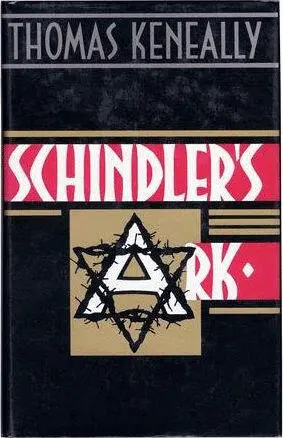
- Название:Schindler's Ark
- Автор:
- Издательство:Hodder and Stoughton
- Жанр:
- Год:1982
- Город:London
- ISBN:0-340-27838-2
- Рейтинг книги:4 / 5. Голосов: 1
-
Избранное:Добавить в избранное
- Отзывы:
-
Ваша оценка:
Schindler's Ark: краткое содержание, описание и аннотация
Предлагаем к чтению аннотацию, описание, краткое содержание или предисловие (зависит от того, что написал сам автор книги «Schindler's Ark»). Если вы не нашли необходимую информацию о книге — напишите в комментариях, мы постараемся отыскать её.
Schindler’s List
Working with the actual testimony of Schindler’s Jews, Thomas Keneally artfully depicts the courage and shrewdness of an unlikely savior, a man who is a flawed mixture of hedonism and decency and who, in the presence of unutterable evil, transcends the limits of his own humanity. From From
A mesmerizing novel based on the true story of Oskar Schindler, a German industralist who saved and succored more than 1000 Jews from the Nazis at enormous financial and emotional expense. How the German Oskar Schindler came to save more than one thousand Polish Jews during the Holocaust is one of the most fascinating stories of the century. Although millions are now learning about Schindler through Steven Spielberg’s recent Academy Award-winning film, his achievement first gained prominence with Keneally’s 1982 “facticious” novel (which is also the basis for the film). Keneally’s account is less melodramatic than the motion picture, and although he does not fully explain how a hedonistic German could have been so altered by the plight of the Jewish workers in his factory, he does make Schindler less enigmatic than the big-screen version. Ben Kingsley, one of the film's stars, reads in a calculatedly matter-of-fact tone, letting the story's power alone convey its complicated emotions. Highly recommended.
Michael Adams, Fairleigh Dickinson Univ. Lib., Madison, N.J.
Schindler's Ark — читать онлайн бесплатно полную книгу (весь текст) целиком
Ниже представлен текст книги, разбитый по страницам. Система сохранения места последней прочитанной страницы, позволяет с удобством читать онлайн бесплатно книгу «Schindler's Ark», без необходимости каждый раз заново искать на чём Вы остановились. Поставьте закладку, и сможете в любой момент перейти на страницу, на которой закончили чтение.
Интервал:
Закладка:
The new Commandant was introduced. He said how pleased he was to be associated with these businessmen whose valuable contributions to the war effort were already widely known.
Amon pointed out on a map of the camp area the section set aside for the factories. It was next to the men’s camp; the women—he told them with an easy and quite charming smile—would have to walk a little farther, one or two hundred meters downhill, to reach the workshops. He assured the gentlemen that his main task was to oversee the smooth functioning of the camp and that he had no wish to interfere with their factory policies or to alter the managerial autonomy they enjoyed here in Cracow. His orders, as Oberführer Scherner could verify, forbade in so many words that sort of intrusion. But the Oberführer had been correct in pointing out the mutual advantages of moving an industry inside the camp perimeter. The factory owners did not have to pay for the premises, and he, the Commandant, did not have to provide a guard to march the prisoners to town and back. They could understand how the length of the journey and the hostility of the Poles to a column of Jews would erode the worth of the workers. Throughout this speech, Commandant Goeth glanced frequently at Madritsch and Schindler, the two he particularly wished to win over. He knew he could already depend on Bosch’s local knowledge and advice. But Herr Schindler, for example, had a munitions section, small and merely in the developmental stage as yet. It would, however, if transferred, give Płaszów a great respectability with the Armaments Inspectorate.
Herr Madritsch listened with a considered frown, and Herr Schindler watched the speaker with an acquiescent half-smile. Commandant Goeth could tell instinctively, even before he’d finished speaking, that Madritsch would be reasonable and move in, that Schindler would refuse. It was hard to judge by these separate decisions which one of the two felt more paternal toward his Jews—Madritsch, who wanted to be inside Płaszów with them, or Schindler, who wanted to have his with him in Emalia.
Oskar Schindler, wearing that same face of avid tolerance, went with the party to inspect the campsite. Płaszów had the form of a camp now—an improvement in the weather had permitted the assembly of barracks; a thawing of the ground permitted the digging of latrines and postholes. A Polish construction company had installed the miles of perimeter fence. Thick-legged watchtowers were going up along the skyline toward Cracow, and also at the mouth of the valley down toward Wieliczka Street, away at the far end of the camp, and up here on this eastern hill where the official party, in the shadow of the Austrian hill fort, watched the fast work of this new creation. Off to the right, Oskar noticed, women were hustling up muddy tracks in the direction of the railway, heavy sections of barracks tilted between them. Below, from the lowest point of the valley and all the way up the far side, the terraced barracks ran, assembled by male prisoners who raised and slotted and hammered with an energy which at this distance resembled willingness.
On the choicest, most level ground beneath the official party, a number of long wooden structures were available for industrial occupation. Cement floors could be poured should heavy machinery need to be installed. The transfer of all plant machinery would be handled by the SS. The road that serviced the area was admittedly little more than a country track, but the engineering firm of Klug had been approached to build a central street for the camp, and the Ostbahn had promised to provide a spur to the camp gate itself, to the quarry down there on the right. Limestone from the quarries and some of what Goeth called “Polish-defaced” gravestones from over in the cemetery would be broken up to provide other interior roads. The gentlemen should not worry about roads, said Goeth, for he intended to maintain a permanently strong quarrying and road-building team.
A small railroad had been laid for the rock trolleys. It ran from the quarry up past the Administration Building and the large stone barracks that were being built for the SS and Ukrainian garrison. Trolleys of limestone, each weighing six tons, were hauled by teams of women, thirty-five or forty of them to a team, dragging on cables set either side of the rock truck, to compensate for the unevenness in the rail line. Those who tripped or stumbled were trampled or else rolled out of the way, for the teams had their own organic momentum and no individual could abdicate from it. Watching this insidious Egyptian-looking industry, Oskar felt the same surge of nausea, the same prickling of the blood he had experienced on the hill above Krakusa Street. Goeth had assumed the businessmen were a safe audience, that they were all spiritual kinfolk of his. He was not embarrassed by that savage hauling down there. The question arose, as it had in Krakusa Street: What could embarrass the SS? What could embarrass Amon?
The energy of the barracks builders had, even to an informed observer like Oskar, the specious appearance of men working hard to put up shelter for their women. But though Oskar had not yet heard the rumor of it, Amon had performed a summary execution in front of those men this morning, so that now they knew what the full terms of their labor were. After the early-morning meeting with the engineers, Amon had been strolling down Jerozolimska and had come to the SS barracks where the work was under the supervision of an excellent NCO, soon to be promoted to officer rank, named Albert Hujar. Hujar had marched up and made his report. A section of the foundations of the barracks had collapsed, said Hujar, his face flushed. At the same time, Amon had noticed a girl walking around the half-finished building, speaking to teams of men, pointing, directing. Who was that? he asked Hujar. She was a prisoner named Diana Reiter, said Hujar, an architectural engineer who had been assigned to the construction of the barracks. She was claiming that the foundations hadn’t been correctly excavated, and she wanted all the stone and cement dug up and the work on that section of the building to begin again from scratch. Goeth had been able to tell from the color of Hujar’s face that he had had a tough argument with the woman. Hujar had, in fact, been reduced to screaming at her, “You’re building barracks, not the frigging Hotel Europa!”
Now Amon half-smiled at Hujar.
We’re not going to have arguments with these people, he said, as if it were a promise. Bring me the girl.
Amon could tell, from the way she walked toward him, the bogus elegance with which her middle-class parents had raised her, the European manners they had imbued her with, sending her—when the honest Poles wouldn’t take her in their universities—off to Vienna or Milan to give her a profession and a heightened protective coloration. She walked toward him as if his rank and hers would bind them in the battle against oafish NCO’S and the inferior craft of whichever SS engineer had supervised the digging of the foundations. She did not know that he hated her the worst—the type who thought, even against the evidence of his SS uniform, of these rising structures, that their Jewishness was not visible.
“You’ve had occasion to quarrel with Oberscharführer Hujar,” Goeth told her as a fact. She nodded firmly. The Herr Commandant would understand, the nod suggested, even though that idiot Hujar couldn’t. The entire foundations at that end must be redug, she told him energetically. Of course, Amon knew “they” were like that, they liked to string out tasks and so ensure that the labor force was safe for the duration of the project. If everything is not redug, she told him, there will be at least subsidence at the southern end of the barracks. There could be collapse. She went on arguing the case, and Amon nodded and presumed she must be lying. It was a first principle that you never listened to a Jewish specialist. Jewish specialists were in the mold of Marx, whose theories were aimed at the integrity of government, and of Freud, who had assaulted the integrity of the Aryan mind. Amon felt that this girl’s argument threatened his personal integrity.
Читать дальшеИнтервал:
Закладка:
Похожие книги на «Schindler's Ark»
Представляем Вашему вниманию похожие книги на «Schindler's Ark» списком для выбора. Мы отобрали схожую по названию и смыслу литературу в надежде предоставить читателям больше вариантов отыскать новые, интересные, ещё непрочитанные произведения.










Обсуждение, отзывы о книге «Schindler's Ark» и просто собственные мнения читателей. Оставьте ваши комментарии, напишите, что Вы думаете о произведении, его смысле или главных героях. Укажите что конкретно понравилось, а что нет, и почему Вы так считаете.