Thomas Keneally - Schindler's Ark
Здесь есть возможность читать онлайн «Thomas Keneally - Schindler's Ark» весь текст электронной книги совершенно бесплатно (целиком полную версию без сокращений). В некоторых случаях можно слушать аудио, скачать через торрент в формате fb2 и присутствует краткое содержание. Город: London, Год выпуска: 1982, ISBN: 1982, Издательство: Hodder and Stoughton, Жанр: Историческая проза, на английском языке. Описание произведения, (предисловие) а так же отзывы посетителей доступны на портале библиотеки ЛибКат.
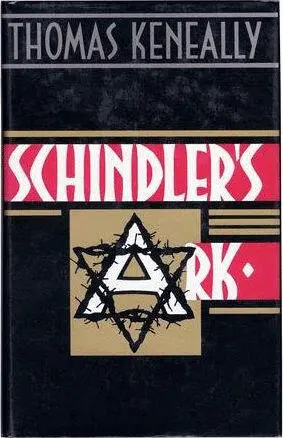
- Название:Schindler's Ark
- Автор:
- Издательство:Hodder and Stoughton
- Жанр:
- Год:1982
- Город:London
- ISBN:0-340-27838-2
- Рейтинг книги:4 / 5. Голосов: 1
-
Избранное:Добавить в избранное
- Отзывы:
-
Ваша оценка:
Schindler's Ark: краткое содержание, описание и аннотация
Предлагаем к чтению аннотацию, описание, краткое содержание или предисловие (зависит от того, что написал сам автор книги «Schindler's Ark»). Если вы не нашли необходимую информацию о книге — напишите в комментариях, мы постараемся отыскать её.
Schindler’s List
Working with the actual testimony of Schindler’s Jews, Thomas Keneally artfully depicts the courage and shrewdness of an unlikely savior, a man who is a flawed mixture of hedonism and decency and who, in the presence of unutterable evil, transcends the limits of his own humanity. From From
A mesmerizing novel based on the true story of Oskar Schindler, a German industralist who saved and succored more than 1000 Jews from the Nazis at enormous financial and emotional expense. How the German Oskar Schindler came to save more than one thousand Polish Jews during the Holocaust is one of the most fascinating stories of the century. Although millions are now learning about Schindler through Steven Spielberg’s recent Academy Award-winning film, his achievement first gained prominence with Keneally’s 1982 “facticious” novel (which is also the basis for the film). Keneally’s account is less melodramatic than the motion picture, and although he does not fully explain how a hedonistic German could have been so altered by the plight of the Jewish workers in his factory, he does make Schindler less enigmatic than the big-screen version. Ben Kingsley, one of the film's stars, reads in a calculatedly matter-of-fact tone, letting the story's power alone convey its complicated emotions. Highly recommended.
Michael Adams, Fairleigh Dickinson Univ. Lib., Madison, N.J.
Schindler's Ark — читать онлайн бесплатно полную книгу (весь текст) целиком
Ниже представлен текст книги, разбитый по страницам. Система сохранения места последней прочитанной страницы, позволяет с удобством читать онлайн бесплатно книгу «Schindler's Ark», без необходимости каждый раз заново искать на чём Вы остановились. Поставьте закладку, и сможете в любой момент перейти на страницу, на которой закончили чтение.
Интервал:
Закладка:
Untersturmführer Goeth was pleased for a pull on a flask of schnapps Pilarzik carried with him. They passed through the fake-Oriental portals and down the trolley lines of Lwówska Street, which cut the ghetto into two icy portions. The dapper Kunde, who had been a customs agent in civilian life and was adept at reporting to superiors, gave a deft sketch of the ghetto. The portion on their left was Ghetto B, said Kunde.
Its inhabitants, about 2,000 of them, had escaped earlier Aktionen or had been previously employed in industry. But new identification cards had been issued since then, with appropriate initials—either W for Army employees, Z for employees of the civil authorities, or R for workers in essential industries. The inhabitants of Ghetto B lacked these new cards and were to be shipped away for Sonderbehandlung (special Treatment).
In clearing the ghetto, it might be preferable to start on that side first, though that sort of tactical decision was entirely up to the Herr Commandant.
The greater portion of the ghetto stood to the right and contained some 10,000 people still. They would of course be the initial labor force for the factories of the Płaszów camp. It was expected that the German entrepreneurs and supervisors—Bosch, Madritsch, Beckmann, the Sudetenlander Oskar Schindler—would want to move all or part of their operations out of town into the camp. As well as that there was a cable-making plant no more than half a mile from the proposed camp, and laborers would be marched there and back each day.
Would the Herr Commandant, asked Kunde, care to continue down the road a few kilometers and have a look at the campsite itself?
Oh, yes, said Amon, I think that would be advisable.
They turned off the highway where the cable-factory yard, snow lying on the giant spools, marked the beginning of Jerozolimska Street. Amon Goeth had a glimpse of a few groups of hunched and bescarved women dragging segments of huts—a wall panel, an eaves section—across the highway and up Jerozolimska from the direction of the railway station at Cracow-Płaszów. They were women from the Prokocim camp, Pilarzik explained. When Płaszów was ready, Prokocim would of course be disbanded and these laboring women would come under the management of the Herr Commandant. Goeth estimated the distance the women had to carry the frames to be some three-quarters of a kilometer. “All uphill,” said Kunde, putting his head on one shoulder, then on the other, as if to say, So it’s a satisfactory form of discipline, but it slows up construction.
The camp would need a railway spur, said Untersturmführer Goeth. He would make an approach to Ostbahn.
They passed on the right a synagogue and its mortuary buildings, and a half-tumbled wall showed gravestones like teeth in the cruelly exposed mouth of winter. Part of the campsite had been until this month a Jewish cemetery. “Quite extensive,” said Wilhelm Kunde. The Herr Commandant uttered a witticism which would come to his lips often during his residency at Płaszów. “They won’t have to go far to get buried.”
There was a house to the right which would be suitable as a temporary residence for the Commandant, and then a large new building to serve as an administration center. The synagogue mortuary, already partly dynamited, would become the camp stable. Kunde pointed out that the two limestone quarries within the camp area could be seen from here. One stood in the bottom of the little valley, the other up on the hill behind the synagogue. The Herr Commandant might be able to notice the tracks being laid for trolleys which would be used in hauling stones. Once the heavy weather let up, the construction of the track would continue.
They drove to the southeast end of the proposed camp, and a trail, just passable in the snow, took them along the skyline. The trail ended at what had once been an Austrian military earthwork, a circular mound surrounding a deep and broad indentation. To an artilleryman it would have appeared an important redoubt from which cannon could be sighted to enfilade the road from Russia. To Untersturmführer Goeth it was a place suited for disciplinary punishment. From up here, the camp area could be seen whole.
It was a rural stretch, graced with the Jewish cemetery, and folded between two hills. It was in this weather two pages of a largely blank book opened and held at an angle, sideways, to the observer on the fort hill. A gray, stone country dwelling was stuck at the entrance to the valley, and past it, along the far slope and among the few finished barracks, moved teams of women, black as bunches of musical notations, in the strange darkling luminescence of a snowy evening. Emerging from the icy alleys beyond Jerozolimska, they toiled up the white slope under the urgings of Ukrainian guards and dropped the sections of frames where the SS engineers, wearing homburgs and civilian clothes, instructed them.
Their rate of work was a limitation, Untersturmführer Goeth remarked. The ghetto people could not, of course, be moved here until the barracks were up and the watchtowers and fences completed. He had no complaints about the pace at which the prisoners on the far hill were working, he told them, confidingly. He was in fact secretly impressed that so late on a biting day, the SS men and Ukrainians on the far slope were not letting the thought of supper and warm barracks slow the pace of operations.
Horst Pilarzik assured him that it was all closer to completion than it looked: the land had been terraced, the foundations dug despite the cold, and a great quantity of prefabricated sections carried up from the railway station. The Herr Untersturmführer would be able to consult with the entrepreneurs tomorrow—a meeting had been arranged for 10 A.M. But modern methods combined with a copious supply of labor meant that these places could be put up almost overnight, weather permitting. Pilarzik seemed to believe that Goeth was in genuine danger of demoralization. In fact Amon was exhilarated. From what he could see here, he could discern the final shape of the place. Nor was he worried about fences. The fences would be a mental comfort to the prisoners rather than an essential precaution. For after the established methodology of SS liquidation had been applied to the Podgórze ghetto, people would be grateful for the barracks of Płaszów. Even those with Aryan papers would come crawling in here, seeking an obscure berth high up in the green, hoarfrosted rooftrees. For most of them, the wire was needed only as a prop, so that they might reassure themselves that they were prisoners against their will.
The meeting with the local factory owners and Treuhänders took place in Julian Scherner’s office in central Cracow early the following day. Amon Goeth arrived smiling fraternally and, in his freshly tailored Waffen SS uniform, designed precisely for his enormous frame, seemed to dominate the room. He was sure he could charm the independents, Bosch and Madritsch and Schindler, into transferring their Jewish labor behind camp wire. Besides that, an investigation of the skills available among the ghetto dwellers helped him to see that Płaszów could become quite a business. There were jewelers, upholsterers, tailors who could be used for special enterprises under the Commandant’s direction, filling orders for the SS, the Wehrmacht, the wealthy German officialdom. There would be the clothing workshops of Madritsch, the enamel factory of Schindler, a proposed metal plant, a brush factory, a warehouse for recycling used, damaged, or stained Wehrmacht uniforms from the Russian Front, a further warehouse for recycling Jewish clothing from the ghettos and dispatching it for the use of bombed-out families at home. He knew from his experiences of the SS jewelry and fur warehouses of Lublin, having seen his superiors at work there and taken his proper cut, that from most of these prison enterprises he could expect a personal percentage. He had reached that happy point in his career at which duty and financial opportunity coincided. The convivial SS police chief, Julian Scherner, over dinner last night, had talked to Amon about what a great opportunity Płaszów would be for a young officer—for them both. Scherner opened the meeting with the factory people. He spoke solemnly about the “concentration of labor,” as if it were a great economic principle new-hatched by the SS bureaucracy. You’ll have your labor on site, said Scherner. All factory maintenance will be undertaken at no cost to you, and there will be no rent. All the gentlemen were invited to inspect the workshop sites inside Płaszów that afternoon.
Читать дальшеИнтервал:
Закладка:
Похожие книги на «Schindler's Ark»
Представляем Вашему вниманию похожие книги на «Schindler's Ark» списком для выбора. Мы отобрали схожую по названию и смыслу литературу в надежде предоставить читателям больше вариантов отыскать новые, интересные, ещё непрочитанные произведения.












Обсуждение, отзывы о книге «Schindler's Ark» и просто собственные мнения читателей. Оставьте ваши комментарии, напишите, что Вы думаете о произведении, его смысле или главных героях. Укажите что конкретно понравилось, а что нет, и почему Вы так считаете.