Thomas Keneally - Schindler's Ark
Здесь есть возможность читать онлайн «Thomas Keneally - Schindler's Ark» весь текст электронной книги совершенно бесплатно (целиком полную версию без сокращений). В некоторых случаях можно слушать аудио, скачать через торрент в формате fb2 и присутствует краткое содержание. Город: London, Год выпуска: 1982, ISBN: 1982, Издательство: Hodder and Stoughton, Жанр: Историческая проза, на английском языке. Описание произведения, (предисловие) а так же отзывы посетителей доступны на портале библиотеки ЛибКат.
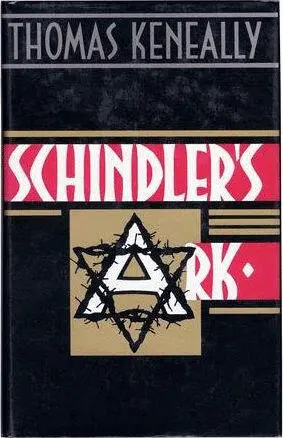
- Название:Schindler's Ark
- Автор:
- Издательство:Hodder and Stoughton
- Жанр:
- Год:1982
- Город:London
- ISBN:0-340-27838-2
- Рейтинг книги:4 / 5. Голосов: 1
-
Избранное:Добавить в избранное
- Отзывы:
-
Ваша оценка:
Schindler's Ark: краткое содержание, описание и аннотация
Предлагаем к чтению аннотацию, описание, краткое содержание или предисловие (зависит от того, что написал сам автор книги «Schindler's Ark»). Если вы не нашли необходимую информацию о книге — напишите в комментариях, мы постараемся отыскать её.
Schindler’s List
Working with the actual testimony of Schindler’s Jews, Thomas Keneally artfully depicts the courage and shrewdness of an unlikely savior, a man who is a flawed mixture of hedonism and decency and who, in the presence of unutterable evil, transcends the limits of his own humanity. From From
A mesmerizing novel based on the true story of Oskar Schindler, a German industralist who saved and succored more than 1000 Jews from the Nazis at enormous financial and emotional expense. How the German Oskar Schindler came to save more than one thousand Polish Jews during the Holocaust is one of the most fascinating stories of the century. Although millions are now learning about Schindler through Steven Spielberg’s recent Academy Award-winning film, his achievement first gained prominence with Keneally’s 1982 “facticious” novel (which is also the basis for the film). Keneally’s account is less melodramatic than the motion picture, and although he does not fully explain how a hedonistic German could have been so altered by the plight of the Jewish workers in his factory, he does make Schindler less enigmatic than the big-screen version. Ben Kingsley, one of the film's stars, reads in a calculatedly matter-of-fact tone, letting the story's power alone convey its complicated emotions. Highly recommended.
Michael Adams, Fairleigh Dickinson Univ. Lib., Madison, N.J.
Schindler's Ark — читать онлайн бесплатно полную книгу (весь текст) целиком
Ниже представлен текст книги, разбитый по страницам. Система сохранения места последней прочитанной страницы, позволяет с удобством читать онлайн бесплатно книгу «Schindler's Ark», без необходимости каждый раз заново искать на чём Вы остановились. Поставьте закладку, и сможете в любой момент перейти на страницу, на которой закончили чтение.
Интервал:
Закладка:
When Oskar heard about it, he knew he could have been there, buttering up some official.
It was the deliberate intent of Shimon and Gusta Dranger and their colleagues to run against the ancient pacifism of the ghetto, to convert it to universal rebellion. They bombed the SS’-ONLY Bagatella Cinema in Karmelicka Street. In the dark, Leni Riefenstahl flickered the promise of German womanhood to the wandering soldier frayed from performing the nation’s works in the barbarous ghetto or on the increasingly risky streets of Polish Cracow, and the next second a vast yellow spear of flame extinguished the sight.
The ZOB would in a few months sink patrol boats on the Vistula, fire-bomb sundry military garages throughout the city, arrange Passierscheins for people who were not supposed to have them, smuggle passport photographs out to centers where they could be used in the forging of Aryan papers, derail the elegant Army-only train that ran between Cracow and Bochnia, and get their underground newspaper into circulation. They would also arrange for two of OD Chief Spira’s lieutenants, Spitz and Forster, who had drawn up lists for the imprisonment of thousands, to walk into a Gestapo ambush. It was a variation of an old undergraduate trick. One of the underground, posing as an informer, made an appointment to meet the two policemen in a village near Cracow. At the same time, a separate supposed informer told the Gestapo that two leaders of the Jewish partisan movement could be found at a particular rendezvous point. Spitz and Forster were both mown down while running from the Gestapo.
Still, the style of resistance for the ghetto dwellers remained that of Artur Rosenzweig, who, when asked in June to make a list of thousands for deportation, had placed his own name, his wife’s, his daughter’s at the top.
Over in Zablocie, in the backyard of Emalia, Mr. Jereth and Oskar Schindler were pursuing their own species of resistance by planning a second barracks.
CHAPTER 17
An Austrian dentist named Sedlacek had now arrived in Cracow and was making wary enquiries about Schindler. He had come by train from Budapest and carried a list of possible Cracow contacts and, in a false-bottomed suitcase, a quantity of Occupation złoty, which, since Governor General Frank had abolished the major denominations of Polish money, took up an unconscionable space.
Though he pretended to be traveling on business, he was a courier for a Zionist rescue organization in Budapest.
Even in the autumn of 1942, the Zionists of Palestine, let alone the population of the world, knew nothing but rumors of what was happening in Europe. They had set up a bureau in Istanbul to gather hard information. From an apartment in the Beyoglu section of the city, three agents sent out postcards addressed to every Zionist body in German Europe. The postcards read: “Please let me know how you are. Eretz is longing for you.” Eretz meant the “land” and, to any Zionist, Israel. Each of the postcards was signed by one of the three, a girl named Sarka Mandelblatt, who had a convenient Turkish citizenship.
The postcards had gone into the void. No one answered. It meant that the addressees were in prison, or in the forest, or at labor in some camp, or in a ghetto, or dead. All the Zionists of Istanbul had was the ominous negative evidence of silence.
In the late autumn of 1942, they at last received one reply, a postcard with a view of the Belvaros of Budapest. The message on it read: “Encouraged by your interest in my situation. Rahamim maher [urgent help] is much needed. Please keep in touch.”
This reply had been composed by a Budapest jeweler named Samu Springmann, who’d first received and then puzzled out the message on Sarka Mandelblatt’s postcard. Samu was a slight man, jockey size, in the prime of his thirties. Since the age of thirteen, despite an inalienable probity, he had been oiling officials, doing favors for the diplomatic corps, bribing the heavy-handed Hungarian Secret Police. Now the Istanbul people let him know that they wanted to use him to pipe rescue money into the German empire and to transmit through them to the world some definite intelligence on what was happening to European Jewry.
In the German-allied Hungary of General Horthy, Samu Springmann and his Zionist colleagues were as bereft of solid news from beyond the Polish border as the people in Istanbul. But he began to recruit couriers who, for a percentage of the bag or else out of conviction, would be willing to penetrate the German territories. One of his couriers was a diamond dealer, Erich Popescu, an agent of the Hungarian Secret Police. Another was an underworld carpet smuggler, Bandi Grosz, who had also assisted the secret police, but who began to work for Springmann to expiate all the grief he had caused his late mother. A third was Rudi Schulz, an Austrian safecracker, an agent for the Gestapo Management Bureau in Stuttgart. Springmann had a gift for playing with double agents such as Popescu, Grosz, and Schulz, by touching their sentimentality, their greed, and, if any, their principles.
Some of his couriers were idealists, working from firm premises. Sedlacek, who asked after Herr Schindler in Cracow near the end of 1942, belonged to that species. He had a successful dental practice in Vienna and, in his mid-forties, did not need to lug false-bottomed suitcases into Poland. But here he was, with a list in his pocket, the list having come from Istanbul. And the second name on the list, Oskar’s!
It meant that someone—Itzhak Stern, the businessman Ginter, Dr. Alexander Biberstein—had forwarded Schindler’s name to the Zionists in Palestine. Without knowing it, Herr Schindler had been nominated for the post of righteous person.
Dr. Sedlacek had a friend in the Cracow garrison, a fellow Viennese, a patient he’d got to know in his practice. It was Major Franz Von Korab of the Wehrmacht. On his first evening in Cracow, the dentist met Major Von Korab at the Hotel Cracovia for a drink. Sedlacek had had a miserable day; had gone to the gray Vistula and looked across at Podgórze, the cold fortress of barbed wire and lofty gravestoned walls, a cloud of a special dimness above it this mean winter’s day, a sharper rain falling there beyond the fake eastern gate where even the policemen looked accursed. When it was time to go and meet Von Korab, he went gratefully.
In the suburbs of Vienna it had always been rumored that Von Korab had a Jewish grandmother. Patients would idly say so—in the Reich, genealogical gossip was as acceptable small talk as was the weather. People would seriously speculate over drinks whether it was true that Reinhard Heydrich’s grandmother had married a Jew named Suss. Once, against all good sense but for the sake of friendship, Von Korab had confessed to Sedlacek that the rumor was true in his case. This confession had been a gesture of trust, which it would now be safe to return. Sedlacek therefore asked the major about some of the people on the Istanbul list. To Schindler’s name, Von Korab responded with an indulgent laugh. He knew Herr Schindler, had dined with him. He was physically impressive, said the major, and made money hand over fist. He was much brighter than he pretended to be. I can call him right now and make an appointment, said Von Korab.
At ten the next morning they entered the Emalia office. Schindler accepted Sedlacek politely but watched Major Von Korab, measuring .his trust of the dentist. After a time Oskar warmed to the stranger, and the major excused himself and would not stay for morning coffee. “Very well,” said Sedlacek, when Von Korab was gone, “I’ll tell you exactly where I come from.”
He did not mention the money he had brought, nor the likelihood that in the future trusted contacts in Poland would be handed small fortunes in Jewish Joint Distribution Committee cash. What the dentist wanted to know, without any financial coloring, was what Herr Schindler knew and thought about the war against Jewry in Poland. Once Sedlacek had the question out, Schindler hesitated. In that second, Sedlacek expected a refusal. Schindler’s expanding workshop employed 550 Jews at the SS rental rate. The Armaments Inspectorate guaranteed a man like Schindler a continuity of rich contracts; the SS promised him, for no more than 7.50 Reichsmarks a day per person, a continuity of slaves. It should not be a surprise if he sat back in his padded leather chair and claimed ignorance.
Читать дальшеИнтервал:
Закладка:
Похожие книги на «Schindler's Ark»
Представляем Вашему вниманию похожие книги на «Schindler's Ark» списком для выбора. Мы отобрали схожую по названию и смыслу литературу в надежде предоставить читателям больше вариантов отыскать новые, интересные, ещё непрочитанные произведения.











Обсуждение, отзывы о книге «Schindler's Ark» и просто собственные мнения читателей. Оставьте ваши комментарии, напишите, что Вы думаете о произведении, его смысле или главных героях. Укажите что конкретно понравилось, а что нет, и почему Вы так считаете.