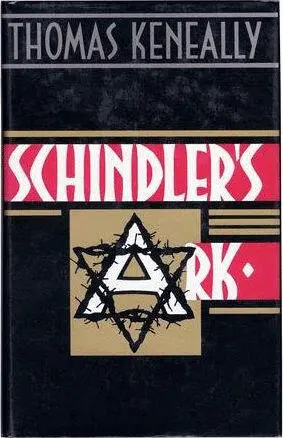
Thomas Keneally - Schindler's Ark
Здесь есть возможность читать онлайн «Thomas Keneally - Schindler's Ark» весь текст электронной книги совершенно бесплатно (целиком полную версию без сокращений). В некоторых случаях можно слушать аудио, скачать через торрент в формате fb2 и присутствует краткое содержание. Город: London, Год выпуска: 1982, ISBN: 1982, Издательство: Hodder and Stoughton, Жанр: Историческая проза, на английском языке. Описание произведения, (предисловие) а так же отзывы посетителей доступны на портале библиотеки ЛибКат.
- Название:Schindler's Ark
- Автор:
- Издательство:Hodder and Stoughton
- Жанр:
- Год:1982
- Город:London
- ISBN:0-340-27838-2
- Рейтинг книги:4 / 5. Голосов: 1
-
Избранное:Добавить в избранное
- Отзывы:
-
Ваша оценка:
Schindler's Ark: краткое содержание, описание и аннотация
Предлагаем к чтению аннотацию, описание, краткое содержание или предисловие (зависит от того, что написал сам автор книги «Schindler's Ark»). Если вы не нашли необходимую информацию о книге — напишите в комментариях, мы постараемся отыскать её.
Schindler’s List
Working with the actual testimony of Schindler’s Jews, Thomas Keneally artfully depicts the courage and shrewdness of an unlikely savior, a man who is a flawed mixture of hedonism and decency and who, in the presence of unutterable evil, transcends the limits of his own humanity. From From
A mesmerizing novel based on the true story of Oskar Schindler, a German industralist who saved and succored more than 1000 Jews from the Nazis at enormous financial and emotional expense. How the German Oskar Schindler came to save more than one thousand Polish Jews during the Holocaust is one of the most fascinating stories of the century. Although millions are now learning about Schindler through Steven Spielberg’s recent Academy Award-winning film, his achievement first gained prominence with Keneally’s 1982 “facticious” novel (which is also the basis for the film). Keneally’s account is less melodramatic than the motion picture, and although he does not fully explain how a hedonistic German could have been so altered by the plight of the Jewish workers in his factory, he does make Schindler less enigmatic than the big-screen version. Ben Kingsley, one of the film's stars, reads in a calculatedly matter-of-fact tone, letting the story's power alone convey its complicated emotions. Highly recommended.
Michael Adams, Fairleigh Dickinson Univ. Lib., Madison, N.J.
Schindler's Ark — читать онлайн бесплатно полную книгу (весь текст) целиком
Ниже представлен текст книги, разбитый по страницам. Система сохранения места последней прочитанной страницы, позволяет с удобством читать онлайн бесплатно книгу «Schindler's Ark», без необходимости каждый раз заново искать на чём Вы остановились. Поставьте закладку, и сможете в любой момент перейти на страницу, на которой закончили чтение.
Интервал:
Закладка:
He’d slept standing, wedged in the hole for fear of drowning there. At last he’d crawled out at night.
Somehow he’d walked out of Bełżec, following the railway tracks. Everyone understood that he had got out precisely because he was beyond reason. Likewise, he’d been cleaned by someone’s hand—a peasant woman’s, perhaps—and put into fresh clothes for his journey back to the starting point.
Even then there were people in Cracow who thought Bachner’s story a dangerous rumor.
Postcards had come to relatives from prisoners in Auschwitz. So if it was true of Bełżec, it couldn’t be true of Auschwitz. And was it credible? On the short emotional rations of the ghetto, one got by through sticking to the credible. The chambers of Bełżec, Schindler found out from his sources, had been completed by March of that year under the supervision of a Hamburg engineering firm and of SS engineers from Oranienburg. From Bachner’s testimony, it seemed that 3,000 killings a day were not beyond their capacity.
Crematoria were under construction, lest old-fashioned means of disposal of corpses put a brake on the new killing method. The same company involved in Bełżec had installed identical facilities at Sobibor, also in the Lublin district. Bids had been accepted, and construction was well advanced, for a similar installation at Treblinka, near Warsaw. And chambers and ovens were both in operation at the Auschwitz main camp and at the vast Auschwitz II camp a few kilometers away at Birkenau. The resistance claimed that 10,000 murders on a given day were within the capacity of Auschwitz II. Then, for the Łódź area, there was the camp at Chelmno, also equipped according to the new technology. To write these things now is to state the commonplaces of history. But to find them out in 1942, to have them break upon you from a June sky, was to suffer a fundamental shock, a derangement in that area of the brain in which stable ideas about humankind and its possibilities are kept. Throughout Europe that summer some millions of people, Oskar among them, and the ghetto dwellers of Cracow too, tortuously adjusted the economies of their souls to the idea of Bełżec or of like enclosures in the Polish forests. That summer also Schindler wound up the bankrupt estate of Rekord and, under the provisions of the Polish Commercial Court, acquired by a species of pro forma auction ownership of the property. Though the German armies were over the Don and on their way to the Caucasus oil fields, Oskar discerned by the evidence of what had happened in Krakusa Street that they could not finally succeed. Therefore it was a good season to legitimize to the limit his possession of the factory in Lipowa Street. He still hoped, in a way that was almost childlike and to which history would pay no regard, that the fall of the evil king would not bear away that legitimacy—that in the new era he would go on being Hans Schindler’s successful boy from Zwittau. Jereth of the box factory went on pressing him about building a hut—a refuge—on his patch of wasteland. Oskar got the necessary approvals from the bureaucrats. A rest area for the night shift was his story. He had the lumber for it—it had been donated by Jereth himself. When finished in the autumn, it seemed a slight and comfortless structure. The planking had that crate-wood greenness and looked as if it would shrink as it got darker, and let in the slanting snow. But during an Aktion in October it was a haven for Mr. and Mrs. Jereth, for the workers from the box factory and the radiator works, and for Oskar’s night shift.
The Oskar Schindler who comes down from his office on the frosty mornings of an Aktion to speak to the SS man, to the Ukrainian auxiliary, to the Blue Police, and to OD details who would have marched across from Podgórze to escort his night shift home; the Oskar Schindler who, drinking coffee, calls Wachtmeister Bosko’s office near the ghetto and tells some lie about why his night shift must stay in Lipowa Street this morning—that Oskar Schindler has endangered himself now beyond the limit of cautious business practice. The men of influence who have twice sprung him from prison cannot do it indefinitely even if he is generous to them on their birthdays. This year they are putting men of influence in Auschwitz. If they die there, their widows get a terse and unregretful telegram from the Commandant. “YOUR HUSBAND HAS DIED IN KONZENTRATIONSLAGER AUSCHWITZ.”
Bosko himself was lanky, thinner than Oskar. Gruff-voiced, and like him a German Czech. His family, like Oskar’s, was conservative and looked to the old Germanic values. He had, for a brief season, felt a pan-Germanic anticipation at the rise of Hitler, exactly the way Beethoven had felt a grand European fervor for Napoleon. In Vienna, where he had been studying theology, he’d joined the SS-partly as an alternative to conscription into the Wehrmacht, partly from an evanescent ardor. He regretted that ardor now and was, more fully than Oskar knew, expiating it. All that Oskar understood about him at the time was that he was always pleased to undermine an Aktion. His responsibility was the perimeter of the ghetto, and from his office beyond the walls he looked inward at the Aktion with a precise horror, for he, like Oskar, considered himself a potential witness. Oskar did not know that in the October Aktion, Bosko had smuggled some dozens of children out of the ghetto in cardboard boxes. Oskar did not know either that the Wachtmeister provided, ten at a time, general passes for the underground. The Jewish Combat Organization (Zob) was strong in Cracow. It was made up mainly of youth-club members, especially of members of Akiva—a club named after the legendary Rabbi Akiva ben Joseph, scholar of the Mishna. The ZOB was led by a married couple, Shimon and Gusta Dranger—her diary would become a classic of the Resistance—and by Dolek Liebeskind. Its members needed to pass freely into and out of the ghetto, for purposes of recruitment and to carry currency, forged documents, and copies of the underground newspaper. They had contacts with the left-wing Polish People’s Army, which was based in the forests around Cracow, and which also needed the documents Bosko provided. Bosko’s contacts with ZOB and the People’s Army were therefore sufficient to hang him; but still he secretly mocked and despised himself and had contempt for partial rescues. For Bosko wanted to save everyone, and would soon try to, and would perish because of it. Danka Dresner, cousin of red Genia, was fourteen years old and had by then outgrown the sure infantile instincts which had led her small relative safely out of the cordon in Plac Zgody. Though she had work as a cleaning woman at the Luftwaffe base, the truth was that by autumn any woman under fifteen or more than forty could be taken away to the camps anyhow. Therefore, on the morning an SS Sonderkommando and squads of Security Police rolled into Lwówska Street, Mrs. Dresner took Danka with her down to Dabrowski, to the house of a neighbor who had a false wall. The neighbor was a woman in her late thirties, a servant at the Gestapo mess near the Wawel, who could therefore expect some preferential treatment. But she had elderly parents who were automatic risks. So she had bricked up a 60-centimeter cavity for her parents, a costly project, since bricks had to be smuggled into the ghetto in barrows under heaps of legal goods—rags, firewood, disinfectant.
God knew what her bricked-up secret space had cost her—maybe 5,000 zł., maybe 10,000.
She’d mentioned it a number of times to Mrs. Dresner. If there was an Aktion, Mrs. Dresner could bring Danka and come herself. Therefore, on the morning Danka and Mrs. Dresner heard from around the corner of Dabrowski the startling noise, the bark of Dalmatians and Dobermans, the megaphoned roaring of Oberscharführers, they hurried to their friend’s place.
Читать дальшеИнтервал:
Закладка:
Похожие книги на «Schindler's Ark»
Представляем Вашему вниманию похожие книги на «Schindler's Ark» списком для выбора. Мы отобрали схожую по названию и смыслу литературу в надежде предоставить читателям больше вариантов отыскать новые, интересные, ещё непрочитанные произведения.






Обсуждение, отзывы о книге «Schindler's Ark» и просто собственные мнения читателей. Оставьте ваши комментарии, напишите, что Вы думаете о произведении, его смысле или главных героях. Укажите что конкретно понравилось, а что нет, и почему Вы так считаете.