Alix Christie - Gutenberg's Apprentice
Здесь есть возможность читать онлайн «Alix Christie - Gutenberg's Apprentice» весь текст электронной книги совершенно бесплатно (целиком полную версию без сокращений). В некоторых случаях можно слушать аудио, скачать через торрент в формате fb2 и присутствует краткое содержание. Год выпуска: 2014, Издательство: Harper, Жанр: Историческая проза, на английском языке. Описание произведения, (предисловие) а так же отзывы посетителей доступны на портале библиотеки ЛибКат.
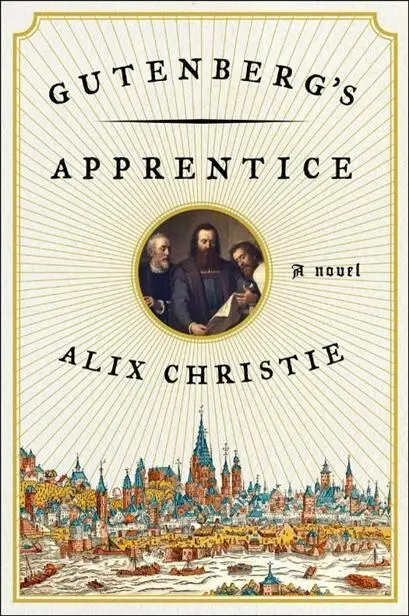
- Название:Gutenberg's Apprentice
- Автор:
- Издательство:Harper
- Жанр:
- Год:2014
- ISBN:нет данных
- Рейтинг книги:5 / 5. Голосов: 1
-
Избранное:Добавить в избранное
- Отзывы:
-
Ваша оценка:
Gutenberg's Apprentice: краткое содержание, описание и аннотация
Предлагаем к чтению аннотацию, описание, краткое содержание или предисловие (зависит от того, что написал сам автор книги «Gutenberg's Apprentice»). Если вы не нашли необходимую информацию о книге — напишите в комментариях, мы постараемся отыскать её.
Youthful, ambitious Peter Schoeffer is on the verge of professional success as a scribe in Paris when his foster father, wealthy merchant and bookseller Johann Fust, summons him home to corrupt, feud-plagued Mainz to meet “a most amazing man.”
Johann Gutenberg, a driven and caustic inventor, has devised a revolutionary — and to some, blasphemous — method of bookmaking: a machine he calls a printing press. Fust is financing Gutenberg’s workshop and he orders Peter, his adopted son, to become Gutenberg’s apprentice. Resentful at having to abandon a prestigious career as a scribe, Peter begins his education in the “darkest art.”
As his skill grows, so, too, does his admiration for Gutenberg and his dedication to their daring venture: copies of the Holy Bible. But mechanical difficulties and the crushing power of the Catholic Church threaten their work. As outside forces align against them, Peter finds himself torn between two father figures: the generous Fust, who saved him from poverty after his mother died; and the brilliant, mercurial Gutenberg, who inspires Peter to achieve his own mastery.
Caught between the genius and the merchant, the old ways and the new, Peter and the men he admires must work together to prevail against overwhelming obstacles — a battle that will change history. . and irrevocably transform them.
Gutenberg's Apprentice — читать онлайн бесплатно полную книгу (весь текст) целиком
Ниже представлен текст книги, разбитый по страницам. Система сохранения места последней прочитанной страницы, позволяет с удобством читать онлайн бесплатно книгу «Gutenberg's Apprentice», без необходимости каждый раз заново искать на чём Вы остановились. Поставьте закладку, и сможете в любой момент перейти на страницу, на которой закончили чтение.
Интервал:
Закладка:
“That wasn’t what he did.”
The abbot purses his pale lips. “Who knows? If he were here… but he is not, and it is left to us to scrutinize his motives. He had his reasons, certainly.”
In irritation Peter shakes his head.
“Everyone put pressure on him,” says Trithemius. “Especially your father.”
Peter hears the master’s roar: What will it take for you to grasp that there is no more gold?
“Sometimes the step that looks wrong in our sight is part of something larger.” Trithemius nods to himself. “As I learned here, three years ago. I did not choose this place — it chose me late one night when I was forced to find a shelter from a snowstorm.” He looks with meaning at the printer. “The ways of the Most High are cloaked in mystery. Not everything is as it seems.”
“You think he had a… nobler reason, then?”
Trithemius is softer now, more the confessor than the judge. “I only say our human sight is prone to error.”
To err is human, Peter thinks. He stands and goes to poke the fire. The coals are not as hot as those he banked to melt their metals. But even so his face feels warm. How many errors has he made along the way? He thinks of the mistakes in setting Genesis, of Mentelin’s calm words that helped him see he’d wronged a girl. For thirty years he’s stoked his pain and his resentment of the master, and for what? He mounds the glowing embers and then strikes them into flame, and for the first time feels a flicker of a doubt.
CHAPTER 3: MONDAY BEFORE THE TRANSLATION OF SAINT BENEDICT
[61.5 of 65 quires]
8 July 1454
THE LEADERS of the city council met ex camera , in the back room of Mompasilier. The better, Peter later thought, for Jakob to attack the battered tables with his fists and roar and goad the other council leaders into action. The chambers of the Rathaus were too crusted with the Elder wealth of years gone by: thick velour drapes and hammer vaulting, leaded glass that looked out on the Rhine. The back room of the guildhall smelled of woodsmoke and conspiracy and hate.
Molsberg was there, and Kraemer of the grocers’ guild; the lawyer Humery had given up all hope of freeing Mainz from Dietrich’s grip, and with that hope, his seat. While this was taking place, the world went on: the dyers dyed; the livestock lowed; the smiths sent up their sparks. Peter in his ignorance climbed to the ramparts in the early mornings, seeking strength to face the day. He had no notion of the movements in the mighty clockwork that whirred over Mainz, the back-and-forth of brute, uncaring forces. He only learned the hour had struck when one of Jakob’s boys fetched him to Mompasilier.
He ought to know the council’s action, Jakob told him, blue eyes bright. His uncle took a gulp and wiped his beard. The heavy seal on his finger glinted in the daylight, slicing through the dimness of the room. “Enough’s enough. We’ve waited long enough to cut this chain.” He made a chopping motion with his hand. “We’ve sent the sheriffs off for Rosenberg to stop him promulgating this indulgence. Even now the thing is done.”
“What thing?” asked Peter.
“Our vicar general has to learn to share.” Jakob’s smile was cruel. “Let’s see now who holds whom for ransom.”
The officers would seize Rosenberg as he was traveling on the archbishop’s business, he said underneath his breath. A cell beneath the Rathaus was prepared.
“Good God.” It was insane. “It’s madness.”
“Madness, no. Lucidity, at last. Force is the only language Dietrich understands.”
“He’ll go mad. It’s an affront.” The protests piled up on his tongue. “Not just to Dietrich but the pope. My God, it’s treason.”
“Treason! Ha! It’s freedom.” Jakob shoved the stein aside and pushed himself up onto his hands. “What’s a free city, otherwise?” He bent, a wild thing, pitched across the table. “What’s freedom, if not casting off the vassal’s noose? To get up off our knees and cry enough! You shall not beggar us for all eternity.”
His face was strange, alight with bloodlust. Horrified, Peter felt himself recoil. “You put us at his mercy, then. Each one of us in this whole city. God only knows what you’ll draw down.”
“We’ve starving farmers plenty with their cudgels, working men with tools gone months without a job. A band enough of angry men, and every manner of sharp weapon.” Peter saw the youths with pikes and axes on the Bleiche.
“This is your plan then — to provoke a war?” His father was still far away. The fastest horse and boat by now had barely reached him with the news of the indulgence. “The walls are rotted, indefensible.” Anna’s face flashed in his mind, and Grede’s, the children’s — the workshop, and their Bible. “You know what happened outside Strassburg.” Six months before, Erlenbach had besieged a nearby fortress town to starve its people out in punishment for insufficient taxes. Strassburg’s merchants, too, had been refused free transit through archdiocesan lands to sell their wares at Lenten Fair.
“For such an insolence in his cathedral city,” Peter hissed, “he’ll hit us even harder.”
“Meet force with force.” Jakob looked at him with scorn. “You always were too soft. Use force, I say; then you can talk.” He spat into the sawdust on the floor. “He ought to pay a portion of each cursed letter to the city. That’s all we ask. We have a right; we’re granting him the privilege of hawking his damned chits inside our walls.”
Peter did not even think of sharing this with Gutenberg. He’d learn it soon enough through his back channels. In Peter’s mind the information snaked like a black thread from Dietrich’s court into the waxy, intermediary ears of toadies in the Tiergarten, the Schreibhaus, friends from youth the master cultivated up at St. Viktor’s. In the event, it took less than a day. “To hell with your damned council,” were the first words from the master’s mouth at noontime the day after. “Those cretins have seized Rosenberg.”
How Peter wanted, then and there, to laugh. Instead he donned a look of shock. “What?” he said, but Gutenberg just growled, “For once when goddamned Fust could be of use.” He thrust his lips out, twisting at his beard. “I’ll have to pry the bugger out myself, the devil take them.” He thrust an arm at Peter. “You’ll come, to keep them straight.” He did not even pause to let him shed his apron. “Move, move!” he said, “we might still save it if we’re quick.”
Peter went as he was ordered. The days were past when he would let the man roll madly, muzzle blasting, out of sight. And yet the city council did not sit on this master’s pleasure, much to his irritation. The Rathaus halls were empty, and the chambers; only Molsberg sat there in his office, leafing through some papers and — as Gutenberg swept in — a second man, a third, both seated, backs toward the burst-open door. His uncle, and another councillor, the master miller Heyt. Surprise, on Jakob’s lean hard face, mutating swiftly into hate.
“Unhand the man,” the master said, advancing.
Molsberg, vast and bald, a pair of glasses on his nose, heaved up behind his desk. He wore the chain of the first Bürgermeister , a gleaming mass of gold upon his chest.
“You give no orders here.”
“This council has no right in law to interfere with matters of the archdiocese.”
“Nor do you represent the archbishop, as far as I’m aware.” The trader coolly looked at him through tiny squares of glass. “What is your business here?” Although their clans were bound by marriage, there wasn’t much love lost between them. Molsberg was a pragmatist, a calm, unhurried man, who though an Elder had no wish to quit the city and the woolen trade his ancestors had built.
Читать дальшеИнтервал:
Закладка:
Похожие книги на «Gutenberg's Apprentice»
Представляем Вашему вниманию похожие книги на «Gutenberg's Apprentice» списком для выбора. Мы отобрали схожую по названию и смыслу литературу в надежде предоставить читателям больше вариантов отыскать новые, интересные, ещё непрочитанные произведения.










Обсуждение, отзывы о книге «Gutenberg's Apprentice» и просто собственные мнения читателей. Оставьте ваши комментарии, напишите, что Вы думаете о произведении, его смысле или главных героях. Укажите что конкретно понравилось, а что нет, и почему Вы так считаете.