Alix Christie - Gutenberg's Apprentice
Здесь есть возможность читать онлайн «Alix Christie - Gutenberg's Apprentice» весь текст электронной книги совершенно бесплатно (целиком полную версию без сокращений). В некоторых случаях можно слушать аудио, скачать через торрент в формате fb2 и присутствует краткое содержание. Год выпуска: 2014, Издательство: Harper, Жанр: Историческая проза, на английском языке. Описание произведения, (предисловие) а так же отзывы посетителей доступны на портале библиотеки ЛибКат.
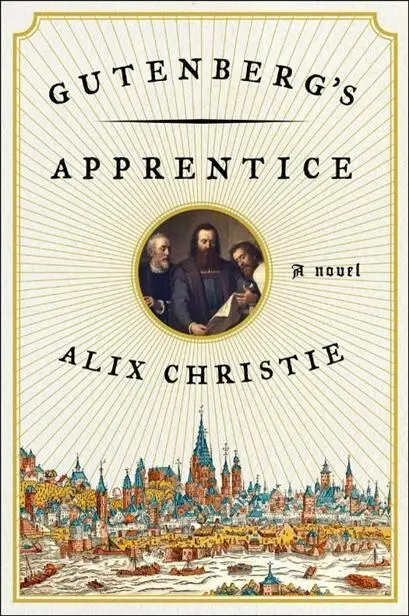
- Название:Gutenberg's Apprentice
- Автор:
- Издательство:Harper
- Жанр:
- Год:2014
- ISBN:нет данных
- Рейтинг книги:5 / 5. Голосов: 1
-
Избранное:Добавить в избранное
- Отзывы:
-
Ваша оценка:
Gutenberg's Apprentice: краткое содержание, описание и аннотация
Предлагаем к чтению аннотацию, описание, краткое содержание или предисловие (зависит от того, что написал сам автор книги «Gutenberg's Apprentice»). Если вы не нашли необходимую информацию о книге — напишите в комментариях, мы постараемся отыскать её.
Youthful, ambitious Peter Schoeffer is on the verge of professional success as a scribe in Paris when his foster father, wealthy merchant and bookseller Johann Fust, summons him home to corrupt, feud-plagued Mainz to meet “a most amazing man.”
Johann Gutenberg, a driven and caustic inventor, has devised a revolutionary — and to some, blasphemous — method of bookmaking: a machine he calls a printing press. Fust is financing Gutenberg’s workshop and he orders Peter, his adopted son, to become Gutenberg’s apprentice. Resentful at having to abandon a prestigious career as a scribe, Peter begins his education in the “darkest art.”
As his skill grows, so, too, does his admiration for Gutenberg and his dedication to their daring venture: copies of the Holy Bible. But mechanical difficulties and the crushing power of the Catholic Church threaten their work. As outside forces align against them, Peter finds himself torn between two father figures: the generous Fust, who saved him from poverty after his mother died; and the brilliant, mercurial Gutenberg, who inspires Peter to achieve his own mastery.
Caught between the genius and the merchant, the old ways and the new, Peter and the men he admires must work together to prevail against overwhelming obstacles — a battle that will change history. . and irrevocably transform them.
Gutenberg's Apprentice — читать онлайн бесплатно полную книгу (весь текст) целиком
Ниже представлен текст книги, разбитый по страницам. Система сохранения места последней прочитанной страницы, позволяет с удобством читать онлайн бесплатно книгу «Gutenberg's Apprentice», без необходимости каждый раз заново искать на чём Вы остановились. Поставьте закладку, и сможете в любой момент перейти на страницу, на которой закончили чтение.
Интервал:
Закладка:
Rapidly the master moved toward the desk. “My business is to bring you back to reason.”
“Reason!” Jakob shot up from his chair. “The nerve, to show your lying mug in here.”
It was as if the words, and he who spoke them, were mere vapor. Gutenberg did not break stride until he leaned and grasped the edge of Molsberg’s desk.
“His Grace will bring his hammer on you, hard. It’s folly, Reinhart, you must see. The damage still can be contained — if you’ll unloose him.”
“Too late,” said Molsberg.
“You should have thought of that before you brought the vipers in the nest,” came Jakob’s voice. He stood a bit behind and to the side, flashing like a blade — directing all his force toward this Elder who refused even to recognize his presence. “Look at me!” he bellowed, and the master turned, just very slightly, with a curving of his lips, the faintest sneer.
“You took protection from us, let us shield you — and for what? Where is the counterpart, I say? Where is the payoff for a year of silence?” Jakob stepped toward him.
The sigh was great, theatrical; the master glanced at Molsberg and was tempted, Peter knew, to roll his eyes. “The counterpart will come,” was all he said, “when we are done.”
“And Mainz again is pumped and half the proceeds land in your own pocket.” Jakob, bright with fury, took another step, his body thin and hard and flexed. “There will be something in it now, not later,” he said, his low voice thick with menace.
Molsberg was cleanly shaved, his chin the barest line of flesh above the lace that pinched his spreading neck. “Indeed.” His voice was steady. “Why should archbishops benefit, cathedral chapters, every grasping palm the whole way down, and Mainz should not?” He looked with meaning at his kinsman. “We have our interest too. It stands to reason, as you say.”
“This is no way—” the master started. The council president put up his hand.
“There is no other way. He refuses to pay tax, yet we are squeezed and squeezed, each time a little more.” The Elder trader shrugged. His face was utterly impassive. “He’ll take it any way he can, but this time he — and you — have gone too far. We have to take a stand.”
“Then let me speak to Rosenberg, at least,” said Gutenberg. “To try to — soften it, perhaps.”
Molsberg shook his head.
“Perhaps you’d like to join him,” Jakob said cuttingly. Gutenberg looked back, above him, through him, toward the goldsmith’s nephew, standing silent at the door.
“As you wish.” His head swung back; his face was ugly, and his words. “You choose to lie with thugs. That is your choice. The rest is on your head.”
For years afterward, Peter wondered just how word of Gutenberg’s appearance in that chamber got back to the archbishop. The city knew reprisal would be swift, but even so the reason Dietrich chose the course he took was never all that clear.
What had angered the archbishop most? The fact that he didn’t even get a chance to promulgate his new indulgence, before those trumped-up laborers of Mainz had dragged it through the muck? Or fear those curs might get their mitts on his new secret toy — this printing press that now appeared a most efficient means of minting gold?
Whichever it had been, he did not hammer with blunt force — with excommunication, or with troops — as he had done four years before. He struck more surgically, and grabbed the things that had real value in his eyes: the master’s press, still at the Hof zum Gutenberg — and then the master, too, drinking with his peers one evening at the Tiergarten.
How Gutenberg must have been furious — embarrassed too, to look up suddenly and see those soldiers, and then feel the rough cold metal of their gauntlets. Peter could not quite imagine it. He’d not have made a scene, not there: he would have stalked out, haughty, dark eyes glittering with rage. They’d taken him into the Little Court; once more, as if in a recurring nightmare, Peter learned this through a pounding at the workshop door.
Lorenz reached toward him, trembling and bewildered. Peter had to find the master, the old servant said. He had to find a way to make it right. The old press had been taken, piece by piece. Peter looked around him at his cranking presses and those sweating acolytes. Mentelin went past him, bearing a full tray before him like a chalice. Inside a week, the world had been turned upside down. Yet if he went, what was the chance that Peter too were seized, and all of this left undefended? The men were gathering by Mentelin and Hans; he heard them indistinctly muttering.
Only as it fell to pieces did he understand how much that brotherhood had sheltered and sustained him. The shop had been as much a cloister as the workshop of a guild. They had their rites, their prayers that shifted with the seasons. Freeze not, melt not, dry not: ink and metal, vellum and paper, bending to their wills. They had depended on each other, and for years the thing had held. Until first one, and then the next, had snapped the links that bound them. He thought of Thomas and his doubt, of Judas Iscariot. What brotherhood could hold, once faith and trust were lost?
Four weeks remained until Autumn Fair: the letters of Saint Paul, Saint James, Saint John, the blinding vision of Revelation. Hans had already started setting that last book. How fitting, thought their foreman bitterly. Yet Peter could not falter. He made a sign to Mentelin. As he came toward him, Peter thought of all those gentle souls whose lives depended more than ever on the men of Mainz, of little Tina, Henchin, Grede, and Anna. What words of comfort might she give him now?
“I have to go and see what’s to be seen,” he said in a low voice. “If I am taken, you must see it through.” He’d had a letter from his father, too; thank Heaven, Fust would soon be home.
“Don’t go alone.” Mentelin gripped his forearm. “Take muscle, if you must.”
“I can’t just leave him there,” said Peter with the palest smile, “though I am sorely tempted.”
Mentelin flashed a brief grin and went back toward his stool.
He’d have to go to Jakob and demand an escort. His uncle’d say, most likely, he should let the bugger rot. Two pawns, each rotting in his separate cell — how clever, Peter would be tempted to respond. Force — then impasse — this was your intent? It isn’t anything to you, Jakob would sneer. Ah, but. If Mainz expected things to move, Gutenberg would have to talk to the archbishop. Someone would have to talk to the inventor and persuade him that there was no other way. And you know as well as I, Peter would have to tell his uncle: Johann Gensfleisch, known as Gutenberg, will never talk to you.
Even in broad daylight the deacon of St. Martin’s kept the torches burning at the Little Court. Pale ghostly flames hung from each column lining the long cloister. Dietrich von Erbach’s representative in Mainz, Konrad von Greifenklau, could not receive the delegation, Peter and the pair of city wardens were informed. The porter eyed their hauberks and their belted swords.
“Wait here,” he said, and scuttled down the vaulted hallway. The marble arches rhymed its length like giant ribs, the ribs of a leviathan, inhaling all who entered there. The walls seemed to narrow as they vanished, glittering with a wealth so concentrated that the senses reeled. Colors burst from endless tapestries; oil paintings glimmered in their gilded frames. He’d always known the first spoils of the ships that docked in Mainz were theirs to take, but never had Peter seen them all displayed.
Father van Holzhausen would agree to hear their errand. The porter blocked the wardens’ path. “The weapons you must leave,” he said. “You have no jurisdiction here.” Curtly Peter nodded, and the wardens, frowning, dropped their belts. Before they knocked he had instructed them to hug close to his heels if this transpired. He’d take no chances; seizure already had bred seizure, one rough deed engendering the next. The tension in the city was extreme.
Читать дальшеИнтервал:
Закладка:
Похожие книги на «Gutenberg's Apprentice»
Представляем Вашему вниманию похожие книги на «Gutenberg's Apprentice» списком для выбора. Мы отобрали схожую по названию и смыслу литературу в надежде предоставить читателям больше вариантов отыскать новые, интересные, ещё непрочитанные произведения.











Обсуждение, отзывы о книге «Gutenberg's Apprentice» и просто собственные мнения читателей. Оставьте ваши комментарии, напишите, что Вы думаете о произведении, его смысле или главных героях. Укажите что конкретно понравилось, а что нет, и почему Вы так считаете.