Alix Christie - Gutenberg's Apprentice
Здесь есть возможность читать онлайн «Alix Christie - Gutenberg's Apprentice» весь текст электронной книги совершенно бесплатно (целиком полную версию без сокращений). В некоторых случаях можно слушать аудио, скачать через торрент в формате fb2 и присутствует краткое содержание. Год выпуска: 2014, Издательство: Harper, Жанр: Историческая проза, на английском языке. Описание произведения, (предисловие) а так же отзывы посетителей доступны на портале библиотеки ЛибКат.
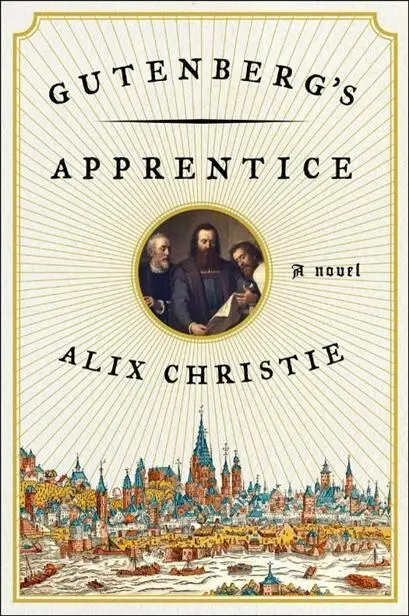
- Название:Gutenberg's Apprentice
- Автор:
- Издательство:Harper
- Жанр:
- Год:2014
- ISBN:нет данных
- Рейтинг книги:5 / 5. Голосов: 1
-
Избранное:Добавить в избранное
- Отзывы:
-
Ваша оценка:
Gutenberg's Apprentice: краткое содержание, описание и аннотация
Предлагаем к чтению аннотацию, описание, краткое содержание или предисловие (зависит от того, что написал сам автор книги «Gutenberg's Apprentice»). Если вы не нашли необходимую информацию о книге — напишите в комментариях, мы постараемся отыскать её.
Youthful, ambitious Peter Schoeffer is on the verge of professional success as a scribe in Paris when his foster father, wealthy merchant and bookseller Johann Fust, summons him home to corrupt, feud-plagued Mainz to meet “a most amazing man.”
Johann Gutenberg, a driven and caustic inventor, has devised a revolutionary — and to some, blasphemous — method of bookmaking: a machine he calls a printing press. Fust is financing Gutenberg’s workshop and he orders Peter, his adopted son, to become Gutenberg’s apprentice. Resentful at having to abandon a prestigious career as a scribe, Peter begins his education in the “darkest art.”
As his skill grows, so, too, does his admiration for Gutenberg and his dedication to their daring venture: copies of the Holy Bible. But mechanical difficulties and the crushing power of the Catholic Church threaten their work. As outside forces align against them, Peter finds himself torn between two father figures: the generous Fust, who saved him from poverty after his mother died; and the brilliant, mercurial Gutenberg, who inspires Peter to achieve his own mastery.
Caught between the genius and the merchant, the old ways and the new, Peter and the men he admires must work together to prevail against overwhelming obstacles — a battle that will change history. . and irrevocably transform them.
Gutenberg's Apprentice — читать онлайн бесплатно полную книгу (весь текст) целиком
Ниже представлен текст книги, разбитый по страницам. Система сохранения места последней прочитанной страницы, позволяет с удобством читать онлайн бесплатно книгу «Gutenberg's Apprentice», без необходимости каждый раз заново искать на чём Вы остановились. Поставьте закладку, и сможете в любой момент перейти на страницу, на которой закончили чтение.
Интервал:
Закладка:
Peter stared at him. Since Christmas he had lived in fear, expecting any moment that the soldiers would return. But now, with a sick twisting in his gut, he understood. The man had known what he was doing all along — had known since Erlenbach had let him go. He’d traded that indulgence for his freedom. And even so he hadn’t had the decency to tell them — he’d simply let them writhe.
“I need Keffer’s press to proof the psalter,” Peter said stiffly.
The master, irritated, shook his head. “Proof it with soot.”
Only the Book, and all the love that he’d poured into it, restrained his rage. Peter felt the blood pound in his ears and face. That psalter type was his — a thing far finer than this cretin ever made with his own hands. The crowning piece of all he’d learned and done, by God, the measure of his mastery, his Meisterstück . He felt his fury flame, consume the love that he’d once felt and leave it in a smoking pile. To think he’d even toyed with showing him what he had tinkered at these recent weeks, the way he’d found to further their technique. He’d burned to take it to him, as he’d always done, the way a cat will drop its catch before its master’s feet. A harder matrix, forged with a new alloy he had found, which he had thought might well work by itself in some device that cast one letter at a time. For Gutenberg was still the only one — save Hans — who had the wit to understand.
Instead the willful Gensfleisch waved his hand. Dismissively he flapped it before reaching in a pocket of his apron.
“ This is the proof,” he said, and thrust a paper toward Peter. “The real proof — of all my press can do.”
Peter saw the letters — new ones, tiny, smoke proofs of that alphabet that Hans indeed had cut behind his back. Half the size of their black Gothic, a bastarda , truly.
“For chancelleries and city councils, letters and decrees.” The look upon the master’s face could only be described as triumph. And in his eyes, thought Peter Schoeffer, the clearest and most naked greed.
“The matrices are struck. I need two men to cast and file.”
Peter looked into those wolflike eyes. “So you don’t care if we are finished by the fair.”
“War is coming.” Pompously, portentously, the master shrugged. “The archbishop needs three thousand by next month. His will be done.”
Peter understood then Gutenberg’s ambition, his design. He meant to use it as a cudgel, turn the press into a weapon made of metal — just like the cannon Mehmet II had wrested from the bowels of the earth.
CHAPTER 2: SPONHEIM ABBEY
February 1486
ALETTER OF INDULGENCE, of itself, is not a loathsome thing. Grede used to buy them, Anna too.
Speaking her name stops Peter for a moment. His lovely little wife. He lost her far too soon, along with their first child. His second wife, Christina, is the mother of his sons. And she too buys indulgences: she puts the shillings in the brass collection box, whenever functionaries of the church alight like crows at the four corners of the market square. She takes each printed form — on which the priest has filled in the blanks with her name and date — and folds it carefully away. All Christians hope to ease the burden of their sins, and pay such fines in counterpart for God’s forgiveness.
“The problem was, he made the thing in secret, for the enemy,” says Peter now, returning to the abbot. “There was no other way to see it but betrayal — not just of me, and of my father, but of the guilds who’d given cover to the workshop.”
The letter issued by the pope that year was of the highest kind: a plenary indulgence granting full remission of all sin. This was no normal letter of indulgence, good for ten days, sometimes thirty. It cleansed the sinner’s soul in perpetuity: there was no limit to it; heaven’s gate stood open. It fetched the highest price and thus was a fat prize for all who had a hand in seeing to its distribution. Few argued with the underlying need, says Peter now: all knew it was a measure of the desperation of the Holy See to raise the funds for the Crusade.
“But naturally the guilds felt burned,” he tells the abbot. “After the master’s promises that Mainz — not the archbishop — would reap the benefit of this new press.”
Trithemius nods thoughtfully. “What was the fee?”
“Two guilders per.”
A flutter parts the abbot’s lips. “Did many citizens of Mainz have that?”
“Precisely what my uncle asked.” One final fleecing of the poor, Jakob had called it. “But still you must imagine,” Peter says, “the terror that the people felt. God’s wrath was kindled and their only hope was to deflect his ire. Repel the Turk! They heard it daily from the pulpits and the hawkers, saw the Elders buying left and right, and tried to do the same.”
The man the pope had charged with the collection in the German lands was one Paulinus Chappe. His territory stretched from Basel to Cologne. “The archbishops of the Rhine, as you recall, refused more tithes to fund the church or, more specifically, the kaiser’s coronation.” So the pope annulled the tithe, ordering instead this vast collect — which anyone who handled got a piece of, from Paulinus to archbishops and then bishops and the heads of the cathedral chapters and the monasteries charged with sending priests and monks to sell the letters in the villages and towns.
“And the producers, too, I guess.” The abbot cocks his head. “The scribes who wrote them — or the printer?”
“Correct.”
The abbot looks long at him, thinking.
“Meanwhile things in Mainz had never been so bad. The river trade was dead, except a little barter with our cloth and wine. The tradesmen barely fed themselves — and yet the church brought all that pressure down to bear. Two guilders — in a good year you might earn it in a month, but not then.” Peter understood now why the council had gone mad. “They squeezed it out of those who least could pay — the whole while knowing less than half of it had any chance of reaching Rome.”
The abbot nods. “’Twas ever thus.”
“I think what rankles me the most,” says Peter softly, “was how the clergy all exploited people’s fear, yet never in their hearts believed in the Crusade.”
“It is a mystery.” The abbot nods. How thirty years can pass and the red tide of Islam lap, while the whole time the One True Church sits on its hands. “So you will understand, perhaps, why I am… skeptical… that we can do much more than wait, and straighten our own house.” Trithemius lets out a sigh and cites Saint Mark:
Watch ye, therefore [for you know not when the lord of the house cometh, at even, or at midnight, or at the cock crowing or in the morning]: Lest coming on a sudden he find you sleeping. And what I say to you I say to all: Watch.
“Now.” The abbot straightens and claps. The acolyte arrives with wood and wine. “You say that Gutenberg had known of this indulgence months before.”
“He must have, and as early as the turning of the year.” Saying it aloud only enrages him anew. “He must have made a deal with Dietrich when they hauled him off over that prophecy. That’s why they let him go. He bought them off with what the diocese could skim from that indulgence.”
Trithemius is looking fixedly at Peter, round-eyed as an owl. Quietly he says, “There is another explanation, though.” He tilts his head so slowly, with a look of such assessment, Peter half expects to see him turn his head around.
“You too have printed many letters of indulgence, I assume?”
“I have.”
“So you yourself are quite aware of the… accommodations… one must sometimes make with power.”
Читать дальшеИнтервал:
Закладка:
Похожие книги на «Gutenberg's Apprentice»
Представляем Вашему вниманию похожие книги на «Gutenberg's Apprentice» списком для выбора. Мы отобрали схожую по названию и смыслу литературу в надежде предоставить читателям больше вариантов отыскать новые, интересные, ещё непрочитанные произведения.





Обсуждение, отзывы о книге «Gutenberg's Apprentice» и просто собственные мнения читателей. Оставьте ваши комментарии, напишите, что Вы думаете о произведении, его смысле или главных героях. Укажите что конкретно понравилось, а что нет, и почему Вы так считаете.