Alix Christie - Gutenberg's Apprentice
Здесь есть возможность читать онлайн «Alix Christie - Gutenberg's Apprentice» весь текст электронной книги совершенно бесплатно (целиком полную версию без сокращений). В некоторых случаях можно слушать аудио, скачать через торрент в формате fb2 и присутствует краткое содержание. Год выпуска: 2014, Издательство: Harper, Жанр: Историческая проза, на английском языке. Описание произведения, (предисловие) а так же отзывы посетителей доступны на портале библиотеки ЛибКат.
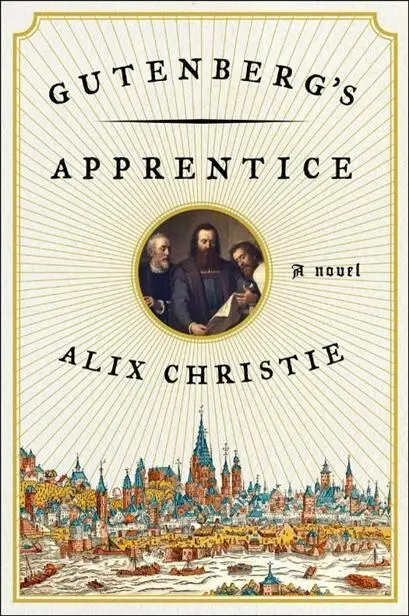
- Название:Gutenberg's Apprentice
- Автор:
- Издательство:Harper
- Жанр:
- Год:2014
- ISBN:нет данных
- Рейтинг книги:5 / 5. Голосов: 1
-
Избранное:Добавить в избранное
- Отзывы:
-
Ваша оценка:
Gutenberg's Apprentice: краткое содержание, описание и аннотация
Предлагаем к чтению аннотацию, описание, краткое содержание или предисловие (зависит от того, что написал сам автор книги «Gutenberg's Apprentice»). Если вы не нашли необходимую информацию о книге — напишите в комментариях, мы постараемся отыскать её.
Youthful, ambitious Peter Schoeffer is on the verge of professional success as a scribe in Paris when his foster father, wealthy merchant and bookseller Johann Fust, summons him home to corrupt, feud-plagued Mainz to meet “a most amazing man.”
Johann Gutenberg, a driven and caustic inventor, has devised a revolutionary — and to some, blasphemous — method of bookmaking: a machine he calls a printing press. Fust is financing Gutenberg’s workshop and he orders Peter, his adopted son, to become Gutenberg’s apprentice. Resentful at having to abandon a prestigious career as a scribe, Peter begins his education in the “darkest art.”
As his skill grows, so, too, does his admiration for Gutenberg and his dedication to their daring venture: copies of the Holy Bible. But mechanical difficulties and the crushing power of the Catholic Church threaten their work. As outside forces align against them, Peter finds himself torn between two father figures: the generous Fust, who saved him from poverty after his mother died; and the brilliant, mercurial Gutenberg, who inspires Peter to achieve his own mastery.
Caught between the genius and the merchant, the old ways and the new, Peter and the men he admires must work together to prevail against overwhelming obstacles — a battle that will change history. . and irrevocably transform them.
Gutenberg's Apprentice — читать онлайн бесплатно полную книгу (весь текст) целиком
Ниже представлен текст книги, разбитый по страницам. Система сохранения места последней прочитанной страницы, позволяет с удобством читать онлайн бесплатно книгу «Gutenberg's Apprentice», без необходимости каждый раз заново искать на чём Вы остановились. Поставьте закладку, и сможете в любой момент перейти на страницу, на которой закончили чтение.
Интервал:
Закладка:
And if thine eye scandalize thee , said Saint Matthew, pluck it out.
He dropped his pen and raised the sheet up to the window to check the lines impressed on either side, laid back-to-back, entwined like lovers one atop another in the summer light. He rubbed his fingers lightly, felt the sweet, strong bite of deep-pressed type. And yes, Lord, he was proud.
“Perhaps the Book wills its own end,” Mentelin had told him, months ago. Peter bowed his head and crossed himself. Lord, make it so .
He stayed that night back at his father’s house in his old upstairs room. He could not sleep among them, as he did from time to time, twisting and turning as they snored. And even so he did not sleep; at four he stood and dressed. The air was warm before the sun had even peeked above the eastern hills. The summer heat was full upon them; he’d have to shift the work now to the night, as they had done the last two years. Silently he came into the workshop, well before the shop boys started stirring. He thought of other mornings long ago, when he had been the one to stoke the forge and sweep the floor. By five the crew would wake and clatter down the stairs.
Noiselessly he padded to the workbench by the great brick oven and sifted through the tools. Hans’s chisels and small pack of awls were nowhere to be seen. The ores were as they ought to be, the paper too. They hadn’t yet begun the casting or the printing then — if they had indeed cut a new small alphabet. In the night he’d tried to tell himself that this was only Heilant’s bitter jibing. There was no proof that Dietrich had not turned, as always, to the scribes: Rosenberg, his vicar, could have ordered half the clerks in the archdiocese. There was a sound like drumbeats as the workers’ feet began to pound the stairs. In the composing room, Peter took his apron from its hook and put on the cotton cap that held the hair out of his eyes. Wearily he bent his head to set his page, part of the letter from Saint James to the twelve tribes.
Hans grunted his hello and took his stick and started setting. Mentelin slid in between them and said cheerfully they’d better work at double time today. Peter stared at him, confused, and then remembered: it was the feast of John the Baptist; he’d given them all half a day. “Right,” he said.
“Though by the looks of it you’re better off in bed — alone,” his friend said, smiling. The three young setters grinned, and Peter forced a smile. Still, it warmed him that someone had noticed. Was this true friendship, then? Of that whole crew, the Strassburg scribe had always understood his calling and his burden. Sidelong, Peter stole a glance at Hans. His scarred brown head was bent, cheeks hollowed as he muttered every word; he did not look to right or left. Once, Peter thought with bitterness, they had been friends.
For three full hours they all sat silent, dropping letters in their sticks. The tower clock struck eight, and Peter read this line: “‘Detract not one another, my brethren. He that detracteth his brother, or he that judgeth his brother, detracteth the law.’” His palms grew slick. He sat a moment, thinking, then abruptly set his stick down. He stood and touched Hans’s back. “If I might have a word.”
Hans blinked and stopped, and followed him out into daylight.
“If there is something you’re not saying”—Peter looked upon his gnarled and weathered face—“I think I have a right to know.”
Hans sighed and scratched his pate, looked everywhere but into his eyes. “I’m not to say.” Discomfort pinched his mouth.
Everything that had joined them seemed to drain away — just like the grains in that old glass that Hans and Konrad used to turn to time their idiotic games.
“It has no bearing on the book.” Hans licked his lips; his mottled irises were ringed a milky blue. “It wouldn’t hurt or hinder, Henne swore.”
The old smith’s look was mournful as a hound. Peter did not answer. Let every man be swift to hear, but slow to speak and slow to anger . The words were sitting in his type stick. He turned and walked back in.
All three presses were in motion: strong arms pumping, platens crashing, sheets of paper rising, falling. The pressmen sweated as they grunted, dancing in a fluid pattern as they stepped away to let the beaters ink the formes . The pace had punished all of them: Peter saw it in their cheeks and eyes. Each one of them yearned for the Sabbath, not just to praise the Lord. All twelve were broken in now, like leather straps. They longed to put this book behind them — although he knew the next one would be just as big, and harder still.
How far they’d come from those first shaky pulls on the bar. Now even Neumeister had reached consistent speed. When all was humming to the spheres, his crew cranked out twelve hundred pages in a day. There stirred in him a feeling of tremendous love and pride, knifed through with all the bitterness of this betrayal. They were a new, amazing brotherhood: a guild free of all rules. A priesthood, secret and disruptive as the early Christians. Though he was charged to lead them, Peter knew this was a lie. They led themselves — and therein lay the miracle. Each man there was the master of himself. Each had his skill, invented on the fly, his part to play in this great passion. The craftsmen in the shops of Mainz could only dream of working as such independent men.
Or so for months he’d thought. But now he understood the price. They stood alone, exposed, entirely at the mercy of the powers ranged above them. It wasn’t just this book that Gutenberg and Hans had betrayed, but their whole status as free, thinking men — this precious gift that in the working of the Bible they’d been granted.
The bastard kept him dangling until after noon. Every passing hour just reinforced the truth: Peter was the coachman, nothing more — his job to lash the team and scoop the droppings. He let the men go as he’d promised, sending the shop boys to stow the ink in crocks in the dark basement of his father’s house. Each season brought its lesson, he thought, tensing at the slap of that sharp tread. The year before, they had not had that cooling thought.
“I hear the cat is out,” the master said without preamble. So Hans had met him on the stairs. He must have hoped his shamefaced smile conveyed sincerity.
“So it is true.”
“Damned nuisance. But it can’t be helped.” He splayed those pity-me hands and shook his head.
“I guess you waited until your partner was away.”
A sharpness started in the master’s face, spread down his neck, his arms, a molten thing that hardened as it cooled. “You have no notion,” he said, “of the things I have to juggle.”
Nor you, thought Peter acidly. “I know full well how much is left to do.”
Gutenberg strode to the chart, which he had taken from the dining hall and put back near his desk. “You think that you’re the only one who checks?”
His fingers jabbed the columns — Peter’s first, then Hans’s. “Two weeks, three at the most,” he growled. His fingers crooked above the other setters: “Here too, except for this.” His finger hovered over Mentelin’s, whose final quire lurched past the others like a hayrick dangling from a cliff. “Another week for that.”
“Then three more weeks for the resetting,” said Peter grimly.
“Two presses will suffice.” The bastard didn’t even turn to look him in the eye. “I’ll use Keffer’s for the letter.”
“And hand the keys to Erlenbach.” What did he think? That Dietrich’s minions would just trust him, leave him to it, without checking that the order went as planned? The thought of all those toadies in the workshop made him want to retch.
“Don’t speak of what you do not know.”
Читать дальшеИнтервал:
Закладка:
Похожие книги на «Gutenberg's Apprentice»
Представляем Вашему вниманию похожие книги на «Gutenberg's Apprentice» списком для выбора. Мы отобрали схожую по названию и смыслу литературу в надежде предоставить читателям больше вариантов отыскать новые, интересные, ещё непрочитанные произведения.











Обсуждение, отзывы о книге «Gutenberg's Apprentice» и просто собственные мнения читателей. Оставьте ваши комментарии, напишите, что Вы думаете о произведении, его смысле или главных героях. Укажите что конкретно понравилось, а что нет, и почему Вы так считаете.