Alix Christie - Gutenberg's Apprentice
Здесь есть возможность читать онлайн «Alix Christie - Gutenberg's Apprentice» весь текст электронной книги совершенно бесплатно (целиком полную версию без сокращений). В некоторых случаях можно слушать аудио, скачать через торрент в формате fb2 и присутствует краткое содержание. Год выпуска: 2014, Издательство: Harper, Жанр: Историческая проза, на английском языке. Описание произведения, (предисловие) а так же отзывы посетителей доступны на портале библиотеки ЛибКат.
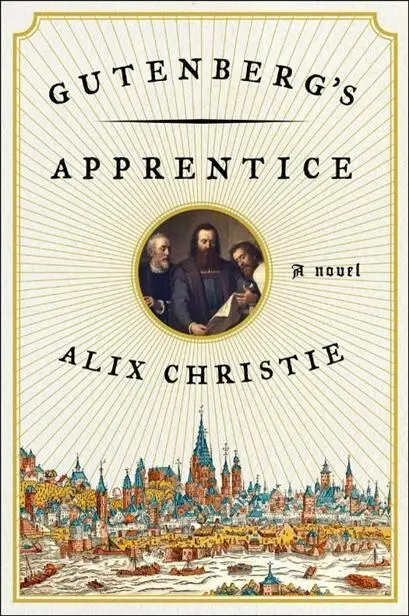
- Название:Gutenberg's Apprentice
- Автор:
- Издательство:Harper
- Жанр:
- Год:2014
- ISBN:нет данных
- Рейтинг книги:5 / 5. Голосов: 1
-
Избранное:Добавить в избранное
- Отзывы:
-
Ваша оценка:
Gutenberg's Apprentice: краткое содержание, описание и аннотация
Предлагаем к чтению аннотацию, описание, краткое содержание или предисловие (зависит от того, что написал сам автор книги «Gutenberg's Apprentice»). Если вы не нашли необходимую информацию о книге — напишите в комментариях, мы постараемся отыскать её.
Youthful, ambitious Peter Schoeffer is on the verge of professional success as a scribe in Paris when his foster father, wealthy merchant and bookseller Johann Fust, summons him home to corrupt, feud-plagued Mainz to meet “a most amazing man.”
Johann Gutenberg, a driven and caustic inventor, has devised a revolutionary — and to some, blasphemous — method of bookmaking: a machine he calls a printing press. Fust is financing Gutenberg’s workshop and he orders Peter, his adopted son, to become Gutenberg’s apprentice. Resentful at having to abandon a prestigious career as a scribe, Peter begins his education in the “darkest art.”
As his skill grows, so, too, does his admiration for Gutenberg and his dedication to their daring venture: copies of the Holy Bible. But mechanical difficulties and the crushing power of the Catholic Church threaten their work. As outside forces align against them, Peter finds himself torn between two father figures: the generous Fust, who saved him from poverty after his mother died; and the brilliant, mercurial Gutenberg, who inspires Peter to achieve his own mastery.
Caught between the genius and the merchant, the old ways and the new, Peter and the men he admires must work together to prevail against overwhelming obstacles — a battle that will change history. . and irrevocably transform them.
Gutenberg's Apprentice — читать онлайн бесплатно полную книгу (весь текст) целиком
Ниже представлен текст книги, разбитый по страницам. Система сохранения места последней прочитанной страницы, позволяет с удобством читать онлайн бесплатно книгу «Gutenberg's Apprentice», без необходимости каждый раз заново искать на чём Вы остановились. Поставьте закладку, и сможете в любой момент перейти на страницу, на которой закончили чтение.
Интервал:
Закладка:
“So you do have a light you hide.” He winked and bowed, hands clasped before his ample waist, at Anna. “The honor is all mine.”
“Petrus Heilant, Anna Pinzler,” Peter said. “Confessor here, and once a fellow scribe.” He dwelt an instant on the “once.” Heilant had tucked up his summer habit in his belt, exposing a white tunic. He had been resting, it would seem, among the apple trees in that extensive orchard.
Anna bent her head devoutly.
“What brings you up this high?” Heilant, hands laced, gave him a wry smile. He meant the word in every sense, undoubtedly. How quickly men put on the manners of their stations: he too, no less than Heilant.
“Saint Bildnis knew to choose the finest view,” he answered. “One dear to every child of Mainz.”
“Indeed,” said Heilant.
“I don’t imagine you’ll enjoy it long though — will you?” Laconically he needled him. He had no doubt the monk had fingered them to his superiors. Yet he felt calm, almost relieved: the word was out, yet they had dodged the worst. “There is a parish in your future, I am certain,” he told Heilant almost gaily.
“Perhaps.” Heilant looked strangely at him. “Some of us must do as we are told.”
“I am no freer.”
“Oh, no?” Heilant cocked one eyebrow. “You do quite well there, in your little workshop.”
Anna glanced between them, sensing all that was unsaid, and Peter squeezed her hand.
“I mind my business,” he said softly. The world would know at last. In six more weeks the truth of what they did would dazzle the whole Rhineland.
“Quite lucrative, that business.” Heilant’s voice was odious.
Sharply Peter said, “You’ve done enough. Leave it alone.”
“Unless”—the full lips lifted in a taunting smile—“you’re not apprised — have not been cut in on the latest?” The man was like a snake, coiled up and waiting on the sunbaked road. Peter shook his head and tasted bile; he tucked his love’s hand in his arm and turned to go.
“I would have thought, since you know all, that you had heard about the Frankfurt order.” The scribe was smiling widely now, his eyes glittering with triumph.
“What order?” Anna asked, when Peter gripped her arm.
“A full indulgence from the pope. For the Crusade. He ordered some ten thousand. I’m surprised you haven’t heard.”
“To fund an army,” Anna whispered. Heilant nodded; Peter felt her fear.
The stock phrase issued like a tapeworm from inside: “He’ll need an army, then, of scribes.” He kept his face impassive as he realized. Of course the Holy See would offer new confessionalia ; it stood to reason they would use this means to raise the funds for the Crusade.
“Metal scribes, no doubt,” said Heilant with his leering, knowing smile.
“Who told you this?”
Heilant’s chin rose almost infinitesimally. “I hear much more than you imagine.”
Fust was in Calais to see what English merchants had for sale; no longer did he patronize Venetian thieves who trafficked with the Turk and sold the spoils in Bruges. He was at least two weeks away.
“So tell me straight.” Peter stood there, drained. “Who Dietrich told to make them.”
Heilant laughed so suddenly and easily, they knew his mirth was real. And then he looked at Peter, wiping at the creases of his eyes — as if the printer were some village dunce, a sad thing only to be pitied. “Come now,” he said. “You know as well as I.”
He walked her home, and she released him, understanding, to retrace his steps back to the Cobblers’ Lane. The shutters were unseeing eyes to either side, indifferent, sun-blistered. He turned into the Quintinstrasse, turned again into their cul-de-sac and fit the key into the lock and entered, crossed the courtyard and unlocked the workshop door.
Inside thin slats of light leaked in, casting bright stripes on the equipment. The presses loomed like crouching beasts, swathed in their thick protective cloths: how much they’d learned, not least about the dust — how even a small mote on the bed could throw the type from true.
He walked the passage from the door past the composing room, down the long drying hall, then back again toward his desk — the master’s desk. The movement of the air he swept behind him set twelve hundred sheets to rustling on the lines. He stopped and tilted up his head and breathed the sweet yet acrid odor of the ink that scented all their nights and days.
After everything they’d done together. Please God, let this not be true .
He’d hammered, and he’d carved, and mixed so many metals at the master’s side. He’d etched his letters while the master etched those visions in his mind. Impossible, his foreman thought: he’d risked it once — but even Gutenberg would not be arrogant enough to risk it all once more.
Peter pushed one shutter open and sat and pulled the proof sheets toward him. Each one was lettered at the bottom corner with a faint brown scratch. He checked their order with the master book, and closed his eyes. How close they were. Last night he’d taken the completed quire of Acts of the Apostles to the storeroom: one hundred eighty copies of each folded set, five sheets that made another twenty pages of this Book of Books.
He wondered as he sat there how they’d even had the heart to start. God knew they’d had no notion of the effort it would cost. Yet it was willed, and nearly done; he’d pledged his father they would have it finished by Autumn Fair. There were just four quires left to set and proof and print, eighty pages out of those twelve hundred sixty-two — and then the forty extra copies of the first three quires, for it was only after those first few that Peter found the faster way of casting, and they decided to print more. Print more! How eager and fevered they had been! He drove the men now more like oxen, heads down, straining up the inclines. Day after day the ink balls hissed, the presses ground, their fingers flew from case to stick. They labored as though sprinting toward some shining vision — driven toward that final page. Apocalypse. He felt a chill and looked back down.
The sheaf he held contained some pages from that final book. He felt his eyes sting, raised his head, looked blindly toward the metal pots, the huge composing stones. The great black letters of their Bible were too large for any small indulgence scrip. Could he have missed it? Could Gutenberg have cut a new type after all? There was no way he could have done it by himself: only one man beside Peter knew how to carve and cast. He tasted iron in his mouth. Hans.
He cast his mind back through the recent weeks. The old smith hadn’t joked or horsed around the way he often did, divining with the drops of lead that gathered at the bottom of the water pans. Peter had simply thought that they were all worn to shreds. But now he asked himself if Hans instead had rolled the truth inside. For weeks he’d barely looked Peter in the eye. He tinkered late into the night; or else he loitered once his pages had been set, waiting silently for Keffer to wash up his press. Dear God, said Peter to himself again. Let not this evil come between us .
Could Gutenberg — could Hans — not see what they had done? They’d done it all together — one for all, and all for one. They were a crew, a brotherhood; he thought of Christ’s apostles, gathered for their final meal, and Judas creeping from the room. He let the sheet fall back; he put his head into his palms. He ought to count the sacks of ore and sheets of vellum, but could not face it yet. Instead he groped and lifted up the glass, and laid it on one printed line.
There, wondrously enlarged, were his own letters. He bent to check the sharpness of each edge, the firmness of each angled line. He was, if nothing else, a scribe. He knew each contour as he knew the shape of his own wrist and fingertips. Slowly he scanned the two black columns. No letter could remain that grinding pressure had begun to splay. He searched for telltale signs: the fattened smear of battered letters, ladies turned to swollen-ankled hags. He struck out every sign he deemed unworthy of God’s Word.
Читать дальшеИнтервал:
Закладка:
Похожие книги на «Gutenberg's Apprentice»
Представляем Вашему вниманию похожие книги на «Gutenberg's Apprentice» списком для выбора. Мы отобрали схожую по названию и смыслу литературу в надежде предоставить читателям больше вариантов отыскать новые, интересные, ещё непрочитанные произведения.




Обсуждение, отзывы о книге «Gutenberg's Apprentice» и просто собственные мнения читателей. Оставьте ваши комментарии, напишите, что Вы думаете о произведении, его смысле или главных героях. Укажите что конкретно понравилось, а что нет, и почему Вы так считаете.