Alix Christie - Gutenberg's Apprentice
Здесь есть возможность читать онлайн «Alix Christie - Gutenberg's Apprentice» весь текст электронной книги совершенно бесплатно (целиком полную версию без сокращений). В некоторых случаях можно слушать аудио, скачать через торрент в формате fb2 и присутствует краткое содержание. Год выпуска: 2014, Издательство: Harper, Жанр: Историческая проза, на английском языке. Описание произведения, (предисловие) а так же отзывы посетителей доступны на портале библиотеки ЛибКат.
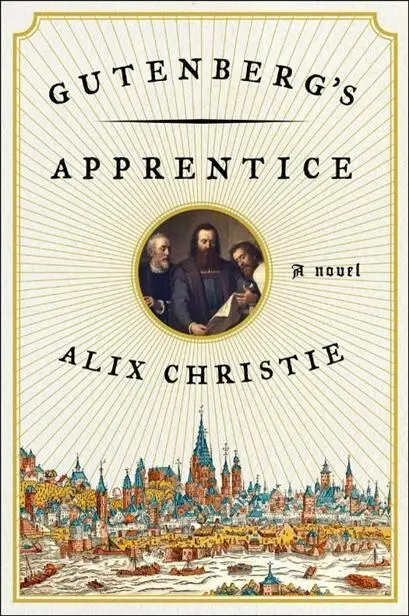
- Название:Gutenberg's Apprentice
- Автор:
- Издательство:Harper
- Жанр:
- Год:2014
- ISBN:нет данных
- Рейтинг книги:5 / 5. Голосов: 1
-
Избранное:Добавить в избранное
- Отзывы:
-
Ваша оценка:
Gutenberg's Apprentice: краткое содержание, описание и аннотация
Предлагаем к чтению аннотацию, описание, краткое содержание или предисловие (зависит от того, что написал сам автор книги «Gutenberg's Apprentice»). Если вы не нашли необходимую информацию о книге — напишите в комментариях, мы постараемся отыскать её.
Youthful, ambitious Peter Schoeffer is on the verge of professional success as a scribe in Paris when his foster father, wealthy merchant and bookseller Johann Fust, summons him home to corrupt, feud-plagued Mainz to meet “a most amazing man.”
Johann Gutenberg, a driven and caustic inventor, has devised a revolutionary — and to some, blasphemous — method of bookmaking: a machine he calls a printing press. Fust is financing Gutenberg’s workshop and he orders Peter, his adopted son, to become Gutenberg’s apprentice. Resentful at having to abandon a prestigious career as a scribe, Peter begins his education in the “darkest art.”
As his skill grows, so, too, does his admiration for Gutenberg and his dedication to their daring venture: copies of the Holy Bible. But mechanical difficulties and the crushing power of the Catholic Church threaten their work. As outside forces align against them, Peter finds himself torn between two father figures: the generous Fust, who saved him from poverty after his mother died; and the brilliant, mercurial Gutenberg, who inspires Peter to achieve his own mastery.
Caught between the genius and the merchant, the old ways and the new, Peter and the men he admires must work together to prevail against overwhelming obstacles — a battle that will change history. . and irrevocably transform them.
Gutenberg's Apprentice — читать онлайн бесплатно полную книгу (весь текст) целиком
Ниже представлен текст книги, разбитый по страницам. Система сохранения места последней прочитанной страницы, позволяет с удобством читать онлайн бесплатно книгу «Gutenberg's Apprentice», без необходимости каждый раз заново искать на чём Вы остановились. Поставьте закладку, и сможете в любой момент перейти на страницу, на которой закончили чтение.
Интервал:
Закладка:
He would have given anything to see her face when it arrived, to know if he would be allowed to hope. This was his punishment: submitting to the consequence of his own pride. He would not push her for an answer either. A day went by, another day; he could not eat or sleep. He set the letters in their lines; he threw them back; he set another page; he prayed.
On the third day he went to the marketplace, for it was market day. He was as rigid as a statue standing there beneath St. Martin’s eaves. A glimpse, he told himself: a glimpse is all, then I will know. Grede bent above the onions and the leeks; Anna was there behind her: fine small head, a basket at her elbow, swathed in a green shawl. He watched them speaking, Anna gravely, Grede embracing her with two swift pecks on either cheek. Anna nodded, walking briskly toward the chapel where he lurked.
He burned with shame. Would he leap out like some mad, costumed ghoul? Or simply shrink and, when she passed, slink back? He had no right to press her. Yet as she passed she must have sensed his presence; she turned her head, and looked. Her eyes burned fiercely, then her cheeks.
“Please,” he said, and stretched out his right hand.
Her own hand crept up to the clasp that held her cloak. “I — wanted — to write back.” Her voice was a bare rasp.
“If we could only speak—,” he said.
“Not here.” She glanced about.
“I know a place,” he said, and stepping from the column touched her elbow, prayed she’d follow as he swiftly left the square. He climbed the hill beyond the church of John the Baptist toward the stock market, into that bitter, pungent fug. Before the little-trafficked side lane that he knew, he turned around to watch her walk, her linen skirt hiked up above the straw and muck. “No place to take a lady,” he said, looking for a place that they might sit.
“You needn’t fear,” she said coolly, and followed him along the empty stalls. He found a wooden crate and turned it up into a stool. She did not take the hand he offered but stepped lightly, wrinkling her nose. The stench was choking: fur and sweat and urine and manure.
He cursed himself; the place was foul. “You deserve far better,” he said, turning up a bucket, pulling it to where she sat. She shrugged. “I’ve seen far worse.”
And then she waited, that small oval face, the deep, dark eyes made even deeper by the paleness of her skin, a bruising of fatigue in rings beneath them. Her cheekbones were more prominent; how she had suffered, Peter thought.
Their knees were almost touching.
“I wronged you. Terribly. I let my pride destroy it all.”
She did not move; her eyes roved over his whole face, as if to probe it for sincerity or hollowness.
“I never answered — it was all my fault. I was too — shattered, too disturbed by your rejection.”
“What I rejected was not you.” She held her hands clasped lightly in her lap. “It was the thing you did, that seemed to me a blasphemy.” She pulled her lips in with her teeth, and looked away, and frowned. “I would have told you, if you’d ever even let me.”
“It meant so much to me.” He shook his head. “I could not bear that you refused.”
She gave a little laugh. “Refused? Who did the refusing? Your father would not look me in the eye. Your master — well.” She shook her head, her nostrils flaring. “He threatened me, if you recall. And you.” For the first time she looked, with vehemence, into his eyes. “You — went away, you sucked the life out of the world, and tossed it down like rags.”
“I know.” He was a husk, unworthy of her love. He could not look at her; he kept his eyes upon her hands. “I was a fool. An arrogant, obnoxious ass.” He shook his head and almost whispered it. “I felt that I was touched by God.”
He raised his eyes at last and saw the way she looked at him, with pity and a certain tenderness. She reached one hand out, touched his cheek.
“As are we all.”
He felt a rush of feeling surge through his whole body: love, despair, a rawness without words. How light she was, how wise, the way she spoke and felt and moved so modest and so graceful. Unlike him — overweening, swollen thick with self-regard.
“You are too good for me,” he said, and felt his heart crack as he said it.
“If that were so, we would not be here face-to-face.” She glanced with meaning at the shit and muck and made a show of wrinkling her nose. “You might at least have brought me scent,” she said, and in the tilting of her head, the fleeting smile that inked her lips, he knew he was forgiven.
“You shall have scent, and any other thing your heart desires.”
“I have but one desire,” she said, and leaned toward him, soft lips meeting his harsh mouth. He took her up into his arms, light as a lamb in May, the smell and touch of her a feast after the months of desert. He kissed her eyes, her nose, her cheeks, her neck, lifting and spinning her, his arms wrapped tightly all around her, crushing her to him with such fervency that he could feel her heartbeat thrumming like a bird’s.
LETTERS
CHAPTER 1: SUNDAY BEFORE JOHN THE BAPTIST
[58 of 65 quires]
23 June 1454
THE AFTERNOON of that midsummer’s eve, Peter took his intended wife out walking past the waters of the Bleiche. Above them rose a checkerboard of yellow flax and tawny wheat, girded by the dark green ribbons of the hedgerows of the Altmünster. The bees were drinking greedily from blossoms rising up from the baked earth. Anna raised her eyes toward the convent. “For a while I thought that I, too—,” she began to say, but Peter turned her face and kissed her quiet, murmuring, “Then I’d have had to break the wall down.”
They clasped each other’s hands and pushed on through the waving grass. The convent buildings were unscalable, he thought, a prison for those surplus daughters. All those Elder girls were penned there, spinning, sewing, baking, praying, giving confession to that toady Heilant — while every John the Baptist from this day on, the two of them would pick the mugwort, gaining strength for their life’s journey.
The plants grew along a rock wall just below the cloister. They gathered up the blossoms in her basket. Anna held one golden flower up. “Luck.” She smiled. The blossom had four petals and not five. “See, even nature can surprise us.”
“Only God is perfect.” Peter took it from her fingers. “Mentelin told me years ago that Muslim craftsmen add an error into everything they make.” He gave a little laugh. “We needn’t fear that we have overreached. We’ve made as many errors with our type as any scribe.”
She put a hand up to his cheek. “So it is not so different, then.”
He looked away across the waving, buzzing fields. “I pray not. I always hoped that we might reach as great an artistry with this new craft as with the old.”
She laced her fingers into his and brought the blossom to her nose. “I pray as well. That come what may, we never lose our hands, our touch — this closeness to the Lord’s Creation.”
They left the fields by a small gate that opened on the lane below the cloister. From that high up, the river was a broad and lazy finger pointing north. “Bingen, Koblenz, then Cologne,” he told her, gesturing toward the places they would go. “And thence to Rotterdam and Amsterdam.” He traced the future’s contours in the air.
“Is that a sermon on the mount I hear?” The faintly mocking voice was not a foot away behind the wall. Its owner’s head poked up, sandy-haired and pink of cheek.
“That is your bailiwick, I think.”
On that slope, for once the scribe — confessor, lektor , spy — stood just at Peter’s height and could look straight into his eyes. More was the pity, Peter thought, for eyes did mirror a man’s soul, and Heilant’s were like tarnish on a glass. Half a minute later he appeared along the lane, a little smirk on his broad face.
Читать дальшеИнтервал:
Закладка:
Похожие книги на «Gutenberg's Apprentice»
Представляем Вашему вниманию похожие книги на «Gutenberg's Apprentice» списком для выбора. Мы отобрали схожую по названию и смыслу литературу в надежде предоставить читателям больше вариантов отыскать новые, интересные, ещё непрочитанные произведения.









Обсуждение, отзывы о книге «Gutenberg's Apprentice» и просто собственные мнения читателей. Оставьте ваши комментарии, напишите, что Вы думаете о произведении, его смысле или главных героях. Укажите что конкретно понравилось, а что нет, и почему Вы так считаете.