Alix Christie - Gutenberg's Apprentice
Здесь есть возможность читать онлайн «Alix Christie - Gutenberg's Apprentice» весь текст электронной книги совершенно бесплатно (целиком полную версию без сокращений). В некоторых случаях можно слушать аудио, скачать через торрент в формате fb2 и присутствует краткое содержание. Год выпуска: 2014, Издательство: Harper, Жанр: Историческая проза, на английском языке. Описание произведения, (предисловие) а так же отзывы посетителей доступны на портале библиотеки ЛибКат.
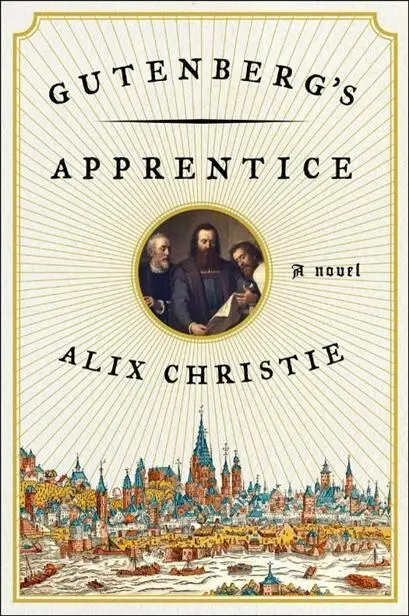
- Название:Gutenberg's Apprentice
- Автор:
- Издательство:Harper
- Жанр:
- Год:2014
- ISBN:нет данных
- Рейтинг книги:5 / 5. Голосов: 1
-
Избранное:Добавить в избранное
- Отзывы:
-
Ваша оценка:
Gutenberg's Apprentice: краткое содержание, описание и аннотация
Предлагаем к чтению аннотацию, описание, краткое содержание или предисловие (зависит от того, что написал сам автор книги «Gutenberg's Apprentice»). Если вы не нашли необходимую информацию о книге — напишите в комментариях, мы постараемся отыскать её.
Youthful, ambitious Peter Schoeffer is on the verge of professional success as a scribe in Paris when his foster father, wealthy merchant and bookseller Johann Fust, summons him home to corrupt, feud-plagued Mainz to meet “a most amazing man.”
Johann Gutenberg, a driven and caustic inventor, has devised a revolutionary — and to some, blasphemous — method of bookmaking: a machine he calls a printing press. Fust is financing Gutenberg’s workshop and he orders Peter, his adopted son, to become Gutenberg’s apprentice. Resentful at having to abandon a prestigious career as a scribe, Peter begins his education in the “darkest art.”
As his skill grows, so, too, does his admiration for Gutenberg and his dedication to their daring venture: copies of the Holy Bible. But mechanical difficulties and the crushing power of the Catholic Church threaten their work. As outside forces align against them, Peter finds himself torn between two father figures: the generous Fust, who saved him from poverty after his mother died; and the brilliant, mercurial Gutenberg, who inspires Peter to achieve his own mastery.
Caught between the genius and the merchant, the old ways and the new, Peter and the men he admires must work together to prevail against overwhelming obstacles — a battle that will change history. . and irrevocably transform them.
Gutenberg's Apprentice — читать онлайн бесплатно полную книгу (весь текст) целиком
Ниже представлен текст книги, разбитый по страницам. Система сохранения места последней прочитанной страницы, позволяет с удобством читать онлайн бесплатно книгу «Gutenberg's Apprentice», без необходимости каждый раз заново искать на чём Вы остановились. Поставьте закладку, и сможете в любой момент перейти на страницу, на которой закончили чтение.
Интервал:
Закладка:
Gutenberg plowed toward him, head bent, face entirely shrouded by the hood, venting like Vesuvius. Unseeing, wrapped in his own drama; Peter moved out from the shadows in his path. If he had had a dagger he might well have closed his hand around the clean hard purpose of its hilt. Instead he bared his teeth and let the words fall with contempt upon the snow.
“They let you go.”
The head jerked up; the eyes blazed as the hood fell back. His master — once his mentor and his father, in loco parentis — stared right through him, gave a short, hoarse laugh.
“Out of my way,” he said, with such a weight of venom in his voice that Peter for an instant faltered.
“No.” Gathered himself, and stepped a pace toward him. “Not after this.”
“Don’t even dare.” Glittering, entirely foreign to him, furious. The voice was little better than a growl. “I’m sick to death of interference.” He made a swipe with one long arm, as if to push his foreman from his path.
“Out of my way, I tell you. I will not be stopped.”
He was wild, inhuman. Horned and dangerous, head down, goring all that stood before him. It ended there, in Peter Schoeffer’s heart. Regard, the joy he’d mirrored, common cause. He felt his hands drop to his side, those hands he’d raised in some vain gesture of defense. He could not trust him, ever, not to trample everything he held most sacred in this life. Gutenberg just switched his cloak and glowered, passing with a jerk to his left side — the way the sailors on the Rhine since time began had dodged the Lorelei.
CHAPTER 7: SPONHEIM ABBEY
Winter 1485
FROM THAT POINT ON I knew — he was a danger to the Book.”
“You can’t mean that.” Trithemius draws back, his look reproving.
“A liability, of that I had no doubt.”
The dream Peter is spinning ruptures with these words. For hours the abbot has said nothing. From time to time he’s bent to scratch a note, attentive as a scribe should be, entirely silent — loath, perhaps to break the flow. Until he flinches, hearing those harsh words.
“This is a weighty charge.”
“He was a risk. I know it sounds… ungrateful. But after such a stunt, how in God’s name was I — was anyone — to trust him?”
In truth, the master never really trusted Peter or his father, not entirely. He took no man into his confidence; he felt the rules did not apply to him.
For a long moment no one speaks. The room is a suspended bell of wood, outside of which the world is white. They’ve sat companionably as fall has turned to snow and ice, thinks Peter, each one of his long visits a tick warmer until this.
Trithemius cinches at the cord that girds his habit. “I am reminded,” he says, in the slightly pompous tone he saves for chapel, “of what the angel said to Ezra.” He folds his hands into a point beneath his spadelike nose.
“Do you recall? How Uriel asked Ezra who could ‘Weigh me the weight of the fire, or measure me the blast of the wind, or call me back the day that is past’?”
He drops his hands. “The answer is that no man can. That is the meaning of the riddle. If we can’t even grasp such things, how can we comprehend the ways of the Most High?”
There is a light in him, the light of new conversion. He’s only been a monk two years, an abbot even less.
“Thus we can never say how any of our actions fit His plan. Not mine, not yours — not even Gutenberg’s.”
Peter’s estimation of the fellow rises. He’d thought the abbot driven mainly by ambition, but this steeliness reveals a deeper side. The printer pours himself a glass of the weak red they make on the Mosel.
“Ezra,” he says, meditatively. “I remember thinking as it went to press that Ezra’s howl was like our own. Incomprehension, rage at the destruction of Jerusalem — just as we felt to know the heathen had destroyed Constantinople.” Strange and riddling books they were, that prophet’s, filled with visions of apocalypse. The question Ezra posed as painful still as when he’d posed it fifteen centuries before: How, Lord, are we to understand your cruel destruction of your chosen people?
“But I remember thinking, too”—Peter holds the abbot firmly with his eyes—“that Ezra held the seed as well for understanding the Lord’s purpose with our Bible.”
Trithemius lifts one nearly hairless eyebrow. “Go on.”
“He tells us, does he not, that all this present suffering is just prelude? ‘For did not the souls of the just in the cellars ask… when shall the fruit come of the floor of our reward?’ And the angel answered, ‘When the number of the seeds in you shall be filled, because he has weighed the world in a balance.’”
Peter waits, expectantly. Surely, if the man is quick, the meaning’s clear. And yet the abbot’s face does not uncloud.
“The numbers of the just and righteous seeds must swell — to overwhelm that evil.” He leans to drive it home. “The Word must spread. There was no greater way to swell their ranks, it seemed to me, than by the printing of this Bible.
“And so, it followed, any interference was transgression of God’s will.”
Trithemius has told him he has Latin, Greek, and Hebrew; he studied at the university in Heidelberg. He’s keen to shake this abbey up and raise again the Benedictine lamp of learning. Yet he is smug as well, a bit too satisfied with his own rise. Peter sees him smile, as if to say I’ve got you now .
“And yet,”—the abbot spreads his hands—“is it not telling that your former master too spread prophecy? It is a fundamental feature of the scriptures that what is meant is hidden. The truth is only shown to those disciples that He trusted.” He waits for Peter’s nod. “There is no doubt that it was willed — the printing of it, even your archbishop’s efforts to prevent it. For after all, you must admit: you did succeed. The Book was made. The Bible, for your master’s sins, was never thwarted.”
He settles back, pleased with his argument.
“Success,” says Peter. The word is bitter on his lips.
Was he the only one who saw? The only one who understood what had been lost in the collapse of that first, extraordinary workshop? Anger flares, as bright and hot as years before, to think of all the books that had not been, the masterpieces they would certainly have made, if Gutenberg had not destroyed that brotherhood.
“The Book was plucked out of the flames. Nothing remained of all we might have done, the greatness that I thought we might achieve.”
The young man laughs. “You speak as if you had a say in how the world unfolds.”
“But Saint Mark says too that man has his role. ‘Prepare ye the way of the Lord; make straight his paths.’” He thinks of Mentelin, setting Isaiah all those years ago: Make straight in the wilderness the paths of our God.
Trithemius blinks. “Of course.” He nods. “The Lord does act through us.”
“We’re not just senseless tools.” The printer scowls. “You must have read the teachings of Saint Hugh.” How lifted he had been, at this pup’s age, to think that God resided in each particle of the created world — and thus in Peter, too.
“I have. Although…” The young man flails, and Peter senses how he calculates. He’s thinking that he’d best not stop the printer now, before he’s got the story safely down. “It seems presumptuous, that’s all,” he shrugs, “to think that we complete His tasks.”
Complete — or start — or carry on: the master would have said that he’d been chosen from the instant he arrived in this harsh world.
“My point is simply this: that if he’d trusted us, it might have held.”
Читать дальшеИнтервал:
Закладка:
Похожие книги на «Gutenberg's Apprentice»
Представляем Вашему вниманию похожие книги на «Gutenberg's Apprentice» списком для выбора. Мы отобрали схожую по названию и смыслу литературу в надежде предоставить читателям больше вариантов отыскать новые, интересные, ещё непрочитанные произведения.






Обсуждение, отзывы о книге «Gutenberg's Apprentice» и просто собственные мнения читателей. Оставьте ваши комментарии, напишите, что Вы думаете о произведении, его смысле или главных героях. Укажите что конкретно понравилось, а что нет, и почему Вы так считаете.