Alix Christie - Gutenberg's Apprentice
Здесь есть возможность читать онлайн «Alix Christie - Gutenberg's Apprentice» весь текст электронной книги совершенно бесплатно (целиком полную версию без сокращений). В некоторых случаях можно слушать аудио, скачать через торрент в формате fb2 и присутствует краткое содержание. Год выпуска: 2014, Издательство: Harper, Жанр: Историческая проза, на английском языке. Описание произведения, (предисловие) а так же отзывы посетителей доступны на портале библиотеки ЛибКат.
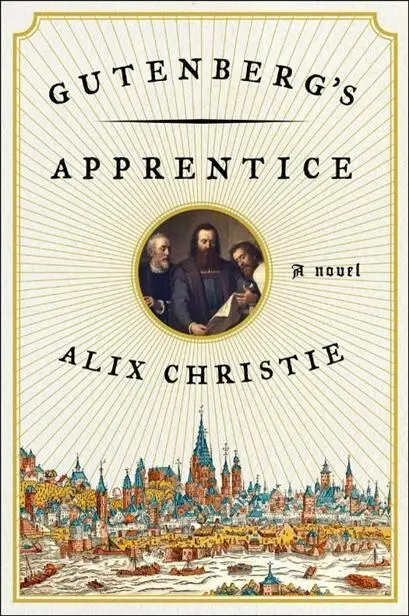
- Название:Gutenberg's Apprentice
- Автор:
- Издательство:Harper
- Жанр:
- Год:2014
- ISBN:нет данных
- Рейтинг книги:5 / 5. Голосов: 1
-
Избранное:Добавить в избранное
- Отзывы:
-
Ваша оценка:
Gutenberg's Apprentice: краткое содержание, описание и аннотация
Предлагаем к чтению аннотацию, описание, краткое содержание или предисловие (зависит от того, что написал сам автор книги «Gutenberg's Apprentice»). Если вы не нашли необходимую информацию о книге — напишите в комментариях, мы постараемся отыскать её.
Youthful, ambitious Peter Schoeffer is on the verge of professional success as a scribe in Paris when his foster father, wealthy merchant and bookseller Johann Fust, summons him home to corrupt, feud-plagued Mainz to meet “a most amazing man.”
Johann Gutenberg, a driven and caustic inventor, has devised a revolutionary — and to some, blasphemous — method of bookmaking: a machine he calls a printing press. Fust is financing Gutenberg’s workshop and he orders Peter, his adopted son, to become Gutenberg’s apprentice. Resentful at having to abandon a prestigious career as a scribe, Peter begins his education in the “darkest art.”
As his skill grows, so, too, does his admiration for Gutenberg and his dedication to their daring venture: copies of the Holy Bible. But mechanical difficulties and the crushing power of the Catholic Church threaten their work. As outside forces align against them, Peter finds himself torn between two father figures: the generous Fust, who saved him from poverty after his mother died; and the brilliant, mercurial Gutenberg, who inspires Peter to achieve his own mastery.
Caught between the genius and the merchant, the old ways and the new, Peter and the men he admires must work together to prevail against overwhelming obstacles — a battle that will change history. . and irrevocably transform them.
Gutenberg's Apprentice — читать онлайн бесплатно полную книгу (весь текст) целиком
Ниже представлен текст книги, разбитый по страницам. Система сохранения места последней прочитанной страницы, позволяет с удобством читать онлайн бесплатно книгу «Gutenberg's Apprentice», без необходимости каждый раз заново искать на чём Вы остановились. Поставьте закладку, и сможете в любой момент перейти на страницу, на которой закончили чтение.
Интервал:
Закладка:
“You have no right,” he snarled, “to tear this shop apart.” He hurled the words at Erlenbach. “You order them to stop. This work is worth ten times their stinking hides.” As if in answer to an order he had not yet even thought, Keffer, Neumeister, and Ruppel moved to block the spaces in between the beams. Like hulking statues, hollow-eyed, broad-shouldered, a living mirror of the Kaufhaus frieze.
The boots sheathed in their jagged metal tips made a strange snicking sound. “Oh,” said Erlenbach, as he approached; as if amused, he looked them up and down.
“You think that this is yours.” He smiled, a hideous distortion of those bloodless lips. “From what that tinker Gutenberg said, though, it is his.” His laugh was soundless, a mere scrape; he reached into his belt and drew out a paper, unfolded it, and flung it at him, forcing Peter to bend down and take it from the ground. A waste sheet, from the book of Jeremiah, he saw as he uncreased it. And yet he kept his face entirely blank.
“Nice work,” said Erlenbach, almost pleasantly, “for liars and for blasphemers.”
Harshly Peter laughed. “The pope then is the blasphemer on high.” He shook his head, and sneered, and strode toward the desk with what he hoped was utter confidence. “I take it you have never seen a psalter, or pontifical.” These cretins had a year of Latin, two at most, he thought. He threw the waste sheet down beside the sheets of canticles and psalms.
“Those are not verses.” Erlenbach bored into him with his hunter’s eyes.
“Nor are they prophecy — or blasphemy. An introduction, only, words of preface to the book of prayer, written by the saint Jerome.” Impatiently he flicked his hand. “For God’s sake, ask His Grace, or Rosenberg, if you do not believe me.”
A vein throbbed silently in that rigid, sunken face; the old knight looked around. His eyes fell on the pile of pilgrim mirrors. “Superstitious twaddle,” he said, his lips twisting.
Peter shrugged and gave his coldest, cruelest smile. “Keep the masses happy — isn’t that the way?” The way you bastards rule by crushing, smashing, dulling those who might object with bright new baubles. Do not the rich oppress you by might? The words of the apostle James rose up inside, and Peter kept on smiling.
How hateful was their power now, arrayed against the breath of these new men — the stirring of renewal flowing through this workshop, this whole city and their Bible. Has not a poor man the right to heaven? May he too not offer the gift of scripture to his parish, in the hope of speeding his own way? Peter felt his chest swell, heard his voice, implacable and biting.
“You have no business here,” he said. “I bid you leave us now in peace.”
He lifted one hand; a dozen strong men silently arrived from every corner to surround him. Erlenbach looked out at him from his clay mask, and Peter felt himself exult, and then he saw it: sticking out from underneath the desk, three paces from the knight’s shod foot. The master book.
He forced himself to tear away his eyes. But something in his face alerted Erlenbach, who stirred and looked around, sniffing almost, as if he too had sensed that something was amiss.
For terrible long seconds no one moved or spoke. The soldiers came like washerwomen from the drying lines, the full sheets hanging from their arms. Erlenbach moved toward the desk, his right hand sweeping the whole surface clean: of inkpot, quills, a pile of paper scraps, the litter of a half a dozen mirrors. His foot came within inches of the book as he turned, snarling. “Insolence. You will hear more.”
Obediently, Peter dipped his head. “I welcome it,” he said. “His Grace has not yet seen the product of our work.” And from the corner of his eye he watched the heel move, almost grazing the thick sheaf — his breath stopped, his throat closed. He swallowed, then advanced and held his hand out.
The knight just eyed it with contempt and pulled his mesh and leather gloves back on.
“Men die who treat me as a fool.” His tone was thuggish, threatening. “Gensfleisch will answer for this — if he’s not already singing.”
He turned, his long cloak snagging on the corner of the book, then pulling free, swirling above his feet as they receded, followed by the thick tramp of his soldiers, bearing their mean spoils.
The minute they were gone, Peter loped the hundred yards across the Quintinstrasse, through the churchyard to the Hof zum Gutenberg. Lorenz unlocked the door. His eyes were wide, his gray hair flying from his head. “They’ve took him off, young master,” he said shakily.
Peter strode down the hall, looked briefly in the master’s study, noted how the stools were knocked about. The stacks of papers on the table were all gone; whatever copies of the prophecy the fool had kept there too. The door onto the little courtyard was ajar, a wake churned through the whiteness toward the stable door. He wrenched it open, groped into the alcove for the tinderbox, and struck a light.
The press was stripped of its protective cloth, which they had stamped into the straw. Whatever type had been left standing in its bed was gone. A twist of twine hung from the bar. He turned toward the desks, the master’s high one and the table by the window, where he’d cut that type an age before. There’d been a setting case there too, to judge from the now-empty frame they’d left behind. Whatever type the master kept in all those pockets had been seized, along with the large case. Peter wondered for an instant how they’d lashed it, four foot square, onto a horse. God damn him. May God send down His plague on him, the arrogant, self-centered fool.
Wiegand and Lorenz stood behind him, gaping. “Get everything that isn’t nailed. Put any type you find into a sack, and every frame and stick.” The press, exposed, he could not help. To Wiegand he said slowly, carefully: “Then go to Hans, and have him send as many as he needs to haul it to the Humbrechthof.” The boy nodded. Peter took a final look, and then went out to find the man.
The fool would crack before they’d even heated up the tongs — if force was even needed, any kind of torture. More likely Gutenberg would spill it of his own accord. Peter wished for catgut then, a metal brand — anything to seal that proud, loose mouth.
He paused a moment, undecided. They might have taken him to the archbishop, yet he had heard no haste of hoofbeats heading north, toward the river ford that led to Eltville or Aschaffenburg. To Dietrich’s residence in Mainz, then: there were cells inside the Little Court, he knew, to hold the miscreants before the court of law, beside those gardens where his peacocks screamed.
The square before St. Martin’s glowed as if each crystal of the snow was lit up from within. Out of the ragged clouds a strange and diffuse brightness came, from hidden moon and stars. The traders had all shuttered and deserted their locked stalls. Peter headed toward the ghostly pillars of the Little Court. He cursed with renewed vigor as the snow soaked through the flimsy leather of his shoes, and wished belatedly he’d brought his boots — and then his torch and knife. For halfway there he saw a movement in the shadows, a flickering; he stopped and peered across the shifting pools of dark and light. This was no time for fingers, murderous or larcenous, around his throat. He sidled silently into the deeper darkness at the edges cast by the great houses. A figure peeled then from the cloister columns, walking slowly toward him from the gate of Dietrich’s palace. Tall and hooded, stalking almost, rustling as its arms swung, punching at the air. Another step, and Peter knew: he heard the muttering beneath the breath, the churning of the consonants, a bitter jumbling like letters clacking to the ground. The bastard’s teeth were doubtless ground as well, absent a bone to chew, a body he might lash with that abusive bludgeon in his mouth.
Читать дальшеИнтервал:
Закладка:
Похожие книги на «Gutenberg's Apprentice»
Представляем Вашему вниманию похожие книги на «Gutenberg's Apprentice» списком для выбора. Мы отобрали схожую по названию и смыслу литературу в надежде предоставить читателям больше вариантов отыскать новые, интересные, ещё непрочитанные произведения.









Обсуждение, отзывы о книге «Gutenberg's Apprentice» и просто собственные мнения читателей. Оставьте ваши комментарии, напишите, что Вы думаете о произведении, его смысле или главных героях. Укажите что конкретно понравилось, а что нет, и почему Вы так считаете.