Alix Christie - Gutenberg's Apprentice
Здесь есть возможность читать онлайн «Alix Christie - Gutenberg's Apprentice» весь текст электронной книги совершенно бесплатно (целиком полную версию без сокращений). В некоторых случаях можно слушать аудио, скачать через торрент в формате fb2 и присутствует краткое содержание. Год выпуска: 2014, Издательство: Harper, Жанр: Историческая проза, на английском языке. Описание произведения, (предисловие) а так же отзывы посетителей доступны на портале библиотеки ЛибКат.
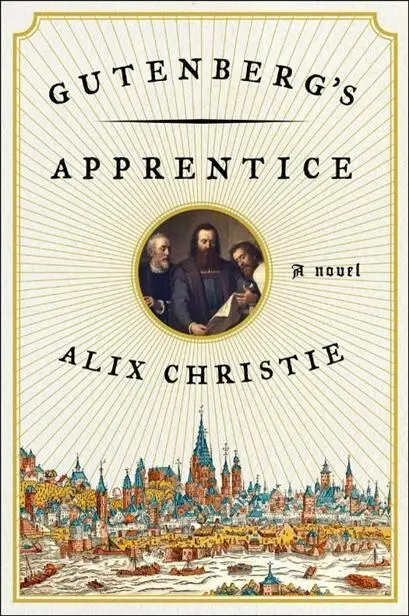
- Название:Gutenberg's Apprentice
- Автор:
- Издательство:Harper
- Жанр:
- Год:2014
- ISBN:нет данных
- Рейтинг книги:5 / 5. Голосов: 1
-
Избранное:Добавить в избранное
- Отзывы:
-
Ваша оценка:
Gutenberg's Apprentice: краткое содержание, описание и аннотация
Предлагаем к чтению аннотацию, описание, краткое содержание или предисловие (зависит от того, что написал сам автор книги «Gutenberg's Apprentice»). Если вы не нашли необходимую информацию о книге — напишите в комментариях, мы постараемся отыскать её.
Youthful, ambitious Peter Schoeffer is on the verge of professional success as a scribe in Paris when his foster father, wealthy merchant and bookseller Johann Fust, summons him home to corrupt, feud-plagued Mainz to meet “a most amazing man.”
Johann Gutenberg, a driven and caustic inventor, has devised a revolutionary — and to some, blasphemous — method of bookmaking: a machine he calls a printing press. Fust is financing Gutenberg’s workshop and he orders Peter, his adopted son, to become Gutenberg’s apprentice. Resentful at having to abandon a prestigious career as a scribe, Peter begins his education in the “darkest art.”
As his skill grows, so, too, does his admiration for Gutenberg and his dedication to their daring venture: copies of the Holy Bible. But mechanical difficulties and the crushing power of the Catholic Church threaten their work. As outside forces align against them, Peter finds himself torn between two father figures: the generous Fust, who saved him from poverty after his mother died; and the brilliant, mercurial Gutenberg, who inspires Peter to achieve his own mastery.
Caught between the genius and the merchant, the old ways and the new, Peter and the men he admires must work together to prevail against overwhelming obstacles — a battle that will change history. . and irrevocably transform them.
Gutenberg's Apprentice — читать онлайн бесплатно полную книгу (весь текст) целиком
Ниже представлен текст книги, разбитый по страницам. Система сохранения места последней прочитанной страницы, позволяет с удобством читать онлайн бесплатно книгу «Gutenberg's Apprentice», без необходимости каждый раз заново искать на чём Вы остановились. Поставьте закладку, и сможете в любой момент перейти на страницу, на которой закончили чтение.
Интервал:
Закладка:
The worst was the huge flock of drying pages, six hundred great sheets, nearly, hanging from their lines. God spare us, Peter whispered, praying that the ink was halfway dried. He called the whole crew hoarsely to come quickly just as soon as they were done, for this, though massive, was not something they could rush. In haste and panic Peter gestured for more barrels, stools — they did not have a dozen ladders. Up swarmed the hands, like tentacles, like harvesters among the vines: each page was lifted, gently, painfully, so slowly that he thought his heart would burst just watching it, his ear trained on the door. Frau Beildeck had come down, astonished at the strange commotion, and he grasped her by her ruddy arm and begged her to ascend again and watch the lane from up above. Another boy was sent to crouch beside the portal in the courtyard, ears pressed tight to the wood, to sound the first alarm.
Peter left them lifting, laying, jogging finished pages; the boys and men began to stagger off outside, toward the storerooms with those printed piles, one following the other like a trail of ants. Peter was moving like a shuttle through the shop: first to the composing room, removing the torn Bible pages clipped to every setter’s stand; then examining minutely all three presses, reaching under one to pull a fallen waste sheet out. Upstairs he unpinned the large chart that tracked their progress, folded it, and took the bundle — dangerous, revealing — of Bible notes and pages out into the cold.
The track between the workshop door and the two storerooms was now wide and trampled. He heard a muffled sound — at least he thought — and tasted acid in his mouth. The men were grave, entirely silent as they filed, except for a slight huffing and the shuffling of their sodden feet. Peter heard again the muffled sound, of feet, perhaps, not hooves, up north again, along the Cobblers’ Lane in the direction of the synagogue — or Mombasilier, or even, he thought with a twist of guilt, the Hof zum Gutenberg. Brusquely he seized Ruppel by the arm, and wildly motioned that the tracks must be erased; on his way back to fetch more pages, every man now dragged his feet in an uneven circuit, flattening the pale, untrammeled snow. Their manic loops and jets of breath, their panting open mouths, were an inversion, a perversion, of those jolly Flemish winter scenes.
Then there was noise, and indisputably the chink of mail, the sound of heavy leather boots approaching. Peter shooed the crew ferociously toward the workshop door. He bent and locked the storehouse, and stood an instant with his head flung back, his face exposed to ice and snow. “Saint Michael defend us against the rulers of this world of darkness,” he whispered to the cloak of heaven, moving then with such a speed as he had never done before into the shop, looking upon the men — his men, by God — each taking his appointed place, Hans and Mentelin bent with rags behind each man to wipe the melted mush that trailed in from the door.
They had a minute, at the most, before the archbishop’s men arrived. Peter looked with shining eyes at all of them: the men poised at the presses and the setters in their places, the drying lines that now hung slack, but for a score of pages Mentelin had draped. He touched his fingers to his lips and raised his hand and made the sign of Christ’s cross in the air. A little voice said, “Sir, they’re here,” and then each body tensed, unwittingly, in answer to the pounding of a metal fist upon the courtyard door.
Peter turned and saw the master book, the blank and numbered dummy Bible, on his desk, and swooped upon it as he passed and dropped it, kicking it beneath the desk. The yard when he stepped out looked churned and grimy. He made a sign to open up the double-gated portal. The hinges creaked in protest as the doors swung in slowly, followed closely by six men-at-arms who flattened themselves either side of the wide arch. They stood stiffly to attention, three by three, right hands on hilts, eyes straight ahead, heads cowled in leather, waiting. From the shadow came the dainty clop of high-strung hooves. A lone rider entered, thin, erect, black horse high-stepping, rolling its wide eyes. The face of Erlenbach, crusader, knight of the Teutonic order, glimmered faintly in the white light of the crushed new-fallen snow.
“Bring torches,” Peter told the boys, and stood unmoving in the center of the courtyard as Archbishop Dietrich’s fist approached. Speech failed him for a moment: he was torn between a stiff, reflexive urge to kneel and then cold fury at this violation of his threshold. “My lord,” he said at last, unflinching as the booted leg in its bright, razored stirrup drew level with his neck. “You seek a service here in Mainz?”
Free soil, free city, freemen, he intended: he tipped his head both graciously and languidly, to show he felt no deference.
Archbishop Dietrich’s Hofmeister looked down on him as if he were a grub. His face was skeletal, mere gristle, long of beak and capped with mail, with tufts of white that sprung from ears and neck.
“Search the place,” he said, his visage hard.
“By what right—,” said Peter, but the knight was swinging down from the saddle with no more attention than he would have spared a cur. The end of his sheath swung around as he dismounted and struck Peter lightly on the arm.
“Treachery. And blasphemy.” A faint twitch lifted the knight’s mouth. He pushed past Peter, tall and slightly stooped, mail faintly jingling beneath his crimson cloak, into the doorway to the workshop where his soldiers had already shouldered through.
The crew looked up, mouths falling open in astonishment, arrayed as if on stage. How they had done this without some direction, each in his own corner, shrinking, freezing, staring with such seeming naturalness, Peter could not say. He planted himself at Erlenbach’s left hand and threw his arm out, with contempt, derision. “What blasphemy, my lord, when as you see, it is your master’s work we are engaged in?”
The proud beak tilted, exactly like a bird’s; with yellow eyes the man looked at him, head turned slightly to the side. “My master’s work,” he sneered, “my eye.” He jerked his chin toward his captain, and the men approached the presses and snatched up the sheets. Keffer put up his hands, and Ruppel followed: ashen-faced they watched as two squat, burly fellows reached into the bed of Keffer’s press and dragged the forme out and began to bash the metal with two cudgels they produced from their thick belts.
“Hey!” said Peter, springing, but the knight was swifter, tougher, and restrained him with the biting grip of his left hand.
“It is the book!” The printer writhed in that hard grasp, no longer feigning his own horror. “The book that Dietrich asked for, damn you, man.” He twisted free and lunged toward the soldiers with their pile of printed sheets. “The Psalms, you heathen slugs,” he said, snatching one and spinning, nearly throwing it at Erlenbach. “The canticles of Solomon and Moses, just as you saw them for yourself, two years ago.” His face was inches from that weathered skull: “Don’t think I don’t recall that you were there, with Rosenberg, in Eltville — do not deny you heard Johann Gutenberg offer him this present for the pope.”
The knight looked on him haughtily and smiled. “A pretty story.” Ruthlessly his eyes swept through the open space of the whole workshop. “Every piece of paper, parchment,” he barked, the soldiers fanning out, two to the drying hall, two more to the composing room, the first two giving the poor forme a final bash before discovering the twine and with an ugly relish pulling on its end to dump the whole tray with a crash onto the floor. A kind of flare went off in Peter, bright and hot, and he moved bodily to block their access to the room in which the heavy frames of letters waited in their cases, six sets of alphabets, set at an angle to six stools.
Читать дальшеИнтервал:
Закладка:
Похожие книги на «Gutenberg's Apprentice»
Представляем Вашему вниманию похожие книги на «Gutenberg's Apprentice» списком для выбора. Мы отобрали схожую по названию и смыслу литературу в надежде предоставить читателям больше вариантов отыскать новые, интересные, ещё непрочитанные произведения.









Обсуждение, отзывы о книге «Gutenberg's Apprentice» и просто собственные мнения читателей. Оставьте ваши комментарии, напишите, что Вы думаете о произведении, его смысле или главных героях. Укажите что конкретно понравилось, а что нет, и почему Вы так считаете.