Alix Christie - Gutenberg's Apprentice
Здесь есть возможность читать онлайн «Alix Christie - Gutenberg's Apprentice» весь текст электронной книги совершенно бесплатно (целиком полную версию без сокращений). В некоторых случаях можно слушать аудио, скачать через торрент в формате fb2 и присутствует краткое содержание. Год выпуска: 2014, Издательство: Harper, Жанр: Историческая проза, на английском языке. Описание произведения, (предисловие) а так же отзывы посетителей доступны на портале библиотеки ЛибКат.
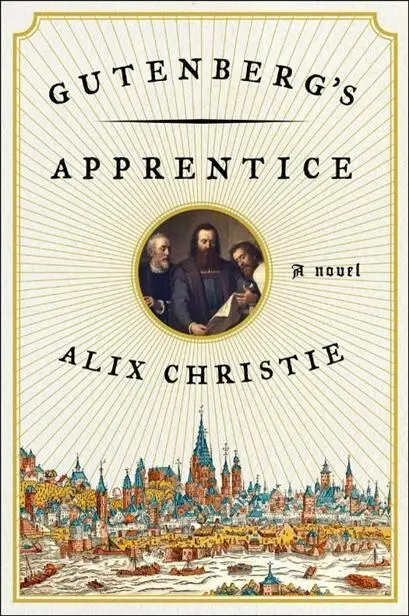
- Название:Gutenberg's Apprentice
- Автор:
- Издательство:Harper
- Жанр:
- Год:2014
- ISBN:нет данных
- Рейтинг книги:5 / 5. Голосов: 1
-
Избранное:Добавить в избранное
- Отзывы:
-
Ваша оценка:
Gutenberg's Apprentice: краткое содержание, описание и аннотация
Предлагаем к чтению аннотацию, описание, краткое содержание или предисловие (зависит от того, что написал сам автор книги «Gutenberg's Apprentice»). Если вы не нашли необходимую информацию о книге — напишите в комментариях, мы постараемся отыскать её.
Youthful, ambitious Peter Schoeffer is on the verge of professional success as a scribe in Paris when his foster father, wealthy merchant and bookseller Johann Fust, summons him home to corrupt, feud-plagued Mainz to meet “a most amazing man.”
Johann Gutenberg, a driven and caustic inventor, has devised a revolutionary — and to some, blasphemous — method of bookmaking: a machine he calls a printing press. Fust is financing Gutenberg’s workshop and he orders Peter, his adopted son, to become Gutenberg’s apprentice. Resentful at having to abandon a prestigious career as a scribe, Peter begins his education in the “darkest art.”
As his skill grows, so, too, does his admiration for Gutenberg and his dedication to their daring venture: copies of the Holy Bible. But mechanical difficulties and the crushing power of the Catholic Church threaten their work. As outside forces align against them, Peter finds himself torn between two father figures: the generous Fust, who saved him from poverty after his mother died; and the brilliant, mercurial Gutenberg, who inspires Peter to achieve his own mastery.
Caught between the genius and the merchant, the old ways and the new, Peter and the men he admires must work together to prevail against overwhelming obstacles — a battle that will change history. . and irrevocably transform them.
Gutenberg's Apprentice — читать онлайн бесплатно полную книгу (весь текст) целиком
Ниже представлен текст книги, разбитый по страницам. Система сохранения места последней прочитанной страницы, позволяет с удобством читать онлайн бесплатно книгу «Gutenberg's Apprentice», без необходимости каждый раз заново искать на чём Вы остановились. Поставьте закладку, и сможете в любой момент перейти на страницу, на которой закончили чтение.
Интервал:
Закладка:
“Now then.” He sat down again.
“Look at these lines.” Heilant’s voice was low. “Exactly even, with the breaks in the same place.”
“This one’s the same,” said Peter grimly.
“It is some devilry.” The scribe and lektor ’s eyes were opened wider than he’d ever seen them. “No hand but Satan’s could create such symmetry.” He stared at Peter, thick lids lifted, like a child caught in a lie. “No human hand could write precisely the same line, a dozen times.”
Peter mimed a thoughtful stroking of his beard, and glanced around the room. “It seems to me it is some kind of stamp,” he whispered.
“Stamp?” Heilant’s full lips opened slightly; a look of merriment, derision, filled those open eyes. “Come now, be serious.”
“You know, the way Cusanus had them carve the Pater Noster.” Peter made a show of running one flat finger on the page. “It punches, like those stamps they carve from wood.”
Heilant peered closely at it. “I see no grain.” He licked his lips and raised his eyes with a bare smile. “This is not wood. Not quite.” Suddenly, his look was snide. “You know much more, I think, than you let on.”
“Not wood?” said Peter lightly, as his stomach jolted.
“You play with metal, it’s well known. And not just for those mirrors.”
Peter looked him full in his soft, flabby face. Heilant would not be so easily diverted. He dropped his voice and leaned with menace toward the monk. “You ought not say such things out loud.” He looked around. “Especially not here.”
The scribe recoiled, but there was enmity in his small eyes. “If I were you, I’d watch the game you play.”
“No game.” Peter sat back. “But strictest orders. You’ll keep your comments to yourself — or you will answer to His Grace — or Rosenberg.”
For an instant Heilant chewed on this. But he’d not gained his rank without a streak of most self-serving cunning. His smile was acid. “Then it’s a good thing, don’t you think, I answer to them both already?”
Each page was tied with twine on the composing stone for him to proof as it arrived. He was teasing out wrong letters with a pick the night he got an answer to that question. It was a few days past Saint Stephen, and that year of woe was nearly at its end. Heilant’s threat was unambiguous. But he could turn to neither partner: the only father he could count on was the Father of them all.
He rose and went out to the courtyard, toward the granary, where all the finished quires were stacked. How often of an evening had he come to check on them with Gutenberg, tucking the waxed cloth as a mother tucks her babe. A pain traversed him: he couldn’t trust the scheming bastard now, no more than he could hope for help from Fust. His father was a broken dike, his power trickling and dispersed, while Gutenberg was wild and uncontained, a risk to the whole workshop. Now, at least, the scales had fallen from his eyes. Peter had been shown, by each man’s carelessness, his weakness, that he alone had been entrusted to complete this work.
He and Fust had managed to prevail, at least, on Gutenberg to box up the remaining prophecies and send them out of Dietrich’s jurisdiction, down the river to Cologne. In the days since, the master had stopped by a few times to check on the workshop. But then, dog-faced, embittered, he had had the grace to leave the crew alone.
The snow fell softly, silently, out of the winter blackness; Peter stood and watched the way it drew the whole dark Humbrechthof beneath its soft white cloak. A few small squares of gold were all that showed, the firelight playing on the paper they had pressed into the windows in vain hope of sealing in the heat. It was past time to shut the heavy wooden shutters. The newly printed sheets would then be shifted to the shed the minute they were dry, Peter thought as he returned in his own tracks across the courtyard. A drumming sound caught his attention far off to the north, but though he waited, he heard nothing more. He entered. All dozen men were busy, half a dozen boys; the clock had just struck five. He stooped to seat himself by Hans. “Snow all night,” he said. “Best get the lads to bring more wood.” Hans put down his stick and stretched his fingers and his hands. “Freeze all them spies too in their beds — that’s good.” He gave Peter a keen look.
And yet he spoke too soon: the sound of hoofbeats came, now close enough that Peter knew the sound as that low, distant pounding he had heard before. “Sshhh!” He sprang up, out to the main room, his long arms lifted toward the pressmen. “Hold off.” He drew a finger at his neck to silence all that grunt and clatter. To a man the crew froze, listening intently, fingers flexing, muscles taut, hearing the hoofbeats thudding ever closer. In half a minute they were right outside, a body’s breadth from their stout outer wall, trampling the snow to ice along the lane. It was unusual, to say the least, to hear a squad of horsemen in the city just as winter darkness closed the gates.
“Four horsemen,” Hans said, deadpan; Peter rolled his eyes. He bid them wait, went out with Wiegand, hoisting him to spy above the wall. “Four, aye,” the boy said, sliding down, “two black, two bay.”
“Which way?”
“St. Martin’s.”
“What livery?”
“I couldn’t see.”
A feeling of tremendous fear swiped through Peter at the very instant they both clearly heard a soft yet rhythmic tapping at the courtyard door. “Quick,” he said, “silent, now, close up the shutters.”
He went with slow, cold feet toward the little door cut in the portal. “Who’s there?” he hissed through solid oak.
“Jost, from Fust,” he heard in a low whisper. “A message, urgently, for Peter Schoeffer.”
As soon as he unlocked the door, a hooded figure slipped inside: his uncle’s foreman, Jost, nodding in recognition. “Erlenbach just rode in, I’m to warn you.” His hood was pulled so tight that Peter barely made out his face. “They know — that’s what he says.” A cloud of mist came from the shadowed lips. “Put everything away, your uncle says.”
There was no sound now in the lane, no clue as to the way those horses and their soldiers might have gone.
“Just here?” said Peter, “or—”
The faintest shrug. “He only sent me here.”
Instantly, he understood. As far as Jakob was concerned, Gutenberg could live or die by his own sword. Peter still could send a warning: the thought was like a bat that darted back and forth as he thanked Jost and dropped the beam across the door. The whole thing was the fool’s own fault, he thought. The Bible and the Humbrechthof were all that counted. Let Dietrich seize the prophecy; it serves the master right. Peter might have sent a boy, but in the instant he was given to decide, he hesitated — then left the man to twist on his own rope.
He flew into the workshop, barking orders. Keffer turned as slowly as a man encased in treacle, sluggish, golden: everything moved with a lethargy, a slowing of time’s motion. “Mirrors, now!” said Peter, and the pressman nodded, cranked the bed back out from underneath the platen. He hoisted out the heavy tray of letters. “To the shed,” said Peter, as he turned to Ruppel and Neumeister.
“You’re making a new psalter, for Pope Nicholas,” he told them. “ Formes out, now, and follow Keffer to the shed. I’ll bring you the new pages.” Mentelin and Hans were at his side, the only men who knew, had helped prepare the plan. He did not need to tell them what to do. Mentelin was a red flame as he went past, the sample sheets of canticles, a few new pages of the Psalms, hung like limp curtains from his outstretched arms. He set to fanning some on the three tables, one beside each press, as if they’d only just been printed. Hans brayed back by the forge, and Peter went to help him carry in the trays of type, the pages of the Psalms that they had set and printed in the dread that they’d be needed for this very purpose. Peter felt the blood pound in his throat, fear and defiance coursing through his trunk, his neck, his forearms. Everyone was moving, clipped, efficient, without words, their hands, their faces, all intently focused. Peter felt the fiercest pride. Keffer moved the mirror molds onto the workbench. Wiegand grabbed the box of mirrors they had cast already, and dealt them out along the bench like playing cards. Two other boys were towing a full pot of molten metal from the forge.
Читать дальшеИнтервал:
Закладка:
Похожие книги на «Gutenberg's Apprentice»
Представляем Вашему вниманию похожие книги на «Gutenberg's Apprentice» списком для выбора. Мы отобрали схожую по названию и смыслу литературу в надежде предоставить читателям больше вариантов отыскать новые, интересные, ещё непрочитанные произведения.







Обсуждение, отзывы о книге «Gutenberg's Apprentice» и просто собственные мнения читателей. Оставьте ваши комментарии, напишите, что Вы думаете о произведении, его смысле или главных героях. Укажите что конкретно понравилось, а что нет, и почему Вы так считаете.