Alix Christie - Gutenberg's Apprentice
Здесь есть возможность читать онлайн «Alix Christie - Gutenberg's Apprentice» весь текст электронной книги совершенно бесплатно (целиком полную версию без сокращений). В некоторых случаях можно слушать аудио, скачать через торрент в формате fb2 и присутствует краткое содержание. Год выпуска: 2014, Издательство: Harper, Жанр: Историческая проза, на английском языке. Описание произведения, (предисловие) а так же отзывы посетителей доступны на портале библиотеки ЛибКат.
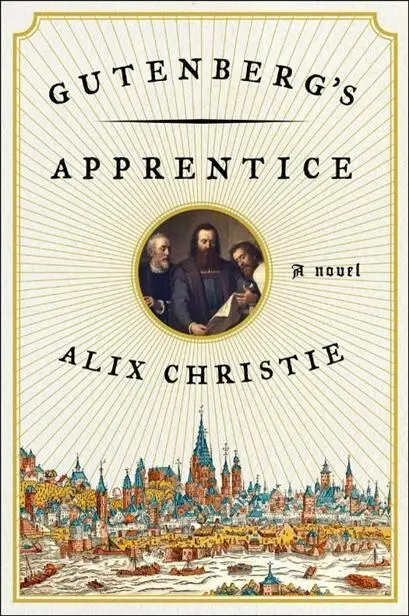
- Название:Gutenberg's Apprentice
- Автор:
- Издательство:Harper
- Жанр:
- Год:2014
- ISBN:нет данных
- Рейтинг книги:5 / 5. Голосов: 1
-
Избранное:Добавить в избранное
- Отзывы:
-
Ваша оценка:
Gutenberg's Apprentice: краткое содержание, описание и аннотация
Предлагаем к чтению аннотацию, описание, краткое содержание или предисловие (зависит от того, что написал сам автор книги «Gutenberg's Apprentice»). Если вы не нашли необходимую информацию о книге — напишите в комментариях, мы постараемся отыскать её.
Youthful, ambitious Peter Schoeffer is on the verge of professional success as a scribe in Paris when his foster father, wealthy merchant and bookseller Johann Fust, summons him home to corrupt, feud-plagued Mainz to meet “a most amazing man.”
Johann Gutenberg, a driven and caustic inventor, has devised a revolutionary — and to some, blasphemous — method of bookmaking: a machine he calls a printing press. Fust is financing Gutenberg’s workshop and he orders Peter, his adopted son, to become Gutenberg’s apprentice. Resentful at having to abandon a prestigious career as a scribe, Peter begins his education in the “darkest art.”
As his skill grows, so, too, does his admiration for Gutenberg and his dedication to their daring venture: copies of the Holy Bible. But mechanical difficulties and the crushing power of the Catholic Church threaten their work. As outside forces align against them, Peter finds himself torn between two father figures: the generous Fust, who saved him from poverty after his mother died; and the brilliant, mercurial Gutenberg, who inspires Peter to achieve his own mastery.
Caught between the genius and the merchant, the old ways and the new, Peter and the men he admires must work together to prevail against overwhelming obstacles — a battle that will change history. . and irrevocably transform them.
Gutenberg's Apprentice — читать онлайн бесплатно полную книгу (весь текст) целиком
Ниже представлен текст книги, разбитый по страницам. Система сохранения места последней прочитанной страницы, позволяет с удобством читать онлайн бесплатно книгу «Gutenberg's Apprentice», без необходимости каждый раз заново искать на чём Вы остановились. Поставьте закладку, и сможете в любой момент перейти на страницу, на которой закончили чтение.
Интервал:
Закладка:
“We can’t protect you — won’t protect you, if he acts against your interest, and our own.”
They stood there silent for a moment, until Jakob sighed. He pulled his cloak taut and wound it around him like a shroud — at last he sat.
“They’ll read it as a call for Crusade,” he said, shaking his head. “You know as well as I that is the last thing Dietrich wants.” His eyes were sunken, glowing in the shadow of his hood.
“His hounds are here,” he said, eyes swiveling to Peter. “His spies, too, everywhere.” His smile was bitter. “The eyes of the archdiocese are trained on Mainz. God only knows what he has promised all his priests to get this tax.”
“So it is done.” Fust sat back heavily.
“And now you lay this in his grasp. There will be nothing, then — no way to restrain that dead hand.”
Der Tote Hand , they called that silent, brutal grasp: the dead hand of the church, exempt from tax on all the property it owned — and yet implacable, invisible, exacting tribute from those under its control. Reaching, always reaching, for some way to suck out their life force.
“You’d better get these on a boat upriver,” said his uncle, “if you hope to hawk them.”
Peter restrained a sudden urge to bolt and scour the city, gathering the traces of this folly. “The ship I run”—he smiled—“is tight, in any case. Secure and battened.” An ark as tough and supple as any cedars out of Lebanon. Levelly he looked at Jakob. “As for the other… who can say?” He shrugged.
Jakob nodded. He looked at Fust. “I’ll do what I can — for you, but no one else.”
Peter went directly toward St. Martin’s. The day was bright and very cold. Puffs of breath hung in the air; beggars huddled, wound in tatters, on the red cathedral stairs. He scanned their sacking, bodies, bowls, and saw a thin boy at the corner by the archbishop’s private chapel, quite clearly freezing, clutching with one paw at a cloak beneath his chin. His other held a sheaf aloft as he called hoarsely, “Comes the Peace-King! To redeem us and destroy the infidel!”
He was grubby, wiry. God only knew where Gutenberg had found him.
“I’ll have one,” Peter muttered, digging in his pocket for the coins. “How many have you, then?” His eyes went to a satchel at the urchin’s feet. The boy just put a hand up to his swaddled ear and shook his head, as if he were stone deaf, and kept on shouting.
Peter turned and started moving quickly at an angle past the Mint, back up and out toward the Cobblers’ Lane. He almost ran into the short man in his path, so deep was he in his dark thoughts. He swerved, and looked up into the ruddy face of Petrus Heilant.
“Rushing, always rushing.” Heilant raised a sandy eyebrow. He was covered in a warm gray cloak with bright red piping. “One might think you had some vital errand.”
“Business waits for no man,” Peter said.
“But surely it must wait for God?” Heilant’s cheeks were pink with cold; he wore the close-fitted crimson cap of the cathedral chapter. Plainly he was simple scribe no more.
“I pray to Him along the way.” Still Peter stopped and held his hand out.
“We see too little of you, though.” Heilant’s eyes were veiled, ironic. “I’d almost think you kept your distance.”
Peter faked a smile. “It looks as if you are the one who’s left me in the dust.”
Heilant brightened and touched his cap. “It suits me, don’t you think?”
As well as it ever suited any lustful soul. Peter rolled his eyes and kept his smile on. So Heilant had managed, after all, to creep his way into some well-paid post. One not too high, nor yet abject; he had, like Peter, studied the four lower orders of theology.
“Let me guess.” Playfully, he poked him. “Not akolyte or ostiar .” Petrus Heilant would not stoop to altar service, or to ringing of the bells.
“ Lektorat .” Heilant’s voice was clipped.
“Bravo. Of course.” Peter clapped him on the back. The only other option would have been as exorzist : far better to read out the lessons than to have to lay one’s hands upon some dread-filled soul.
His former schoolmate’s eyes roved over him, taking in his threadbare cloak, his ink-stained hands, then froze. He seemed to coil himself up as his hand jabbed toward the pamphlet clutched at Peter’s side. “So you have seen it too,” he breathed. His face was guarded suddenly: if Peter had not known him better, he’d have said that he was scared.
The printer measured out each word. “I only just now bought it. Why?”
Heilant bent his head close. “It’s more than strange.” His breath was hot in Peter’s ear. “Something queer — ungodly. I’ve seen three now and”—he was hissing—“every one is just exactly, I mean exactly — not an altered letter, not an eyeskip — utterly the same.”
He stood rooted, clutching Peter’s arm. The look upon his face was clearly fear. It was a look that Peter knew: he’d seen it too on Anna Pinzler’s face. If years ago he’d not been told how they were made — and at the very instant that his hand first grazed those printed lines — he would have looked as frightened and amazed.
The scribe’s blue eyes were latched on to his face.
“How many are there, do you know?” was all that Peter thought to ask.
Heilant shook his head and reached to tug at it.
“Not here.” The printer cinched it tighter between arm and ribs.
“Then come to me. And we will put them side by side.” Heilant’s color had returned. But there was still repulsion in his eyes. “It isn’t right. I’ve never seen its like. It was not made by any scribe.”
Soothingly, his hand as steady as a rock, Peter touched his arm. “We will examine them.” He willed his voice smooth. “Perhaps the answer is… entirely banal. Look at Lauber, he has a writing army now. Perhaps he has a pattern book as well.”
“I pray it’s so.” Heilant crossed himself. “But everything about it leaves a dread upon my soul.”
They parted, Peter promising to come as soon as he was able. He hurried down the lane, passing the Humbrechthof, slowing for an instant to be sure he could hear nothing through its outer wall. Please God, he prayed. His legs strode on past St. Quintin’s, then to the master’s house upon its knoll. He came around to the back door and pounded, his hand coiled tightly in the biting cold.
Lorenz looked startled, dragged from sleep, when finally he opened. The master wasn’t there.
Where was he then, God damn him? Peter cursed and spun. Courting favor with the archbishop’s men, coaxing coins from merchants, Elders, sousing with whoever paid inside some hole? Scrounging for another piece of tripe that he could spin from lead to gold? Where was he, when it came right down to it, when he was needed? Peter turned back to the workshop, frozen through. The man was gone — had left them, as he always did, to clean up the mess he left behind.
“Let me see it.” Heilant creased one pamphlet open, then the other, to the selfsame page. Peter traced an a , then moved his finger to the a upon the other page. “Indeed,” he said. “Extremely strange.”
There was an unaccustomed bustle in the Schreibhaus common room that night. The back was filled with strangers in a jumble of dark robes; the roads were full these days with delegations, Heilant said. Peter looked up at the counter where the food and drink were served, and saw an orphan pamphlet in plain view.
“Two of a kind,” he whispered into Heilant’s ear. “Let’s make a flush, and see.”
He rose and palmed the lonely booklet. There was a tray for coins, a lettered notice in the master’s hand. He dropped five shillings in and winced.
Читать дальшеИнтервал:
Закладка:
Похожие книги на «Gutenberg's Apprentice»
Представляем Вашему вниманию похожие книги на «Gutenberg's Apprentice» списком для выбора. Мы отобрали схожую по названию и смыслу литературу в надежде предоставить читателям больше вариантов отыскать новые, интересные, ещё непрочитанные произведения.







Обсуждение, отзывы о книге «Gutenberg's Apprentice» и просто собственные мнения читателей. Оставьте ваши комментарии, напишите, что Вы думаете о произведении, его смысле или главных героях. Укажите что конкретно понравилось, а что нет, и почему Вы так считаете.