Alix Christie - Gutenberg's Apprentice
Здесь есть возможность читать онлайн «Alix Christie - Gutenberg's Apprentice» весь текст электронной книги совершенно бесплатно (целиком полную версию без сокращений). В некоторых случаях можно слушать аудио, скачать через торрент в формате fb2 и присутствует краткое содержание. Год выпуска: 2014, Издательство: Harper, Жанр: Историческая проза, на английском языке. Описание произведения, (предисловие) а так же отзывы посетителей доступны на портале библиотеки ЛибКат.
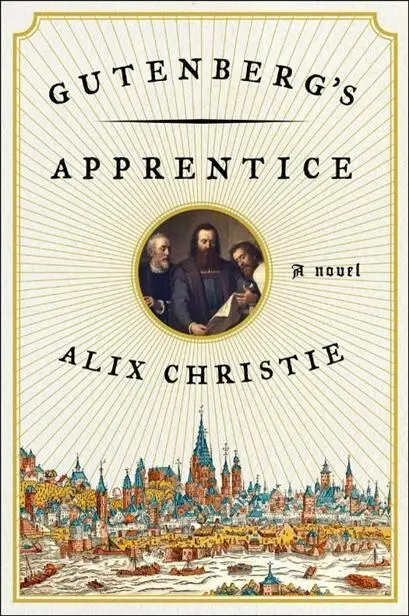
- Название:Gutenberg's Apprentice
- Автор:
- Издательство:Harper
- Жанр:
- Год:2014
- ISBN:нет данных
- Рейтинг книги:5 / 5. Голосов: 1
-
Избранное:Добавить в избранное
- Отзывы:
-
Ваша оценка:
Gutenberg's Apprentice: краткое содержание, описание и аннотация
Предлагаем к чтению аннотацию, описание, краткое содержание или предисловие (зависит от того, что написал сам автор книги «Gutenberg's Apprentice»). Если вы не нашли необходимую информацию о книге — напишите в комментариях, мы постараемся отыскать её.
Youthful, ambitious Peter Schoeffer is on the verge of professional success as a scribe in Paris when his foster father, wealthy merchant and bookseller Johann Fust, summons him home to corrupt, feud-plagued Mainz to meet “a most amazing man.”
Johann Gutenberg, a driven and caustic inventor, has devised a revolutionary — and to some, blasphemous — method of bookmaking: a machine he calls a printing press. Fust is financing Gutenberg’s workshop and he orders Peter, his adopted son, to become Gutenberg’s apprentice. Resentful at having to abandon a prestigious career as a scribe, Peter begins his education in the “darkest art.”
As his skill grows, so, too, does his admiration for Gutenberg and his dedication to their daring venture: copies of the Holy Bible. But mechanical difficulties and the crushing power of the Catholic Church threaten their work. As outside forces align against them, Peter finds himself torn between two father figures: the generous Fust, who saved him from poverty after his mother died; and the brilliant, mercurial Gutenberg, who inspires Peter to achieve his own mastery.
Caught between the genius and the merchant, the old ways and the new, Peter and the men he admires must work together to prevail against overwhelming obstacles — a battle that will change history. . and irrevocably transform them.
Gutenberg's Apprentice — читать онлайн бесплатно полную книгу (весь текст) целиком
Ниже представлен текст книги, разбитый по страницам. Система сохранения места последней прочитанной страницы, позволяет с удобством читать онлайн бесплатно книгу «Gutenberg's Apprentice», без необходимости каждый раз заново искать на чём Вы остановились. Поставьте закладку, и сможете в любой момент перейти на страницу, на которой закончили чтение.
Интервал:
Закладка:
That written Bible was a handsome thing: the lettering was fluid, the decoration in the standard Cherry Orchard style of branching bowers filled with buds and birds. Their flowers were orange or red, white-hatched; they used the leaves of the acanthus, indigo or green. The style was graceful, calm, though to his eye — and to his father’s and to Anna’s, Peter knew — too rote and filled with gold-flecked preening. “I see now why His Grace approves your work.” Fust gave an enigmatic smile.
Without intending to, Peter glanced at Anna. Her eyes were on him; for an instant he could feel the torrent they unleashed. If they had been alone, he knew she would have scorned that work. With pity — after all, her brothers labored there. But he had heard her more than once dismiss it as mere shiny surface, just copied from a pattern book. Repetitive, identical — just like those metal letters he had shown her.
All he had offered her. All she had spurned. Peter looked back down.
His mistake had been to think that she was like him — born of this clay, yet able to rise out of it somehow. He felt her eyes still on him, prickling. His face felt taut: he was intensely conscious of that beam of her attention, like a thread across the table, stitching at his skin. Again he glanced up, and the tension broke. She looked away; she could not bear his gaze.
Markus gathered up his sheets. Casually Peter asked how many pages the whole Bible made. Around a thousand, was the answer. He nodded, galled inside — to have to gaze at this, and yet be barred from showing off the wonder of its freshly printed rival.
The Austrian gave a small cough and nudged his papers forward. They were samples only, he explained; the works of course remained inside the abbeys and the castles he had served. “You name the thing, I’ve colored it,” he said, his mouth a crooked line. “Choir books, land grants, books of hours, and Bibles too. I heard you had a big one here.”
Fust pursed his lips, then opened the worn sheets. He sat unmoving for a while, staring at a strange and gleaming thicket. This artist’s vines were hung with spiky leaves, in shades of silvered green, gray slate. He turned the page, to find the same wild bushiness upon the next sheet, and the next. The man possessed a queer and otherworldly style: Peter had never seen such flowers grow upon this earth as bloomed upon those pages. His large initials used less gilding than the Mainzers’; he formed them out of patterns flecked with dots. Here and there he’d dropped in figures — monkeys, saints — that were more awkward, less successful. The Pinzlers looked on silently, and Peter tasted sourness in the air.
“You must have stumbled into nettles once.” His father clucked his tongue.
The painter kept his sad eyes fastened on the man who might, with luck, become a client. Fust was peering down, evidently charmed by, or at the very least intrigued at, those barbed and writhing lines. “Nettles, aye.”
“I’ve tried to paint more true to life.” The painter spread his fingers, long and tapered as an angel’s. “But never seem quite able.”
“You have then, like the others, some pattern that you follow?”
“Just in my mind.”
Fust raised his head and eyed the fellow. “You were last in Würzburg, am I right?”
“I was.”
“And painted there a Bible.”
“I was one of many hands.”
“Before that?”
“In Bohemia, then Salzburg.”
“I like a man who moves around.”
The Austrian relaxed a bit. “It is an interesting life.”
“You hear things,” Fust said. “I would guess,” and tipped his head at Klaus. Their host rose and came back with wine and glasses.
There wasn’t much about the tramp, at least, for anyone to fancy. His face was weather-blasted, with a glint of animal alertness in his fully opened eye.
“What news is there, then, from the East?” his father asked.
“The heretics encircle Belgrade.”
“Bad news.” Klaus frowned.
“Shields and banners.” Peter looked at Klaus with sympathy. “That’s all that anyone wants painted now.”
Anna’s father drew down his dark brows. “Chests are what you need, and altars, windows, if you want to feed a wife and child.” His tone was sharp.
“And to the south?” Fust kept on.
“A man from Graz said I might like to know there was a mountain of old manuscripts on one ship he saw coming into Venice.”
“From Constantinople?”
“Survivors, aye. The Greeks are fleeing.” The Austrian looked up, around. “Manuscripts of all descriptions, what I heard. They saved some libraries, at least — they say there’re books there none of us have seen.”
“What kind of books?” Fust leaned forward.
“Medicine, geography. Ptolemy and Plato — all of it in Greek.” The painter hitched his shoulders and gave a ghost of a smile.
Fust turned toward Peter; for the first time in long weeks, his eyes began to stir.
The last time anyone had salvaged learning from the East, it had been Cardinal Cusanus. A dozen years before, he’d sailed off to Byzantium, and smuggled treasures from those monasteries that lay crushed now underneath the despot’s boot. What other riches had they salvaged in their flight? Things only ancients knew, which few had seen — except in scribbled Latin copied from the Arabs.
“A silver lining,” Fust said thoughtfully, and then fell silent.
After a time Klaus made a sign; there was a scraping as both painters stood and pushed their chairs back. Fust stood and shook their hands. “The choice is hard,” he said, and tipped his head. Anna stiffly curtseyed, and then they all withdrew. Her waist was just as slim, her hair as long and shining. Peter wondered if she’d brushed it fifty times, as she had done so long ago for him.
Frau Pinzler came and without a word set down three steins of beer. His father didn’t notice how tight her lips were, nor how she carefully avoided Peter’s eyes.
“It’s good to see you back, Johann,” said Klaus.
“This has been — most enlightening.” Indeed, his son thought: a raft of news.
“Share and share alike.” The painter cut the sausage. “There’s precious little now to go around.”
Fust nodded. “You’ll not get lapis now, nor azurite, but what you can from Cornwall.”
“Won’t matter if the buyers stay this scarce.” Klaus took a quaff. “How soon you think you’ll need him?” Which “him” he meant was clear.
Fust glanced at Peter. “Hard to say,” he said. “A month or two.”
“By then the Austrian will be long gone.” Klaus smiled, a little lighter now. “It stands to reason, anyway,” he paused, “that we look out for ours.” He could not stop himself from glancing at the son he might have had.
He hoped to cut a deal with Markus, plainly: have the painting done right there, and not at Weydenbach’s a few doors down. Fust made a noncommittal noise.
“A shame, I mean,” Klaus kept on, “to spread the benefits too far afield.”
“When you could keep it underneath this roof, you mean.”
“It shouldn’t make much difference to your partner.”
Fust’s face went hard. “This has no bearing on that work.”
“You get what’s yours, eh? The old sinner gets what’s his?” The wink, the tone, were both much too familiar.
“I do not grasp your meaning.”
Klaus licked his lips. “Just that — he bought a vat of linseed oil last week, for some new project, as he said.” He turned toward Peter. “I couldn’t think what he would do with it — with metal, anyway, if you get my meaning.” He made a little motion with his finger, to show he knew about those pilgrim mirrors. “Herr Gutenberg was winking and grinning, like he does, you know — like it was something big.”
Читать дальшеИнтервал:
Закладка:
Похожие книги на «Gutenberg's Apprentice»
Представляем Вашему вниманию похожие книги на «Gutenberg's Apprentice» списком для выбора. Мы отобрали схожую по названию и смыслу литературу в надежде предоставить читателям больше вариантов отыскать новые, интересные, ещё непрочитанные произведения.


Обсуждение, отзывы о книге «Gutenberg's Apprentice» и просто собственные мнения читателей. Оставьте ваши комментарии, напишите, что Вы думаете о произведении, его смысле или главных героях. Укажите что конкретно понравилось, а что нет, и почему Вы так считаете.