Alix Christie - Gutenberg's Apprentice
Здесь есть возможность читать онлайн «Alix Christie - Gutenberg's Apprentice» весь текст электронной книги совершенно бесплатно (целиком полную версию без сокращений). В некоторых случаях можно слушать аудио, скачать через торрент в формате fb2 и присутствует краткое содержание. Год выпуска: 2014, Издательство: Harper, Жанр: Историческая проза, на английском языке. Описание произведения, (предисловие) а так же отзывы посетителей доступны на портале библиотеки ЛибКат.
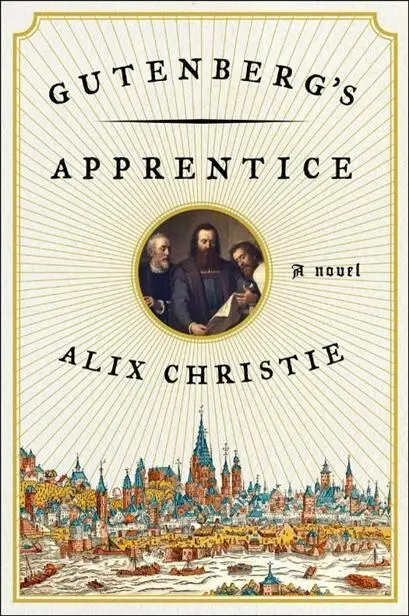
- Название:Gutenberg's Apprentice
- Автор:
- Издательство:Harper
- Жанр:
- Год:2014
- ISBN:нет данных
- Рейтинг книги:5 / 5. Голосов: 1
-
Избранное:Добавить в избранное
- Отзывы:
-
Ваша оценка:
Gutenberg's Apprentice: краткое содержание, описание и аннотация
Предлагаем к чтению аннотацию, описание, краткое содержание или предисловие (зависит от того, что написал сам автор книги «Gutenberg's Apprentice»). Если вы не нашли необходимую информацию о книге — напишите в комментариях, мы постараемся отыскать её.
Youthful, ambitious Peter Schoeffer is on the verge of professional success as a scribe in Paris when his foster father, wealthy merchant and bookseller Johann Fust, summons him home to corrupt, feud-plagued Mainz to meet “a most amazing man.”
Johann Gutenberg, a driven and caustic inventor, has devised a revolutionary — and to some, blasphemous — method of bookmaking: a machine he calls a printing press. Fust is financing Gutenberg’s workshop and he orders Peter, his adopted son, to become Gutenberg’s apprentice. Resentful at having to abandon a prestigious career as a scribe, Peter begins his education in the “darkest art.”
As his skill grows, so, too, does his admiration for Gutenberg and his dedication to their daring venture: copies of the Holy Bible. But mechanical difficulties and the crushing power of the Catholic Church threaten their work. As outside forces align against them, Peter finds himself torn between two father figures: the generous Fust, who saved him from poverty after his mother died; and the brilliant, mercurial Gutenberg, who inspires Peter to achieve his own mastery.
Caught between the genius and the merchant, the old ways and the new, Peter and the men he admires must work together to prevail against overwhelming obstacles — a battle that will change history. . and irrevocably transform them.
Gutenberg's Apprentice — читать онлайн бесплатно полную книгу (весь текст) целиком
Ниже представлен текст книги, разбитый по страницам. Система сохранения места последней прочитанной страницы, позволяет с удобством читать онлайн бесплатно книгу «Gutenberg's Apprentice», без необходимости каждый раз заново искать на чём Вы остановились. Поставьте закладку, и сможете в любой момент перейти на страницу, на которой закончили чтение.
Интервал:
Закладка:
“It is of little consequence.” Peter stood and put the book back on its shelf. “Though you may tell her, if you like, I wish her well.”
“That’s all?” Her face was white, and strangely twisted.
He saw the steeples shining whitely and the soaring towers of God’s City sometimes, in his mind.
“Where I must go,” he said, and touched her on the hand, “I doubt that anyone can follow.”
He was sitting at the table upstairs at the Humbrechthof, reviewing distribution of the quires, when the first man came demanding monies due. Hans came galumphing up, his composing cap in hand. “I don’t know how he knew,” he said, “but there’s a herdsman at the door what claims we owe him twenty guilders.”
The man stood in the lane outside, just at the portal to the courtyard, with a skinny youth beside him. He shifted on his hobnail boots; a bit of straw was caught in his brown beard. “Don’t like to do it, sir,” he said, “but winter’s coming on.” His skin was grooved and brown as an old nut, and Peter felt the range wind scouring till the herder was entirely polished, one with his long staff of yew.
The boy produced a sheet and thrust it toward him.
“How came you here? Who steered you to this house?”
The herder looked at him through narrowed eyes. “I look for Gutenberg.”
“He lives down the road.”
“This here’s his works. He took the hides in here.” The man moved as if to enter; Peter barred the way.
“He isn’t here. But I’m empowered to conduct his business.” He took the paper off the boy. “He owes you then, you say.”
“In consequence of three hundred fifty skins of six-month calves,” it said, priced at six shillings each. The total, 45 guilder, had been struck out, replaced by 35, a scrawled notation “15 down” in Gutenberg’s crabbed hand.
“I see,” he said. Peter looked harder at the man. Why had he come, why was he sent, at this very hour, this very day? “No date,” said Peter, flicking the receipt with one hard finger.
“This time the year just past.” The face turned one shade darker. “The whole stock market is my witness.”
Peter too recalled those heaps of skins, close to overwhelming the poor donkeys as they stumbled from the livestock pens. Damn him, he thought. Damn him.
“Why did you not go to his house? He made the terms.” Peter temporized. Gutenberg had left no lockbox, only coins to keep the men in food.
“His man said he was on a journey. As I would fain be too.” The herder’s hand went to his belt, where hung a battered sheath.
Hans jerked his head, and they conferred. He could get ten off of Lorenz; Henne had a secret jar. As Grede kept her own store for an emergency, thought Peter. He eyed the herder for an instant, recognizing the lean men of his own native farmland.
“Where are you from?” he asked.
“Black Forest way.”
Gutenberg’s apprentice, now his foreman, nodded. “While you’re waiting, have a bite.” He left them in the courtyard in Frau Beildeck’s care, but not before he locked the workshop and closed up the shutters. “Hey!” said Keffer. “Light a candle,” Peter growled.
The bastard, he was thinking. Timed his trip, most likely, to the monthly livestock market. Kept his head down while the drovers and the butchers did their business in four legs with all the traders. The wily bastard , he was still intoning deep inside, as he told Grede in all sincerity that Fust would pay the man if he were there.
Both of the partners were due back now any day. Peter paid the herdsman and watched his whittled staff and belted robe receding down the lane. He shook his head and looked up briefly at St. Martin’s red stone steeple. Who else? The chandler, papermaker, varnish man? He chuckled then and crossed himself and closed the little door cut in the portal. He had been warned.
A few days later, Peter heard from his cousin Jakob that a merchant stopping at the Kaufhaus out of Erfurt had been asking awkward questions on the trading floor. His uncle sent his son to tell him, not a serving boy; Peter understood it was a warning. A year had passed since all the guilds had taken gold for silence, but patience had its limits.
Jakob the younger was a thick man, dark-haired like his mother, not that quick. “There’s them that wager you are casting weapons,” he said. “They know they’re not to talk, but…” Up and down went his broad shoulders. “The point is that your ship is leaky — so my father says.”
The Erfurt merchant had inquired if Fust was in the city, as he’d like to buy a book. They had been saved by a swift wagoneer who said he wasn’t — but his brother was Fust’s other half. He’d pointed the fellow to Jakob’s great fine house, built by their father right across from the cathedral. A lucky thing, Jakob the younger said, though Peter knew it was not simply luck. He wondered only how his uncle answered — if he’d impressed upon the man the need for some discretion, and if so, exactly how. They could not say the thing was secret, not from Dietrich — only whisper meaningfully that this technique was of such value, and so marvelous, that none should hear of it until the Book was done. Then he could brandish it as proudly as he pleased, one of the lucky few to hold one in his hands. That at any rate is how the printer would present the thing, if he were charged with sales — which, God be praised, he wasn’t. Why in the devil had his father stopped to show the quires in Erfurt, anyway? It was too close, thought Peter, and too thick with clergymen.
That was the question Gutenberg put sharply to his father too, when in October they both returned home. They rattled in and overlapped just like those tin-plate skaters on the tower clock. Gutenberg was bright-eyed, rested, clean, as if he’d stopped quite close to Mainz the night before, in Eltville or at St. Viktor’s.
“How much did you get done?” He threw his cloak off, thrusting it at Peter, then kept moving down the hall. Peter looked at Hans, who rolled his rheumy eyes; he tossed the cloak toward a chair, not caring if it fell. The man moved through the workshop room by room, touching things as if to leave his scent in every corner.
“You might have told me I’d have visitors,” Peter told him. First there had been the creditor, and then a nosy merchant. Gutenberg went still, his dark eyes moving between Hans and Peter. “I’d be obliged next time,” his foreman said, “if you’d leave more than Lorenz’s jar.”
“You’re worse than an old woman.” The master waved a hand peevishly. And then that hand crept up and started worrying the fringes of his beard.
They both jumped to hear Fust’s voice a few hours later, greeting someone in the yard. Peter laid aside his composing stick and stood, but Gutenberg was faster, always; he’d already darted to the door. He grasped his partner by the arm and steered him back out into the fall sunlight. Peter watched the way he turned his back, as if the two of them were all that mattered, and the workshop simply ran itself. Silently he followed, pulling shut the door. He was taller than his father, nearly as tall as Gutenberg, and yet more muscled, stronger than the master now. He inserted himself between them.
“You plunder my own household, I have heard,” Fust drily said. “Ten guilders here, ten guilders there.” He tipped his head in greeting at his son.
“And you shoot off your mouth to merchants.”
“There was a merchant here from Erfurt,” Peter clarified. “Inquiring after Fust’s new Bible.”
His father’s lips pulled tight. “Damnation.”
“I said you’d best take care in how you peddled it,” growled Gutenberg.
“He used the word?” Fust turned to Peter. “He called it, actually, a Bible?” His eyes were troubled. Peter shrugged. “I wasn’t there. Your ‘fine new book,’ or something like it — Jakob knows, he spoke to him.”
Читать дальшеИнтервал:
Закладка:
Похожие книги на «Gutenberg's Apprentice»
Представляем Вашему вниманию похожие книги на «Gutenberg's Apprentice» списком для выбора. Мы отобрали схожую по названию и смыслу литературу в надежде предоставить читателям больше вариантов отыскать новые, интересные, ещё непрочитанные произведения.









Обсуждение, отзывы о книге «Gutenberg's Apprentice» и просто собственные мнения читателей. Оставьте ваши комментарии, напишите, что Вы думаете о произведении, его смысле или главных героях. Укажите что конкретно понравилось, а что нет, и почему Вы так считаете.