Alix Christie - Gutenberg's Apprentice
Здесь есть возможность читать онлайн «Alix Christie - Gutenberg's Apprentice» весь текст электронной книги совершенно бесплатно (целиком полную версию без сокращений). В некоторых случаях можно слушать аудио, скачать через торрент в формате fb2 и присутствует краткое содержание. Год выпуска: 2014, Издательство: Harper, Жанр: Историческая проза, на английском языке. Описание произведения, (предисловие) а так же отзывы посетителей доступны на портале библиотеки ЛибКат.
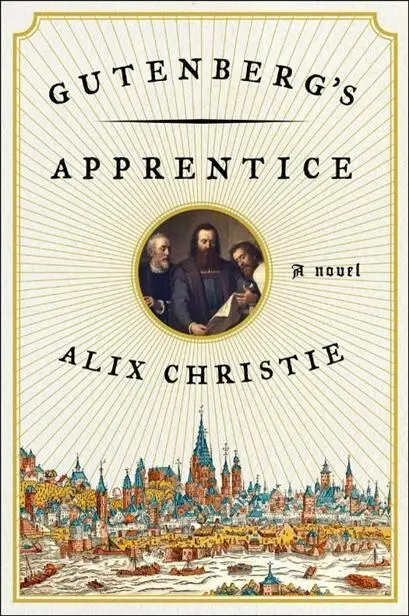
- Название:Gutenberg's Apprentice
- Автор:
- Издательство:Harper
- Жанр:
- Год:2014
- ISBN:нет данных
- Рейтинг книги:5 / 5. Голосов: 1
-
Избранное:Добавить в избранное
- Отзывы:
-
Ваша оценка:
Gutenberg's Apprentice: краткое содержание, описание и аннотация
Предлагаем к чтению аннотацию, описание, краткое содержание или предисловие (зависит от того, что написал сам автор книги «Gutenberg's Apprentice»). Если вы не нашли необходимую информацию о книге — напишите в комментариях, мы постараемся отыскать её.
Youthful, ambitious Peter Schoeffer is on the verge of professional success as a scribe in Paris when his foster father, wealthy merchant and bookseller Johann Fust, summons him home to corrupt, feud-plagued Mainz to meet “a most amazing man.”
Johann Gutenberg, a driven and caustic inventor, has devised a revolutionary — and to some, blasphemous — method of bookmaking: a machine he calls a printing press. Fust is financing Gutenberg’s workshop and he orders Peter, his adopted son, to become Gutenberg’s apprentice. Resentful at having to abandon a prestigious career as a scribe, Peter begins his education in the “darkest art.”
As his skill grows, so, too, does his admiration for Gutenberg and his dedication to their daring venture: copies of the Holy Bible. But mechanical difficulties and the crushing power of the Catholic Church threaten their work. As outside forces align against them, Peter finds himself torn between two father figures: the generous Fust, who saved him from poverty after his mother died; and the brilliant, mercurial Gutenberg, who inspires Peter to achieve his own mastery.
Caught between the genius and the merchant, the old ways and the new, Peter and the men he admires must work together to prevail against overwhelming obstacles — a battle that will change history. . and irrevocably transform them.
Gutenberg's Apprentice — читать онлайн бесплатно полную книгу (весь текст) целиком
Ниже представлен текст книги, разбитый по страницам. Система сохранения места последней прочитанной страницы, позволяет с удобством читать онлайн бесплатно книгу «Gutenberg's Apprentice», без необходимости каждый раз заново искать на чём Вы остановились. Поставьте закладку, и сможете в любой момент перейти на страницу, на которой закончили чтение.
Интервал:
Закладка:
Speed was of the essence, clearly. Thus it was all the more bizarre when Gutenberg produced his two new hires: a pair of brothers out of Eltville, faces smooth as babies’ rumps, their fingers white and slender as new shoots. If every other member of the crew had brought some knowledge of writing and engraving, the Bechtermünze brothers at the most had held a silver spoon.
“Nikolaus and Heinrich, meet the crew.” Hans looked them up and down and with his teeth made a low sucking sound. “Train up, train up,” the master said and turned. It took no imagination to deduce the truth: he’d got a pretty price to take them off their father’s hands. Old Bechtermünze surely saw the chance as providential. He was a distant clansman of the master’s too — which Elder wasn’t, in those looping ties connecting Mainz’s thirty wealthy clans? He doubtless saw the workshop as a safer cloister than the abbeys where he might have shelved his youngest sons, before the monks began that cant about reform.
Still, presses are not cheap, nor hands, connected as they are to mouths: four more gullets, with the pressman and the beater, wine and bread and now and then some meat. Fust’s face was purple when he learned on his return.
“No warning? Not a blessed word?” He grabbed Peter’s elbow after church. “Is this how I’m repaid?”
“It’s not my works.”
“But mine. And that does make it your concern.”
“I did not feel it was my place,” said Peter.
“Your place is where I put you — there, to keep an eye on things, hold up my side.”
Peter smiled. “I did not know that there were sides.” He stood there, at the portal of the church, a bright late summer’s day. “Do we not pull together?”
“And I buy all the bloody oxen feed,” Fust growled. “Do not forget who buys these tools and pays the bills, and by the way, your wage.”
The next day their two voices rose in counterpoint to Ruppel’s hammer building the new press. In the composing room they eyed their texts, pretending that they didn’t hang on every word. They had the room, the master bellowed: hell, they had the space for working, eating, too.
“Who said that you could make decisions for the two of us?”
“As far as I recall, I am the master of this works.”
“Four more mouths to house and feed.”
“What’s it to you? So long as your own payment stays the same? The trouble is all mine, as far as I can see. To make it work.”
They stepped into the corridor and into view.
“To make it work.” The words, in Fust’s mouth, sounded vulgar. He stopped and raised a finger to his partner’s chest. “No matter how you count it, though, it raises all the costs one-third.”
Sidelong, Peter saw the way they locked their wills: Fust with his belly round and hard, his legs braced far apart, Gutenberg with his beard flowing, pulled to his full height.
“Johann.” The master dropped his voice. “We have to finish this, and soon. You know it’s true.” He took his arm; Fust shook it off. They headed toward the door. “I saw no other way. .. Besides…” They heard the way he tried to smooth that standing fur. “We’re not without resources. We can bring money in as well…”
“A charmer, when it suits him.” Hans rolled his old eyes heavenward.
A third pressman was brought in, called Johann Neumeister. Grede’s young cousin Wiegand was appointed as his beater. More boys were hired to fold and damp. And so their number — six compositors, two men each for three presses — swelled to twelve. Peter did not think he was the only one to think of the apostles, preparing Gospels for a fallen world. Only later did he look back on that final shape and ask himself which played the part of Thomas, which of Judas? Which ones were steadfast, which deceitful, which of them began to doubt?
CHAPTER 2: APOTHEOSIS
[22 of 65 quires]
August 1453
THE MASTER SUMMONED Peter the week they started the New Testament. He recalls it quite precisely — can remember clearly the strange sense of portent, the conviction that it all was willed. The prologue to the Four Evangelists had just come off the press, and in it he saw prophecy. He took a clean proof with him when he locked the shop after the night’s long haul, and walked it over to the Hof zum Gutenberg.
“This you must read,” he said, and held out the sheet to Gutenberg.
Jerome’s introductions to each Bible book were oddly frank and often out of tune with what was written in the Scriptures. Here Jerome had moaned a bit, and said he feared reprisals, then justified his duty to revise — and, yes, correct — the Holy Book, in words that clearly foretold their own printed Bible.
“‘Even the testimonies of the evil-sayers agree that what varies cannot be true.’” The master read it out. “‘For if we are to be faithful to the Latin editions, let them answer: to which of them? For there are practically as many editions as there are copies.’
“Excellent,” he said, and gave it back.
“‘What varies cannot be true,’” said Peter, smiling, shaking his dark head. “He knew one day we’d fix the Word, and make it permanent, forever.”
“It is ordained.” Gutenberg half stood and leaned to push the shutters open. A bright new Sabbath streamed into the room.
“Yet still amazing,” Peter said.
“That I will grant.” The master tucked his beard into his shirt. “To think that such as we might figure in His plan.” His grin was crooked. He poured them each a glass. “But then again, it isn’t ours to ask if we are fit for the task.”
“Indeed.”
“Now more than ever we must fall back on our faith.”
For all the foulness of his mouth, he was a God-revering man. He drank from tin and not from silver; he cared little for the fine things of the world. Peter found himself surveying his disorderly front room, struck for the first time by this fact.
“Frau Beildeck would be horrified,” said Gutenberg and smiled.
“She has her work cut out with us.”
The master nodded, but kept his eyes on Peter just a fraction longer than was comfortable. “Slaves lashed to their spars.” He lightly snorted. “Don’t think that I don’t know it. They’ll be just fine — in fact, that’s why I called you here.”
Peter’s nape hairs lifted instantly. Lately he’d enjoyed the master’s high regard — but even so, you never knew just what might issue from that mouth.
Gutenberg leaned toward him, his brown eyes clear and calm and flecked with gold.
“You’ve learned as much as I had hoped. Not just technique — the men respect you, too.”
A rod of fear swiped through him.
“I’ve seen the way you treat them — I daresay better than I do. It seems to me you’re ready as you’ll ever be to run it day to day.”
Peter tried to speak, but found his throat was closed.
“Don’t look like that!” The hoary face was grinning now. “You’ve run it, nearly, these last months. I’ve seen the way you keep the copy moving, how you guide them.” He touched Peter on the arm. “Don’t think I haven’t seen as well the way you watch my every move.”
“No more than you.”
The master laughed and settled back.
“You cannot mean you’re going.”
Gutenberg shook his head no.
“But then—”
“I’ll keep my eye in here and there. Somebody has to go ahead, though — sweep the track.”
The master looked at him and, not unkindly, laughed. “It’s running now with decent speed, correct?” he asked. Peter nodded.
“There’s nothing to it, then. Remember Theophilus. It is a sin to shirk the gifts that God has given.” Gutenberg seemed not to grasp the fear that paralyzed his journeyman, now elevated to the master of the shop. “Come, man. You’re fit to go. God knows I’ve got no patience for the thousand petty problems of the crew.”
Читать дальшеИнтервал:
Закладка:
Похожие книги на «Gutenberg's Apprentice»
Представляем Вашему вниманию похожие книги на «Gutenberg's Apprentice» списком для выбора. Мы отобрали схожую по названию и смыслу литературу в надежде предоставить читателям больше вариантов отыскать новые, интересные, ещё непрочитанные произведения.











Обсуждение, отзывы о книге «Gutenberg's Apprentice» и просто собственные мнения читателей. Оставьте ваши комментарии, напишите, что Вы думаете о произведении, его смысле или главных героях. Укажите что конкретно понравилось, а что нет, и почему Вы так считаете.