Alix Christie - Gutenberg's Apprentice
Здесь есть возможность читать онлайн «Alix Christie - Gutenberg's Apprentice» весь текст электронной книги совершенно бесплатно (целиком полную версию без сокращений). В некоторых случаях можно слушать аудио, скачать через торрент в формате fb2 и присутствует краткое содержание. Год выпуска: 2014, Издательство: Harper, Жанр: Историческая проза, на английском языке. Описание произведения, (предисловие) а так же отзывы посетителей доступны на портале библиотеки ЛибКат.
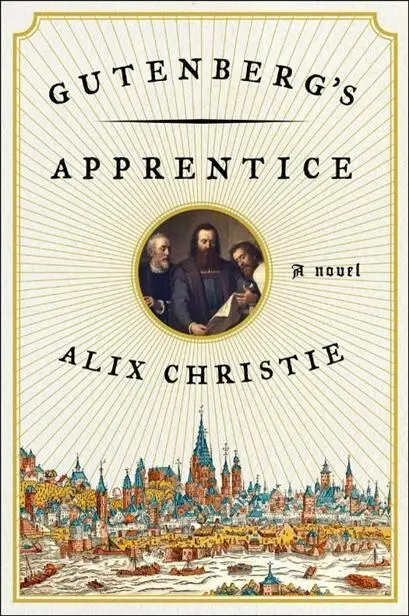
- Название:Gutenberg's Apprentice
- Автор:
- Издательство:Harper
- Жанр:
- Год:2014
- ISBN:нет данных
- Рейтинг книги:5 / 5. Голосов: 1
-
Избранное:Добавить в избранное
- Отзывы:
-
Ваша оценка:
Gutenberg's Apprentice: краткое содержание, описание и аннотация
Предлагаем к чтению аннотацию, описание, краткое содержание или предисловие (зависит от того, что написал сам автор книги «Gutenberg's Apprentice»). Если вы не нашли необходимую информацию о книге — напишите в комментариях, мы постараемся отыскать её.
Youthful, ambitious Peter Schoeffer is on the verge of professional success as a scribe in Paris when his foster father, wealthy merchant and bookseller Johann Fust, summons him home to corrupt, feud-plagued Mainz to meet “a most amazing man.”
Johann Gutenberg, a driven and caustic inventor, has devised a revolutionary — and to some, blasphemous — method of bookmaking: a machine he calls a printing press. Fust is financing Gutenberg’s workshop and he orders Peter, his adopted son, to become Gutenberg’s apprentice. Resentful at having to abandon a prestigious career as a scribe, Peter begins his education in the “darkest art.”
As his skill grows, so, too, does his admiration for Gutenberg and his dedication to their daring venture: copies of the Holy Bible. But mechanical difficulties and the crushing power of the Catholic Church threaten their work. As outside forces align against them, Peter finds himself torn between two father figures: the generous Fust, who saved him from poverty after his mother died; and the brilliant, mercurial Gutenberg, who inspires Peter to achieve his own mastery.
Caught between the genius and the merchant, the old ways and the new, Peter and the men he admires must work together to prevail against overwhelming obstacles — a battle that will change history. . and irrevocably transform them.
Gutenberg's Apprentice — читать онлайн бесплатно полную книгу (весь текст) целиком
Ниже представлен текст книги, разбитый по страницам. Система сохранения места последней прочитанной страницы, позволяет с удобством читать онлайн бесплатно книгу «Gutenberg's Apprentice», без необходимости каждый раз заново искать на чём Вы остановились. Поставьте закладку, и сможете в любой момент перейти на страницу, на которой закончили чтение.
Интервал:
Закладка:
NUMBERS
CHAPTER 1: RETRIBUTION
[18 of 65 quires]
July 1453
THEY HEARD the bugles first, resounding in the hills, and then the great bell of St. Martin’s, striking without cease. A cry went up among the sentries at the Diether Gate. And only then did Gutenberg stand up, alert; the men threw down their tools. The Cobblers’ Lane was jammed with men and women clutching at their children, rushing toward the square. Hooves pounded down the lane that led toward the city center, clattering as they hit the cobbles.
Into their hot and sleepy little city came the horsemen of the Holy See, their cornets sounding, reining in their prancing, foam-flecked mounts.
“Christians, awake!” The herald strained, voice hoarse, lifting from his stirrups. “Be warned! His Holiness Pope Nicholas the Fifth sends dreadful tidings.
“Rome of the East has fallen to the infidel.”
The beggars squatting in the shadows threw their rags over their heads and started wailing. Women screamed; men blanched. And then there was a dreadful silence, punctuated only by the throbbing of the bells. In the crush of people — aproned, sweaty, staring, clutching hammers, brushes, knives — Peter saw his father, wrenched too from the Kaufhaus scales.
“The guns of Satan fired without remorse or cease upon our brethren day and night.” The envoy raised his arm. “All are slaughtered or enslaved. Our brother Constantine is dead, his city desecrated. The holy church of Saint Sophia has become a mosque.”
Rome of the East, Constantinople, the beacon of the Eastern Christian Church. Destroyed. In every stuttered mind, the prophecy of Daniel: The End Times come when new Rome falls.
In stealth the Muslim Turks had struck, attacking in the darkness before dawn. They’d felled her mighty towers, burned and murdered, raped her women, altars, churches. Forty thousand people turned to meat, their corpses bobbing in the Sea of Marmara like melons in the Grand Canal. No siege and sack more terrible, not even those that had befallen Babylon, Jerusalem, or Troy.
“We’ll have to fight.” Peter blurted it and turned. Gutenberg seemed not to hear. His eyes were locked on the herald, filled both with horror and a grudging awe.
Mehmet II, the Ottomans’ young chieftain, with his lust for blood had caused huge cannons to be forged. They’d pounded at the city wall for weeks, those guns, that force of hell some twenty thousand strong. The largest bombard was as long as your Rhine ships, the envoy said, and gestured toward the waterline. Those few who managed to escape said that the very air was rent with flames.
The master’s look was terrible, transparent. Peter read its meaning instantly. How had those heathen Turks forged such a hellish and immense thing? The wonder froze his mouth and left a flicker twisting in his eyes. What kind of mold, what metal mix, could forge a tube so huge a man could fit inside? When Gutenberg at last broke off his baleful stare, it was to look up at the great bell tolling in St. Martin’s steeple.
At length they learned from those who’d fled to Patmos, Crete, and Venice, creeping broken in their caravels across the Middle Sea, of how the Muslims had turned Christian genius to their worst defeat. Hungarians it was, who traveled into Anatolia and cast that monster that the Turks called their Basilic — Christians like themselves, turned to heretics, who forged it for their mortal enemies deep inside a huge clay pit.
God tests them, holds them to the fire. He roars instead of weeps at their stupidity and sins. Why else had Peter, on that very day, been setting up that very passage? He was on the fourth book of Moses, known as Numbers. This is the number of the children of Israel, of their army divided according to the houses of their kindreds and their troops, six hundred and three thousand five hundred and fifty. The Lord bid Moses take the tribes and number them and muster them into a mighty army.
Peter turned to Mentelin. The shock in his green eyes was like a mirror of his own. Was this why God had given men these gifts? To put his creatures to a test He knew they’d fail? The sultan’s cannon proof that man’s techniques could serve the cause of evil just as easily as good?
This happened on the twenty-ninth of May, although the news had only just reached Rome. The tiding reached the pope on the feast day of a local saint: Saint Maximinus of Trier, who once gave succor to Saint Paul, the patriarch of Constantinople. How scripture’s web did weave its dreadful meanings.
All were punished. Their sins, their cravenness, their greed, were to be blotted, every sinner swept away. The world was changed. Peter felt it even then, the drop inside the gut, the wrenching as it all began to pivot. What he and Gutenberg and Fust, the workshop, lost that day was not of much account, compared to that terrible bloodbath on the Bosphorus. But still the sultan’s strike was the clear cause of all that followed.
“They must be mad!” The master found his voice at last. “To strike like that!” He punched his fist toward the sky. In the dense crowd a man yelled out, “Strike back!” Another, then another, until it thickened to a chant: “Strike back! Strike back!”
“God have mercy!” Gutenberg was shouting. “Strike them, push them back.”
Mentelin and Peter stood dumbstruck, hearing the great roar of hate. There would be holy war: God save them all.
The master did not monger war, more than the rest. Peter understands that now. Gutenberg just felt, like every Christian soul, profoundly wronged — attacked on his own soil. And yet that blow too struck a gong in him that rang an end to all that had been theretofore. The day they heard of Christendom’s defeat, Peter saw a side of Master Gutenberg he’d never seen before: the warrior, with a fey, unseemly lust for battle.
Inside his uncle’s house the family sat ashen and speechless. Johann, Grede; his uncle Jakob and his aunt Elisabeth; Peter’s cousin Jakob and his thick, slow bride. The children — future, hope — had all been bustled off into back rooms. It was impossible to say what course the kaiser and the pope would take in answer. Fust slid to his knees, and everybody followed. He did not lead, but only mouthed a silent prayer.
Grede raised herself the first and put her feet up on a stool. Her hands she held protectively against her barely swollen belly; she was again with child. A servant came with cool mint drinks and bread and meat. Flies buzzed and buzzed above the untouched food.
There would be meetings, of the city council and the traders and the guilds, in the Rathaus and the Kaufhaus and at Mompasilier, inside the Little Court, the Schreibhaus, and at Dietrich’s central palace at Aschaffenburg — in all the abbeys and the churches of the archdiocese, the empire, all of Christendom, there would be voices raised, debating now.
Friedrich III, first king, now kaiser, burst into tears on learning the appalling news, they heard. They could not count on him to lead: he was a weak-willed man, too lily-livered even to forsake his court in Wiener Neustadt and come meet his own archbishops in the Reich. This Jakob said; Peter’s father nodded. The pope had no control: the city-states of Italy were all at war, as England was with France. They knew too well how all the German dukes and princes warred.
And in that void, who then would rise to their defense? Grimly the merchants and the guildsmen stiffened. The trading routes would close, if they were not already shut: the fleets from Genoa and Venice that ferried silk and spice down through the Bosphorus were commandeered, no doubt, or sunk. There’d be no cloves from Araby, no fabrics from the East, no lapis from the Afghan mines, and certainly no eastern markets for Mainz linen or Mainz wine.
Читать дальшеИнтервал:
Закладка:
Похожие книги на «Gutenberg's Apprentice»
Представляем Вашему вниманию похожие книги на «Gutenberg's Apprentice» списком для выбора. Мы отобрали схожую по названию и смыслу литературу в надежде предоставить читателям больше вариантов отыскать новые, интересные, ещё непрочитанные произведения.












Обсуждение, отзывы о книге «Gutenberg's Apprentice» и просто собственные мнения читателей. Оставьте ваши комментарии, напишите, что Вы думаете о произведении, его смысле или главных героях. Укажите что конкретно понравилось, а что нет, и почему Вы так считаете.