Alix Christie - Gutenberg's Apprentice
Здесь есть возможность читать онлайн «Alix Christie - Gutenberg's Apprentice» весь текст электронной книги совершенно бесплатно (целиком полную версию без сокращений). В некоторых случаях можно слушать аудио, скачать через торрент в формате fb2 и присутствует краткое содержание. Год выпуска: 2014, Издательство: Harper, Жанр: Историческая проза, на английском языке. Описание произведения, (предисловие) а так же отзывы посетителей доступны на портале библиотеки ЛибКат.
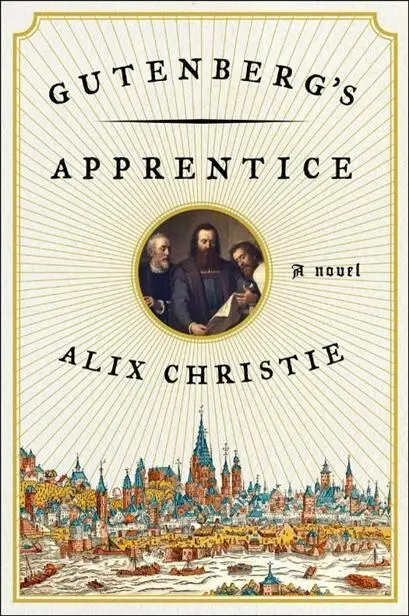
- Название:Gutenberg's Apprentice
- Автор:
- Издательство:Harper
- Жанр:
- Год:2014
- ISBN:нет данных
- Рейтинг книги:5 / 5. Голосов: 1
-
Избранное:Добавить в избранное
- Отзывы:
-
Ваша оценка:
Gutenberg's Apprentice: краткое содержание, описание и аннотация
Предлагаем к чтению аннотацию, описание, краткое содержание или предисловие (зависит от того, что написал сам автор книги «Gutenberg's Apprentice»). Если вы не нашли необходимую информацию о книге — напишите в комментариях, мы постараемся отыскать её.
Youthful, ambitious Peter Schoeffer is on the verge of professional success as a scribe in Paris when his foster father, wealthy merchant and bookseller Johann Fust, summons him home to corrupt, feud-plagued Mainz to meet “a most amazing man.”
Johann Gutenberg, a driven and caustic inventor, has devised a revolutionary — and to some, blasphemous — method of bookmaking: a machine he calls a printing press. Fust is financing Gutenberg’s workshop and he orders Peter, his adopted son, to become Gutenberg’s apprentice. Resentful at having to abandon a prestigious career as a scribe, Peter begins his education in the “darkest art.”
As his skill grows, so, too, does his admiration for Gutenberg and his dedication to their daring venture: copies of the Holy Bible. But mechanical difficulties and the crushing power of the Catholic Church threaten their work. As outside forces align against them, Peter finds himself torn between two father figures: the generous Fust, who saved him from poverty after his mother died; and the brilliant, mercurial Gutenberg, who inspires Peter to achieve his own mastery.
Caught between the genius and the merchant, the old ways and the new, Peter and the men he admires must work together to prevail against overwhelming obstacles — a battle that will change history. . and irrevocably transform them.
Gutenberg's Apprentice — читать онлайн бесплатно полную книгу (весь текст) целиком
Ниже представлен текст книги, разбитый по страницам. Система сохранения места последней прочитанной страницы, позволяет с удобством читать онлайн бесплатно книгу «Gutenberg's Apprentice», без необходимости каждый раз заново искать на чём Вы остановились. Поставьте закладку, и сможете в любой момент перейти на страницу, на которой закончили чтение.
Интервал:
Закладка:
He took the Sabbath meal with them from time to time, but not too often, lest they guess he did not dine at home. It steadied him to be at their calm hearth, watching Anna paint and holding up his arms to help her mother wind her yarns. His love worked with a deep intensity, her little tongue poked out as she minutely brushed a scene on a ceramic box: a tiny castle on an emerald hill, its ruby pennants rippling.
If anyone had asked him why he cleaved to her, this quiet slip of a girl — if he had ever been prepared to open up his heart for that inspection — Peter would have said that she was all that stood in those dark days between himself and the abyss. She rooted him, and held him to the earth. He was alone, more clearly, coldly, than at any time before. More so even than when he was orphaned, for an infant does not feel the absence at its back. He had not chosen this, but it was his.
He mimed an ordinary life: Anna never knew that when he left her, he did not return to the Haus zur Rosau, nor did she guess that his Sunday mass was sung no longer in his father’s pew, but at the master’s in St. Christopher’s. “My fondest greeting to your father and your mother,” she would say in parting, as his stomach twisted. What small allowance he might once have made for Fust’s ambition disappeared, corroded by the bile inside. It was his father’s fault that Peter had to feign a lightness that he did not feel; but for his veto, Peter might have spared himself — and her — that web of lies.
Klaus Pinzler would not wait much longer for the handshake. The only hope was to present his father with a dowry of the customary size, and pray he’d have to take it or lose face. The Handschlag did require a host of witnesses; a minor crowd could be arranged. Peter pictured Jakob’s face when he let drop his brother had refused a craftsman’s daughter. The Pinzlers had two elder sons as well, who painted manuscripts and doubtless knew his father’s clients. Peter felt a bitter exultation at the thought of trapping him at his own game.
The only question was the shape and size of wedding goods the Pinzlers should provide. He thought at first of asking Grede. But he refused to put her in that place, stretched between him and his father. He should have asked her help, and long before; he was a fool. Even so he roughly knew the dowry should be worth a year of a good income, some twenty, thirty guilders. And on the evening that he broached this figure, Anna blanched. He took her face between his palms. What Mitgift she could offer was laid piece by piece in a small chest of scented pine beneath the rafters of her room. Sheets and curtains, table linens — serviceable, certainly, but not the finest quality; some pewter dishes, several mirrors, ceramic pitchers painted by a Pinzler hand. Five years’ accumulated treasure, more or less.
“There’s more where that came from,” he murmured as he kissed the lines of worry from her brow. She kept on glancing down the ladder to her loft. They’d snuck him up to snatch a look; at any moment either parent might appear. They fled into the darkness, running toward the wall, ducking with their hoods pulled close into the foreyard of the Augustinerhof, where townsfolk clustered for the friars’ cheap wine and fire. Under cover of the crowd, he told her of his plan. He would build her dowry up himself — buy more fabrics and furnishings, all fine enough for any merchant’s house. He had some money put aside; he’d ask his uncle, maybe even Grede. Jakob was the leader of the guild, for pity’s sake; he’d cough up cutlery and candlesticks at least. And then, if they were quick, they both could earn a little more. Anna’s face lit then with hope. She’d paint a mirror for the duchess, she said, nodding; he could find some work to scribe. They laughed and stole a kiss; like two old hens, he said, scrabbling after fallen groats.
This was how he found himself once more inside the Schreibhaus. He collared Heilant, swallowing his pride. He needed work, he said, a little something he could do at night. The scribe looked at him at first with coolness, then his face broke into a wide smile. “Perfect.” He clapped his hands. “Two days ago we lost our best man to the house in Erfurt.” He was in charge of half a dozen scribes, Heilant explained — three from St. Viktor’s, three hired in from outside — to pen a big new monastery Bible. “Providence is swift,” he said, his cheeks spreading with genuine delight.
“My father’d have my hide,” said Peter quickly — much too quickly, he thought afterward, as if he were some wayward child. “You don’t know Johann Fust.”
“Come,” said Petrus Heilant. “You’re years past your majority.”
The blood rose into Peter’s cheeks — he felt it, cursed it, as he cursed these lies. And too, the thing was rich — a Bible, God above, another Bible, written out by scribes in Mainz this time.
“I couldn’t do it by the piece?” he asked, knowing full well that they would never parcel out such volumes. A tome like this would be a work of years, a dedicated team in a scriptorium.
“You amaze me.” Heilant pulled back slightly, as if Peter foamed about the mouth or showed some other sign of madness. “Of course not.”
“It’s just — I am enslaved,” said Peter, with a smile he hoped was winsome. God knew it was the truth. “And”—he bent as if to share a confidence—“the truth is, it’s the price of his consent for marriage.” He winked and made a filthy gesture with his index in the ring of his left thumb and finger. “I’m wed now to the brothers Fust — but let us pray for not much longer.”
It wasn’t bad, as fabrications went.
Heilant pursed his lips. “I am amazed,” was all he said, again. His eyes were veiled. “You would have given anything to do this, once.”
“Instead I must content myself with an Aquinas or a Virgil.” Peter held up his praying hands. They agreed to a copy of the first part of the Summa Theologica . But since the great scholastic was long-winded, Peter would bring back each quire as it was done, and wait for payment. Heilant made a smart remark about his seeming need. “If you but knew,” said Peter, smiling.
It did amuse him in the next few weeks to watch the way his former schoolmate fawned and flattered as he lay in wait for rising stars. One night he breathed that Peter had just missed Konneke, along with Budenweg, Archbishop Dietrich’s private scribe. Peter thought back to that audience, now nearly two full years ago. Was Budenweg the hunched dark figure he had seen, a writing desk upon his lap, at Dietrich’s keep? And then it came to him, a blinding bolt, the thing that he had put out of his mind: a mighty gift, a handsome, ornate sheaf — that proposed present for the pope.
The pontifical they’d shown to Dietrich had not come about, as Gutenberg had prophesied. They’d set and printed a few sheets of those four canticles while proofing their new type, long months ago. But then the missal had consumed them, and the pope had promulgated his new tithe. Dietrich then had not been in a mood for gifts, or missals — they had set the thing aside and concentrated on their Bible. Just one of those extra copies, Peter told himself. He could not sell it openly, of course. But in the secrecy in which the guilds had wrapped them, there was no harm in settling a copy on one of those helpful Brudermeisters , who could be counted on to prize the prayers in private.
Peter found the pages easily when he returned, tied on a shelf above the master’s desk. They’d printed off four sets. What beauties they would be, he thought, embellished by his lover’s hand. He hesitated for an instant. These sheets were Gutenberg’s, or Fust’s. “Forgive me, Lord,” he whispered, “as Thou didst forgive my namesake long ago.”
Читать дальшеИнтервал:
Закладка:
Похожие книги на «Gutenberg's Apprentice»
Представляем Вашему вниманию похожие книги на «Gutenberg's Apprentice» списком для выбора. Мы отобрали схожую по названию и смыслу литературу в надежде предоставить читателям больше вариантов отыскать новые, интересные, ещё непрочитанные произведения.








Обсуждение, отзывы о книге «Gutenberg's Apprentice» и просто собственные мнения читателей. Оставьте ваши комментарии, напишите, что Вы думаете о произведении, его смысле или главных героях. Укажите что конкретно понравилось, а что нет, и почему Вы так считаете.