Alix Christie - Gutenberg's Apprentice
Здесь есть возможность читать онлайн «Alix Christie - Gutenberg's Apprentice» весь текст электронной книги совершенно бесплатно (целиком полную версию без сокращений). В некоторых случаях можно слушать аудио, скачать через торрент в формате fb2 и присутствует краткое содержание. Год выпуска: 2014, Издательство: Harper, Жанр: Историческая проза, на английском языке. Описание произведения, (предисловие) а так же отзывы посетителей доступны на портале библиотеки ЛибКат.
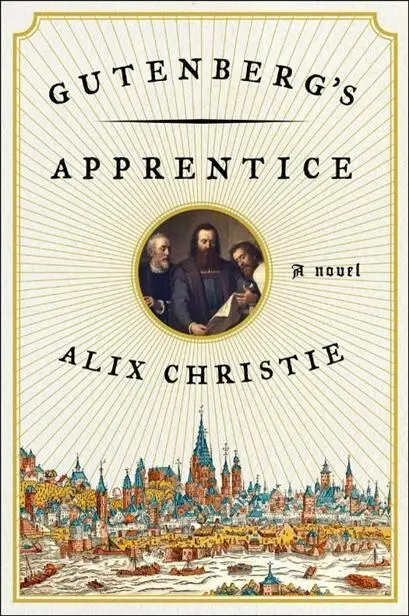
- Название:Gutenberg's Apprentice
- Автор:
- Издательство:Harper
- Жанр:
- Год:2014
- ISBN:нет данных
- Рейтинг книги:5 / 5. Голосов: 1
-
Избранное:Добавить в избранное
- Отзывы:
-
Ваша оценка:
Gutenberg's Apprentice: краткое содержание, описание и аннотация
Предлагаем к чтению аннотацию, описание, краткое содержание или предисловие (зависит от того, что написал сам автор книги «Gutenberg's Apprentice»). Если вы не нашли необходимую информацию о книге — напишите в комментариях, мы постараемся отыскать её.
Youthful, ambitious Peter Schoeffer is on the verge of professional success as a scribe in Paris when his foster father, wealthy merchant and bookseller Johann Fust, summons him home to corrupt, feud-plagued Mainz to meet “a most amazing man.”
Johann Gutenberg, a driven and caustic inventor, has devised a revolutionary — and to some, blasphemous — method of bookmaking: a machine he calls a printing press. Fust is financing Gutenberg’s workshop and he orders Peter, his adopted son, to become Gutenberg’s apprentice. Resentful at having to abandon a prestigious career as a scribe, Peter begins his education in the “darkest art.”
As his skill grows, so, too, does his admiration for Gutenberg and his dedication to their daring venture: copies of the Holy Bible. But mechanical difficulties and the crushing power of the Catholic Church threaten their work. As outside forces align against them, Peter finds himself torn between two father figures: the generous Fust, who saved him from poverty after his mother died; and the brilliant, mercurial Gutenberg, who inspires Peter to achieve his own mastery.
Caught between the genius and the merchant, the old ways and the new, Peter and the men he admires must work together to prevail against overwhelming obstacles — a battle that will change history. . and irrevocably transform them.
Gutenberg's Apprentice — читать онлайн бесплатно полную книгу (весь текст) целиком
Ниже представлен текст книги, разбитый по страницам. Система сохранения места последней прочитанной страницы, позволяет с удобством читать онлайн бесплатно книгу «Gutenberg's Apprentice», без необходимости каждый раз заново искать на чём Вы остановились. Поставьте закладку, и сможете в любой момент перейти на страницу, на которой закончили чтение.
Интервал:
Закладка:
They found a cauldron filled with hot mulled wine and drank it fast, and downed some more. Mentelin, for all his freckled innocence, had little trouble putting his away. “What’s on the program then?” Peter bawled in Keffer’s ear.
“First gold, then honey!” Keffer’s yellow locks were shining, like his eyes. He elbowed Mentelin, half a head shorter, at his side. “Best show the bishop how it’s done.” The gaming house up on the flax market would be full to bursting. Mentelin looked back and forth between the two large workingmen, Ruppel slumped on Keffer’s arm. He threw a smile at Peter. “I guess I’d better keep these two in line.”
Ruppel jerked his head up, sketched a sloppy curve into the air with one limp hand. “I’ll show you lines!” he slurred.
“You coming?” Mentelin asked; Peter shook his head. The night was far too fine, the wine too pleasant in his veins, to jam into some stinking cave.
“Got honey of his own,” Keffer hooted as they dragged the scribe away.
The departing pressmen half collided with two monks who stood bemused in the thick, pungent throng, and Peter groaned inside. The damage they might wreak tonight could be extreme. He was still laughing as he turned toward Hans, shaking his head, when someone grasped his arm.
“I hardly recognized you,” came a low, unwelcome voice.
Peter forced himself to focus and cursed the drink that fogged his sight.
“They let you out,” he thickly said, “to spy the seat of sin?” With a forced smile he embraced Petrus Heilant. The scribe looked at him archly and nodded briefly toward Hans. His fellow monk was no one Peter knew.
“The better to combat it,” Heilant answered drily, his right hand lifting to inscribe a cross, ironically, before their eyes. “Drowning your sorrows, like those roughs who nearly crushed us?” He cocked an eyebrow and glanced back, but the three printers had been swallowed by the crowd. “Nice friends you have.”
“Once a smith,” said Peter, shrugging. “Half my uncle’s workshop’s here tonight.” Heilant looked a trace too long at him, with a smile that Peter didn’t like. He dipped his head. “We’ll leave you to your business then, and hope to see you in more… salubrious… surroundings.”
They moved away, and Peter watched them long enough to see how Heilant glanced back once, his features calculating, before pretending he was gazing past them at the stalls.
“Nosy bugger,” Peter said to Hans.
The smith nodded. “Don’t know why you give that kind the time of day.”
“Know thine enemy,” said Peter, as they edged back toward the stand of wine. They gave their cups back, pocketing their penny caution, and started roaming. Now and then they paused to look more closely at a clock, a hide, a whirligig, a feathered cap. Eventually like homing birds they fetched up at the goldsmiths’ stands along the Chapel of the Blessed Virgin. Across the square, the columns of the Mint were dimly lit, but here the smiths had made resplendent the huts where they sold goods throughout the year. The Windeckes’ shelves were draped in crimson velvet, piled with jewelry that flashed with semiprecious stones. To either side stood a dour smith, a dagger at his belt. Jakob’s shop displayed its silver goblets, copper chafing dishes, candlesticks and sconces on three rising tiers, each carpeted in lamb’s wool. Beside this Gottholt’s stand was filled with cutlery, then Isenmenger’s, iron pots and clasps and tongs.
Hans bent, examining a ring, and Peter asked, “You ever miss it?”
“Now and again.” He put the ring back. “But then there’s only so much you can do with gold.”
“You’d rather muck about with lead.”
“Wouldn’t know what I should buy with it.” Hans shrugged.
“You’ll keep your copy then?” The others, Peter guessed, would sell their Bibles just as soon as they were finished. Hans ran his tongue across his teeth and shook his head. “Don’t ride your horse before it’s shod.”
“Sound advice,” said Peter.
“Not that Henne ever heeds it.” Hans smiled grimly. “Always rushing on ahead.” He called the master by a name nobody else would dare to use — knew him more closely, Peter thought, than anyone. A mouse ran down a hallway in his head. Was this what happened, way back when, he slowly asked — that thing he’d said, a while ago — something about a Christian robbing graves?
Hans glanced quickly left and right. He jerked his head, and Peter followed to the market’s darker edge. “You swear,” he said, and Peter nodded. A brief smile lit the smith’s creased face. “A scene, it was. They even hauled me up before the judge.” Then he went serious again. “It wasn’t nothing, though, but greed. He had these partners, see. Two fellows called Andreas — for the mirrors. He already had me carving letters too, one at a time.” Hans rolled his eyes back, as if rolling the whole thing back through his mind. “Anyway, they paid a heap to get in on the business. Then one of the poor bastards got the fever. You should have seen the master tell Lorenz to run like hell and grab the formes and under no condition touch the man.” He grinned. “He’s always had a deathly fear of pox and plague.”
“And came much closer than a Christian should, to robbing graves,” Peter murmured.
“The dead man’s brother went after him hammer and tongs. The thieving dog, he tried to grab his brother’s piece. Called in the law and witnesses, the lot — for all the good it did him.” Hans shook his head. “Master won it fair and square, according to the contract.”
“But even so he didn’t stick around in Strassburg.”
“We had to save our skins, too, don’t forget, from all them Armagnacs.”
They drifted back. As they were passing the last stall, a chalice caught the goldsmith’s eye. He picked it up and ran a finger along the square flanged base. “Too thick,” he said beneath his breath.
“I’m sure that yours was finer.” Hans would have made the rank of master, surely, if he hadn’t followed Gutenberg — yet he had been content to stay a journeyman. Hans set the chalice back, looked with disdain upon the rings, some of plain gold, others made of plaited bands.
“We had to do a setting in my day.” He turned away.
These were not Meisterwerks , of course, but simple journeywork. In Mainz, like Strassburg, journeymen would have to set a beveled stone, or craft a silver bowl, at least engrave the inside of a decorated band, to gain the master’s rank.
“That I would like to see,” said Peter.
Reflexively, Hans put a hand up to his chest. “All right,” he said, and started walking swiftly from the market.
“I didn’t mean—,” said Peter as he caught him up, but Hans just shushed him, trotting out into the lane. The air was colder there; the snow was barely trodden. Hans plunged a hand into his leather jerkin. The little packet he drew out was wrapped in silk; he opened it and held it to his mouth and blew, then polished it upon his sleeve before he handed it to Peter.
By the snip of moon he saw it was a woman’s band, in braided gold, set with a large, dark stone. It was too dark to tell the color. Hans’s eyes were on the ring, but by their look he saw instead the hand that ring once graced.
“I made that nineteen years ago.” His voice was low. “I could have had my own shop, in Speyer or Cologne. I had my eye on a girl in Strassburg, though. Funny, how things go.”
He took the ring back, lifted it to catch the light. Above them there were candles in the narrow windows of the hospice of the Holy Ghost, and the writhing creatures on its gutters cast strange shadows on its stones. Hans shrugged. “That’s how I wound up working for the lunatic, Gutenberg, and made a pile of useless gold.”
Читать дальшеИнтервал:
Закладка:
Похожие книги на «Gutenberg's Apprentice»
Представляем Вашему вниманию похожие книги на «Gutenberg's Apprentice» списком для выбора. Мы отобрали схожую по названию и смыслу литературу в надежде предоставить читателям больше вариантов отыскать новые, интересные, ещё непрочитанные произведения.






Обсуждение, отзывы о книге «Gutenberg's Apprentice» и просто собственные мнения читателей. Оставьте ваши комментарии, напишите, что Вы думаете о произведении, его смысле или главных героях. Укажите что конкретно понравилось, а что нет, и почему Вы так считаете.