Alix Christie - Gutenberg's Apprentice
Здесь есть возможность читать онлайн «Alix Christie - Gutenberg's Apprentice» весь текст электронной книги совершенно бесплатно (целиком полную версию без сокращений). В некоторых случаях можно слушать аудио, скачать через торрент в формате fb2 и присутствует краткое содержание. Год выпуска: 2014, Издательство: Harper, Жанр: Историческая проза, на английском языке. Описание произведения, (предисловие) а так же отзывы посетителей доступны на портале библиотеки ЛибКат.
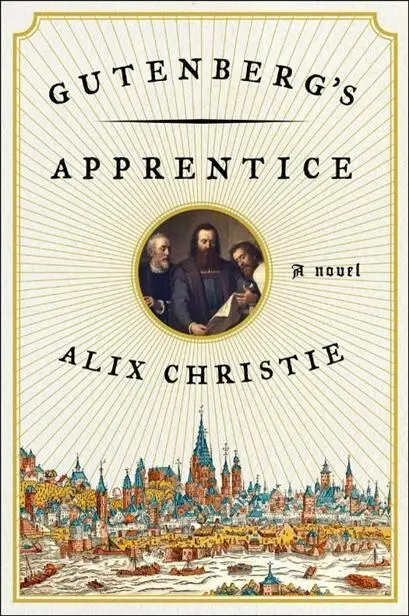
- Название:Gutenberg's Apprentice
- Автор:
- Издательство:Harper
- Жанр:
- Год:2014
- ISBN:нет данных
- Рейтинг книги:5 / 5. Голосов: 1
-
Избранное:Добавить в избранное
- Отзывы:
-
Ваша оценка:
Gutenberg's Apprentice: краткое содержание, описание и аннотация
Предлагаем к чтению аннотацию, описание, краткое содержание или предисловие (зависит от того, что написал сам автор книги «Gutenberg's Apprentice»). Если вы не нашли необходимую информацию о книге — напишите в комментариях, мы постараемся отыскать её.
Youthful, ambitious Peter Schoeffer is on the verge of professional success as a scribe in Paris when his foster father, wealthy merchant and bookseller Johann Fust, summons him home to corrupt, feud-plagued Mainz to meet “a most amazing man.”
Johann Gutenberg, a driven and caustic inventor, has devised a revolutionary — and to some, blasphemous — method of bookmaking: a machine he calls a printing press. Fust is financing Gutenberg’s workshop and he orders Peter, his adopted son, to become Gutenberg’s apprentice. Resentful at having to abandon a prestigious career as a scribe, Peter begins his education in the “darkest art.”
As his skill grows, so, too, does his admiration for Gutenberg and his dedication to their daring venture: copies of the Holy Bible. But mechanical difficulties and the crushing power of the Catholic Church threaten their work. As outside forces align against them, Peter finds himself torn between two father figures: the generous Fust, who saved him from poverty after his mother died; and the brilliant, mercurial Gutenberg, who inspires Peter to achieve his own mastery.
Caught between the genius and the merchant, the old ways and the new, Peter and the men he admires must work together to prevail against overwhelming obstacles — a battle that will change history. . and irrevocably transform them.
Gutenberg's Apprentice — читать онлайн бесплатно полную книгу (весь текст) целиком
Ниже представлен текст книги, разбитый по страницам. Система сохранения места последней прочитанной страницы, позволяет с удобством читать онлайн бесплатно книгу «Gutenberg's Apprentice», без необходимости каждый раз заново искать на чём Вы остановились. Поставьте закладку, и сможете в любой момент перейти на страницу, на которой закончили чтение.
Интервал:
Закладка:
“It would take half again as long,” the master said. “There is a rubric every third, fourth page.”
“We knew that from the start.” Fust’s mouth was set, his eyes more gray than blue. The look he gave his son was like a boot. “I thought we planned to make a fine and mighty thing,” he said, and set the page back down. More perfect than the most perfect manuscript it was always meant to be.
Fust faced the two of them with bitter eyes, as if they’d forged some dark, satanic bond against him.
“We have to gain more speed.” Gutenberg leaned toward his partner. Attend, he said: at this rate they took two months for each quire. “We need another man, it seems to me.”
Fust’s mouth twitched. Then he harshly laughed. The sound was forced, unpleasant. “First you kick me, then you strip me bare.”
CHAPTER 8: JOURNEYMEN
[3 quires of 65]
December 1452
THE ADVENT SEASON came, and with it the relief and warmth of firesides and candles, of drawing close in the community of Christ. Peter had been courting Anna all that autumn, walking with her while the married men of Mainz slept off their Sunday lunch. He’d toss a pebble at her window, and they’d steal away into the little lanes or walk among the bare boughs of the orchards. As it got colder, they would slip into an empty chapel and warm themselves in some back pew. Quite early on she’d asked if he would read to her; she brought him block books she collected for the pictures. Though these were crude, she listened raptly as he read their message of salvation. In the dimness he sought other verses, psalms that she had learned by heart, and traced her fine cold fingers on the words.
The Christ’s mass gift that he might give her sprang to mind this way. He made a little book of stories she would know, lettered in his simplest cursive: the parable of Dives and the beggar; the raising up of Lazarus; the Pater Noster and her favorite psalms. He has this book still, locked in a small chest inside his big new house in Frankfurt. He still can see her shining face and how she clapped her hands in wonder. The heavens shew forth the glory of God, and the firmament declareth the work of his hands.
Her gift to him was likewise from her hands. She painted him a portrait of Saint Peter at the gate, with Peter’s own brown beard, his narrow, sober face. “Heresy,” he said, laughing, and brought her fingers to his lips. They met in secret, though of course her parents knew. A few months in, Klaus cornered him and plainly asked him his intention. Marriage, Peter answered, and Klaus frowned and fingered his thick beard. They both knew Fust would not approve without a fight.
Peter watched and waited for a likely moment, but his father’s mood was not improved. He was still angry over the lost ruby lines — disgruntled, too, to see how fast his guilders gushed. They paid dues to carpenters and smiths and tanners, butchers, bakers, brewers, although he drew the line at tipping off the painters who worked hand in glove with scribes. He wasn’t just some pig to stick and bleed, he growled — although the new man, too, in due course did arrive, another mouth that he must pay and feed and house.
This fellow hailed from Alsace like the others, though Johann Mentelin was not a smith, praise God. Peter was delighted to discover he had been a clerk in Strassburg’s bishopric. Nor was he a mere notary: he specialized in gilding letters and had a flowing, calligraphic hand. How in God’s name had Gutenberg seduced him? Peter wondered underneath his breath as they all stood to greet him. Hans shook his rippled forehead and just laughed.
The new compositor swore his oath of secrecy on the first page of their Bible. A sum of money passed into the master’s hand: the training fee, which Mentelin would pay half at John the Baptist, half at the Solemnity of Mary. His coming raised the level of the talk inside the shop. His Latin was impeccable; he’d studied in Erfurt a few years ahead of Peter. At noon he’d bow his ginger head, recite the readings with his eyes closed from the book stored in his mind. The jokes were ribald, naturally, when the master said where he would start. He’d pick up setting where they broke the book into a second volume: Proverbs, followed by the Canticum Canticorum, the randy, lovesick Song of Songs.
They numbered nine or so that first Yule at Fust’s table — the master and apprentices and journeymen, plus the boys they’d dubbed their devils. His father had convened them on the feast of the Three Patriarchs, those Hebrew men of staunch, unyielding faith. The groaning board was meant to mark their first full year of common labor, he declared. Exceptionally, the workingmen had bathed. Their eyes went wide at the long table draped in Flemish lace, the beeswax flames reflected in the silver platters. Pork haunch with cherries, ducks with sage clamped in their yellow bills, heaps of greens and tubers — and that was nothing to the Riesling and the Spätburgunder. Along the sideboard Grede had ranged a deadly chorus of assorted brandies. The master stood and tapped his goblet with a knife and bid them shut their gabbling mouths.
“I give you Johann Fust,” he roared. Already he had had a few. The men began to drum their feet upon the floor. His father smiled and whispered something in Grede’s ear, and rose.
“It’s been a long year, but a good one,” he began. “We’re making slow but steady progress.” His eyes went all around the table; when they came to Peter, he paused slightly, then moved on.
The master leaned, and cracked: “We’re out of Kings, is what he means, and into Proverbs. Though I am sorry to report that Peter is still wandering the Garden.” The mugs flew up, and Keffer yelled “Hear! Hear!” Peter stood, and took a little bow, then raised his own.
“To Johann Fust and Johann Gutenberg,” he cried, “and Tubalcain.” To their blank looks, he grinned. “The son of Sella, great-great grandson of Cain,” he said, and quoted out of Genesis: “‘who was a hammerer and artificer in every work of brass and iron.’”
The drumming of the workers’ feet drowned out all other sound. “As custom holds, therefore,” his father called above the din, “each one will be rewarded.”
Gutenberg began to hand out gifts. The journeymen and apprentices he gave a little paper roll. The young ones and the servants each received a pilgrim mirror. How very like the skinflint, Peter thought, smiling. He skimmed the ribbon off his roll. The square of linen bore a single sentence in the master’s sloping hand: “To be redeemed, with the Lord’s aid and grace, against one copy of the Biblia latina , created without help of pen or reed by a new and secret art in the golden city of Maguncia, Christ’s mass: Anno 1452.”
Gutenberg was grinning like a cat. “A gauge of our respect and faith.”
The devil. Peter had to laugh.
“Consider it,” the master added, “payment against wages.”
“The devil.” Peter whispered it this time to Hans. “To bind us even tighter in the harness.”
“Worth its weight though.” Hans peered closely at his scroll.
The man was diabolical, in truth: offering the fruit when every bough was bare and nowhere near to budding. Sheer evil genius, Peter thought: a paper Bible was worth twice, three times, what any craftsman earned in a whole year. And yet — he looked back at the scrap — how fine, how marvelous. He pictured it upon a lectern in a home where he would bring his bride; he saw it bright with red and running titles, filled with tiny, brilliant scenes, penned and painted by their two laced hands.
The snow was falling in thick clots when they staggered out toward the Christmas market. The tented canvas lifted, orange and glowing, like a galleon on the market square. They ducked inside: the stalls were wedged so tightly that the flakes were trapped and melted overhead, or else died hissing in the flaming torches, sizzling in the chestnut barrels. Keffer grasped Ruppel by the scruff of his thick neck, steering him around the stands of glassware. They wove past wooden toys and crystal candy toward the kegs along the edge. Nearby a hand-cranked organ shrieked; a crone in rags pressed her hard cup in Peter’s ribs. He smelled the rankness of her breath and pressed a penny in her hand. The rich were all shut up in their great mansions draped with fir, their candles sketching steeples on the glass.
Читать дальшеИнтервал:
Закладка:
Похожие книги на «Gutenberg's Apprentice»
Представляем Вашему вниманию похожие книги на «Gutenberg's Apprentice» списком для выбора. Мы отобрали схожую по названию и смыслу литературу в надежде предоставить читателям больше вариантов отыскать новые, интересные, ещё непрочитанные произведения.









Обсуждение, отзывы о книге «Gutenberg's Apprentice» и просто собственные мнения читателей. Оставьте ваши комментарии, напишите, что Вы думаете о произведении, его смысле или главных героях. Укажите что конкретно понравилось, а что нет, и почему Вы так считаете.