Alix Christie - Gutenberg's Apprentice
Здесь есть возможность читать онлайн «Alix Christie - Gutenberg's Apprentice» весь текст электронной книги совершенно бесплатно (целиком полную версию без сокращений). В некоторых случаях можно слушать аудио, скачать через торрент в формате fb2 и присутствует краткое содержание. Год выпуска: 2014, Издательство: Harper, Жанр: Историческая проза, на английском языке. Описание произведения, (предисловие) а так же отзывы посетителей доступны на портале библиотеки ЛибКат.
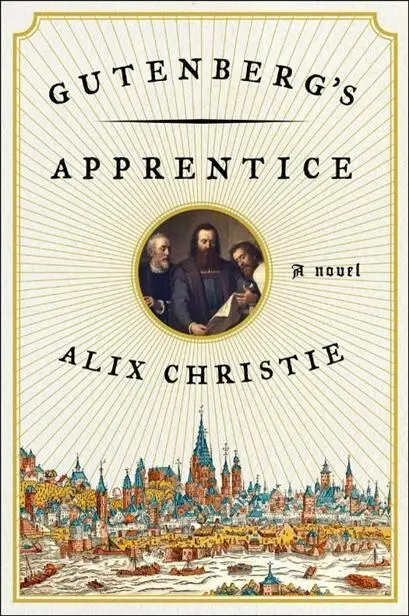
- Название:Gutenberg's Apprentice
- Автор:
- Издательство:Harper
- Жанр:
- Год:2014
- ISBN:нет данных
- Рейтинг книги:5 / 5. Голосов: 1
-
Избранное:Добавить в избранное
- Отзывы:
-
Ваша оценка:
Gutenberg's Apprentice: краткое содержание, описание и аннотация
Предлагаем к чтению аннотацию, описание, краткое содержание или предисловие (зависит от того, что написал сам автор книги «Gutenberg's Apprentice»). Если вы не нашли необходимую информацию о книге — напишите в комментариях, мы постараемся отыскать её.
Youthful, ambitious Peter Schoeffer is on the verge of professional success as a scribe in Paris when his foster father, wealthy merchant and bookseller Johann Fust, summons him home to corrupt, feud-plagued Mainz to meet “a most amazing man.”
Johann Gutenberg, a driven and caustic inventor, has devised a revolutionary — and to some, blasphemous — method of bookmaking: a machine he calls a printing press. Fust is financing Gutenberg’s workshop and he orders Peter, his adopted son, to become Gutenberg’s apprentice. Resentful at having to abandon a prestigious career as a scribe, Peter begins his education in the “darkest art.”
As his skill grows, so, too, does his admiration for Gutenberg and his dedication to their daring venture: copies of the Holy Bible. But mechanical difficulties and the crushing power of the Catholic Church threaten their work. As outside forces align against them, Peter finds himself torn between two father figures: the generous Fust, who saved him from poverty after his mother died; and the brilliant, mercurial Gutenberg, who inspires Peter to achieve his own mastery.
Caught between the genius and the merchant, the old ways and the new, Peter and the men he admires must work together to prevail against overwhelming obstacles — a battle that will change history. . and irrevocably transform them.
Gutenberg's Apprentice — читать онлайн бесплатно полную книгу (весь текст) целиком
Ниже представлен текст книги, разбитый по страницам. Система сохранения места последней прочитанной страницы, позволяет с удобством читать онлайн бесплатно книгу «Gutenberg's Apprentice», без необходимости каждый раз заново искать на чём Вы остановились. Поставьте закладку, и сможете в любой момент перейти на страницу, на которой закончили чтение.
Интервал:
Закладка:
“You do not jest?” She cocked her head, a little ember glowing in her eyes.
He laced her arms around his neck and laid his forehead down to hers. “Here in the sight of God, I swear to you. No other woman holds the keys to this poor kingdom.”
In the shimmer in her eyes he saw as much of heaven as a man can pray for in this life, the darkness stirring with a flame that burned him to her, soldered him forever to her frame. They pressed together, scorched, their eagerness and hunger naked as the white curve of her neck. Only with the greatest effort did they step apart and, bodies bursting, gasp the sweetness of the evening. Never had he felt such torment, yet such peace.
“Shhh,” she said, as he began to speak. She put a finger to his lips, and he could not prevent himself from seizing it, and sucking it, and pulling her back to his hips. She groaned, and they were only saved by a great sound, of men and women cheering, and the thud of ax on wood.
“God help me,” he said hoarsely. “I am but a beast.”
“No beast, but Adam’s flesh.” She kissed him, chastely, and began to straighten up her hair.
He wove her a garland of St.-John’s-wort, for even Peter knew that it was used for strength on a long journey. They embarked that night for somewhere neither one had been before. She took it from his hands and said to add more blossoms, so he did, and then she placed it on her waist and let him fix it there, with kisses up her dress and to the open swelling of her breasts. She reminded him of the tradition as she led him toward the fire. The solstice belt of mugwort is a charm against all sickness, for the leaching of all evil: a pledge they tossed into the fire to guarantee their health. “They even say”—she smiled—“that if you hang one in your house, it wards off looks from evil men.”
“Then hang a dozen, when this night is done,” he said as they stepped into the mass of dark and dancing bodies in the bonfire’s glow. He saw her parents there, her brothers, painters, tanners, weavers, bakers, coopers, saddlers: men and women lined and hard from scraping, beating, shaping, forming. Hans, too, Ruppel, Keffer, those last two with girls, drawn like himself to that communion with their fellows. He thought he saw his uncle, then his cousin, in the flashing of the fire; he saw them, then he lost them in the dance, which wove and leapt around with screams and shouts — and all that while, as he could hear the reeds and flutes beneath his skin, as if the music rose from his own soul, he thought not of God or devil but of Anna, only Anna, with her fire-kissed skin all flushed with love. He knew himself at last to be a child of earth and heaven, body fused to spirit in the sight of God and man, when as the solstice flames died down they looked at one another and agreed, without a word, and ran, and sprang across the embers and came down in one another’s arms. If this be sin , he thought, and tore the belt from round her waist and cast it in the flames and heard the crowd roar praise. They stood there, panting, joined before the world.
CHAPTER 7: IMPRESSORIUM
Tuesday after Saint Augustine (30 August 1452)
THE DAYS of the saints are lettered in red. It has always seemed to Peter Schoeffer that this day should be remembered the same way.
The morning they began the printing on the Bible, the crew came round the press in the cool darkness before dawn. The master stood before that oaken frame, his hair pulled back, his eyes uplifted as if at an altar. “May God Almighty bless this work,” he boomed and raised his arm.
Peter held his breath through that first pull, ears waiting for the telltale metal bite, the little grunt that Ruppel always made at the last tug. Then everyone stepped back as Keffer hauled the whole works out and peeled the printed sheet away. Gutenberg and Fust each took a corner of the sheet and bent their heads, one dark, one fair, and surveyed it closely. Peter never would forget the look of triumph they exchanged.
“Fiat imprimere!” his father cried this time.
The crew all hooted. The press began to crash as the two pressmen found a rhythm. The others should have gone back to their stools in the composing room, but none of them could tear themselves away.
Peter fell in love with the whole motion: of the great sheet lifting and then settling; the hard and painful kiss; the sweet, slight sucking sound of linen peeling from the metal. The master’s ink was as black as the night before Creation, blacker than the oak gall ever was. Peter held it to his eyes and marveled. Never had lines ended in such symmetry; never had the world seen such a thing.
The city just outside their door receded utterly. They were aware only of the chain of being, one man handing the sheet on to the next: the boy who reached it to the inker to the pressman who returned the printed sheet back to the master, his beard tucked into his shirt. Like a living creature they were now, a new and many-headed thing.
And then the glow wore off, as it must always. Yet even at the time Peter knew those days were incandescent, without rival. There was a bursting in him — a heady sense of strength, that wondrous feeling of pure rightness that does shine in every life for some brief time.
It fell to Peter to set the first five books of the Old Testament, the Pentateuch of Moses. Hans didn’t care which lines he set, so long as he could do them sitting down. His back had started aching.
“How old are you, then?” Peter asked. Hans scratched his pate and reckoned. “Fifty, maybe,” he said, shrugging. “Sigismund was on the throne.”
They’d work in parallel, the master said: Peter would start on Genesis, Hans on the book of Judges. The text they took from pages torn from that small scribal Paris Bible. The man who’d written it used every trick to shorten the words so he could cram in more. It strained Peter’s mind sometimes to grasp which word was meant by which abbreviation — and he’d been trained. For Hans it was a horror, plainly. “Ex-audio, ex-animo, ex-bloody amino,” he’d mutter, lips protruding with the effort. Peter felt for his old friend. But how to help him, without seeming that he flaunted his own skill? He started turning now and then to him, and asking what he thought some word might be. Hans would grunt, and spit into the can he kept below his feet for just that purpose. How in the devil should he know, if it was gibberish to fancy hands? So Peter wrote a list out of the words that were most common, and their usual abbreviations, made a show of looking at it, asking Hans to scan his lines. Thus did they find a way to choose, together, phrasings of felicity, and lines neither too loose nor tight.
They set it seriatum , page by page. Peter had never read the scriptures in this way, from first word of each chapter to the last, historia unspooling in his hands. He was amazed that he should be the one to put these words on this skin and paper. They shaped it physically, he and Gutenberg and Hans: they made the Word incarnate. Peter would pause sometimes and gaze on his wizened friend as they sat hunched above their letter cases, and ask the Lord how such a task had fallen to such two unlikely men.
If copying a manuscript was prayer, then this was shouting out the psalms from every rooftop. It grew in him with every passing day, this feeling of abashedness and wonder. Why hast Thou, Lord, put such a gift in these poor hands?
It could not be for beauty’s sake alone, or even just to multiply His teachings. It seemed to Peter that God had sent His Word, as He’d once sent His son, to cleanse their corrupt and misguided world. Was this not the clear message of the Gospel according to John? In principio erat verbum : in the beginning was the Word — a Word they flung out now, a boundless net of shining letters, cast out by that great fisher among men.
Читать дальшеИнтервал:
Закладка:
Похожие книги на «Gutenberg's Apprentice»
Представляем Вашему вниманию похожие книги на «Gutenberg's Apprentice» списком для выбора. Мы отобрали схожую по названию и смыслу литературу в надежде предоставить читателям больше вариантов отыскать новые, интересные, ещё непрочитанные произведения.








Обсуждение, отзывы о книге «Gutenberg's Apprentice» и просто собственные мнения читателей. Оставьте ваши комментарии, напишите, что Вы думаете о произведении, его смысле или главных героях. Укажите что конкретно понравилось, а что нет, и почему Вы так считаете.