Alix Christie - Gutenberg's Apprentice
Здесь есть возможность читать онлайн «Alix Christie - Gutenberg's Apprentice» весь текст электронной книги совершенно бесплатно (целиком полную версию без сокращений). В некоторых случаях можно слушать аудио, скачать через торрент в формате fb2 и присутствует краткое содержание. Год выпуска: 2014, Издательство: Harper, Жанр: Историческая проза, на английском языке. Описание произведения, (предисловие) а так же отзывы посетителей доступны на портале библиотеки ЛибКат.
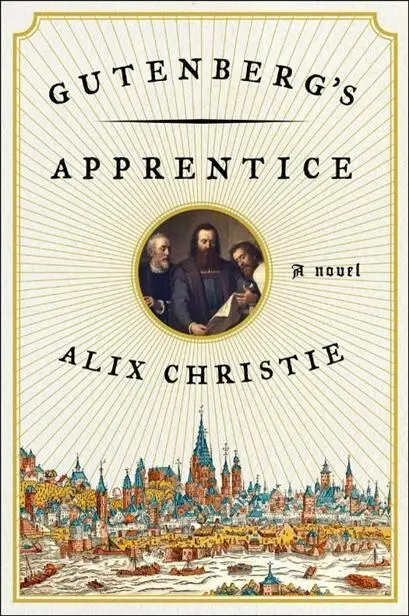
- Название:Gutenberg's Apprentice
- Автор:
- Издательство:Harper
- Жанр:
- Год:2014
- ISBN:нет данных
- Рейтинг книги:5 / 5. Голосов: 1
-
Избранное:Добавить в избранное
- Отзывы:
-
Ваша оценка:
Gutenberg's Apprentice: краткое содержание, описание и аннотация
Предлагаем к чтению аннотацию, описание, краткое содержание или предисловие (зависит от того, что написал сам автор книги «Gutenberg's Apprentice»). Если вы не нашли необходимую информацию о книге — напишите в комментариях, мы постараемся отыскать её.
Youthful, ambitious Peter Schoeffer is on the verge of professional success as a scribe in Paris when his foster father, wealthy merchant and bookseller Johann Fust, summons him home to corrupt, feud-plagued Mainz to meet “a most amazing man.”
Johann Gutenberg, a driven and caustic inventor, has devised a revolutionary — and to some, blasphemous — method of bookmaking: a machine he calls a printing press. Fust is financing Gutenberg’s workshop and he orders Peter, his adopted son, to become Gutenberg’s apprentice. Resentful at having to abandon a prestigious career as a scribe, Peter begins his education in the “darkest art.”
As his skill grows, so, too, does his admiration for Gutenberg and his dedication to their daring venture: copies of the Holy Bible. But mechanical difficulties and the crushing power of the Catholic Church threaten their work. As outside forces align against them, Peter finds himself torn between two father figures: the generous Fust, who saved him from poverty after his mother died; and the brilliant, mercurial Gutenberg, who inspires Peter to achieve his own mastery.
Caught between the genius and the merchant, the old ways and the new, Peter and the men he admires must work together to prevail against overwhelming obstacles — a battle that will change history. . and irrevocably transform them.
Gutenberg's Apprentice — читать онлайн бесплатно полную книгу (весь текст) целиком
Ниже представлен текст книги, разбитый по страницам. Система сохранения места последней прочитанной страницы, позволяет с удобством читать онлайн бесплатно книгу «Gutenberg's Apprentice», без необходимости каждый раз заново искать на чём Вы остановились. Поставьте закладку, и сможете в любой момент перейти на страницу, на которой закончили чтение.
Интервал:
Закладка:
The table in the upstairs loft was covered by a jumble of small shells and vials, toward which the painter’s daughter flapped a small, thin hand. “Forgive the mess,” she said.
His eyes roved over brushes and vibrant powders: cerulean and forest green and crimson, lapis lazuli. He glanced at her pale hands and said, “I liked them blue.”
“I do wash, now and then.” Anna Pinzler rolled her dark almond eyes.
There was a little vial of dried red beetles Peter knew; he had himself used these to make the ruby ink for rubrication. He bent and inhaled the bitter, earthy notes of gum and wax and oil. He felt a sudden urge to sit and open up his pouch, unwrap his vitriol and lumps of gall — though they sat unused now in his own room. The girl was taking out a packet from a pocket in her smock. Instantly he smelled it.
“Fishy,” he said, and then blushed scarlet.
She looked at him as if he were entirely mad. An innocent, a virgin, then. Inside the wrapping she pulled open lay a dried, translucent membrane. “The lining of the sturgeon’s breast,” she said. Peter must have looked perplexed. “Part of his lungs, I guess.” She stroked the pearly sheet. “Which when he dies, gives us the matter we dissolve to fix our pigments.” She frowned, a pretty little scowl. “It has to soak in lime and vinegar an age.”
He thought he’d never seen a girl so self-possessed. She bent, dark-haired and elfin, and started naming things. “Malachite, azurite, minim, chalk. Auripigmentium.” A warning finger: “Never let the metals near the mouth.” A row of drying plants swung by her casement window. “Blue woad and indigo tinctoria, crozophora for the mauve.” She gestured at a row of vials, a mortar and its pestle. “Amber, hempseed, linseed. Tears of Arabic.” She lifted up the little waxy balls. “And then the Kermes bugs, pour souls.” She peered into the jar. “I never like to think of how they get them.” Or else the way they die, he thought, but did not say: the females only blazed that red when pregnant with new life.
“I use them too,” he said, “sometimes.”
Then as abruptly as she started, she was done. “That’s all there is.”
He looked around: a window and a mirror and a narrow bed. “Oh, I don’t know. There’s also quite good light.”
He caught a flash of little pearly teeth. “It’s better in the orchard.”
“Perhaps you’ll show me then, sometime.” The words were stupid, but he watched with pleasure as they brushed a rosy wash across her cheeks. He felt himself stir in response, and clattered down the stairs to seize his cloak and cover up the hunger that arose. He did not look to see if she had followed, but slipped out, his blood pounding, picturing those pale fingers in his mouth.
CHAPTER 4: BROTHERHOOD
June 1452
THEFT WAS THE FEAR: theft of an idea that, unmoored from its true genesis inside one mind, might readily be snatched, passed on, proclaimed by an impostor as his own. The law protected property, but not the private precincts of a bold, inventive mind.
The master knew this more than most. Had he not come back from a trip to Holland the preceding year, muttering about a book he’d seen with images and words printed from wooden blocks? A man with half his wits might see how easily those lines of wooden letters could be sawed apart. Had he not sworn them all to secrecy and double-locked the shop and the men with it, every night and morning? Had he not hidden all his life — as he hid now behind this subterfuge, installing every evening the fake molds for making mirrors in plain view?
The threat emerged in earnest early in the summer when Fust returned to say he’d heard about a man in Avignon who taught a secret art involving alphabets of steel. “You haven’t shown it anywhere?” he asked his partner sharply. The master’s face had darkened at his words, but he answered just as curtly. “I keep my affairs secret, as you know.” He glanced at Hans, his thin lips working. “But spies are everywhere. I’ve had them try to steal from me before.”
They could not be too careful. Pray to Saint Benedict, or Paul or Peter, to all fourteen Holy Helpers, I don’t care, the master said. Just pray for some protection: the workshop was ringed round with thieves, and they’d not even printed the first sheet.
“My point precisely.” Fust said it like a banker. “How much longer until you get started printing?”
“Three weeks — or four.”
And then, thought Peter — months and months — and years, more years — until they’d printed all hundred and twenty copies of those scores of quires. They’d need a host of angels, he thought, sick at heart — the whole host of the archangels with their bright enfolding wings — to keep this secret under guard.
“What about Rosenberg?” He pushed it grimly out. “He’s seen our printing, too.” The master’s head jerked up.
“And quite forgotten it,” snapped Gutenberg.
Fust looked between them. “What gives you that assurance?”
“There’s a new order for indulgences,” said Peter, turning to his father, “which might well jog his memory.”
The master shot his apprentice a sour look. “Leave them to me.”
Fust wiped his forehead with one arm. “If only we were sure of silence.” He looked out through the grime that streaked the upstairs window. “But how — how do you buy the silence of six thousand souls?”
Instantly, the thought arrived. “The guilds,” said Peter.
Both men looked at him with incredulity. The vision had passed swiftly, but Peter had no doubt of what he’d seen: his uncle, twisting that great golden seal.
“It’s in their interest, surely.” His heart was racing as he worked it out. “It’s in all our interest — the whole city’s — that it not fall into Dietrich’s hands.”
“Insanity.” The master’s lips drew back. “I wouldn’t trust a Mainz guild any further than I spit.”
“You were a member of a guild yourself, I thought.”
“Another place. Another life. The guildsmen here are poison—”
“—no more than are the Elder clans,” Fust cut across him, folding both his arms. They stood that way a moment, facing off.
“It seems to me,” said Peter, stepping in between them for the first time, although not the last, “that to the council this might seem a step toward freedom. Not now”—he held a hand up to thwart Gutenberg from speaking—“but when we’re done. The press might help them too, then — I don’t know, to mint some gold, shake off that yoke.”
“This press is mine.” Gutenberg pulled himself to his full, imposing height.
“Not only.” Fust stood planted, balancing as he always had between the working class from whence he’d sprung and the upper classes he now served.
“You think some yokels can protect us?” Gutenberg laughed harshly.
Fust kept his head. “What other shield would you suggest? None of your friends, or relatives, Johann — not any member of the clergy.”
“I’ve got it well in hand, I said. I have his ear, and I can work him like a piece of putty if I have to.” The look he shot at Peter was pure venom.
“It takes one whisper, only one.” Fust pursed his lips. “You cannot guarantee that none will leak, not over all this time.”
“So you would drag it through each tavern.”
“That isn’t how it works.” Fust drew himself up too then, every bit as proud. “I know these guilds. I know the leaders, every one. If they’re convinced it’s in their interest, they will take our dues and keep the secret sealed.”
Gutenberg looked first at Peter, then at Fust, and knew he was defeated. “I bow then to your great superiority,” he said, and turned and vanished down the stairs.
Читать дальшеИнтервал:
Закладка:
Похожие книги на «Gutenberg's Apprentice»
Представляем Вашему вниманию похожие книги на «Gutenberg's Apprentice» списком для выбора. Мы отобрали схожую по названию и смыслу литературу в надежде предоставить читателям больше вариантов отыскать новые, интересные, ещё непрочитанные произведения.



Обсуждение, отзывы о книге «Gutenberg's Apprentice» и просто собственные мнения читателей. Оставьте ваши комментарии, напишите, что Вы думаете о произведении, его смысле или главных героях. Укажите что конкретно понравилось, а что нет, и почему Вы так считаете.