Alix Christie - Gutenberg's Apprentice
Здесь есть возможность читать онлайн «Alix Christie - Gutenberg's Apprentice» весь текст электронной книги совершенно бесплатно (целиком полную версию без сокращений). В некоторых случаях можно слушать аудио, скачать через торрент в формате fb2 и присутствует краткое содержание. Год выпуска: 2014, Издательство: Harper, Жанр: Историческая проза, на английском языке. Описание произведения, (предисловие) а так же отзывы посетителей доступны на портале библиотеки ЛибКат.
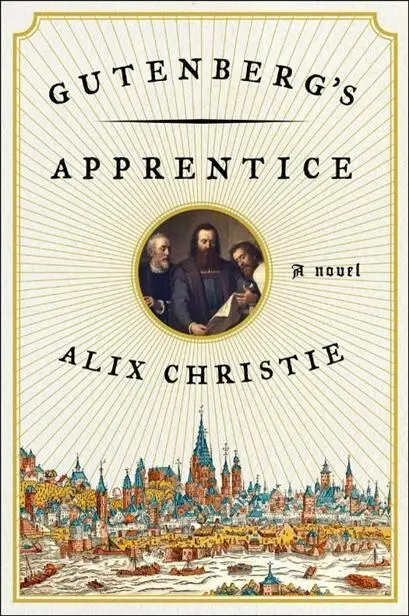
- Название:Gutenberg's Apprentice
- Автор:
- Издательство:Harper
- Жанр:
- Год:2014
- ISBN:нет данных
- Рейтинг книги:5 / 5. Голосов: 1
-
Избранное:Добавить в избранное
- Отзывы:
-
Ваша оценка:
Gutenberg's Apprentice: краткое содержание, описание и аннотация
Предлагаем к чтению аннотацию, описание, краткое содержание или предисловие (зависит от того, что написал сам автор книги «Gutenberg's Apprentice»). Если вы не нашли необходимую информацию о книге — напишите в комментариях, мы постараемся отыскать её.
Youthful, ambitious Peter Schoeffer is on the verge of professional success as a scribe in Paris when his foster father, wealthy merchant and bookseller Johann Fust, summons him home to corrupt, feud-plagued Mainz to meet “a most amazing man.”
Johann Gutenberg, a driven and caustic inventor, has devised a revolutionary — and to some, blasphemous — method of bookmaking: a machine he calls a printing press. Fust is financing Gutenberg’s workshop and he orders Peter, his adopted son, to become Gutenberg’s apprentice. Resentful at having to abandon a prestigious career as a scribe, Peter begins his education in the “darkest art.”
As his skill grows, so, too, does his admiration for Gutenberg and his dedication to their daring venture: copies of the Holy Bible. But mechanical difficulties and the crushing power of the Catholic Church threaten their work. As outside forces align against them, Peter finds himself torn between two father figures: the generous Fust, who saved him from poverty after his mother died; and the brilliant, mercurial Gutenberg, who inspires Peter to achieve his own mastery.
Caught between the genius and the merchant, the old ways and the new, Peter and the men he admires must work together to prevail against overwhelming obstacles — a battle that will change history. . and irrevocably transform them.
Gutenberg's Apprentice — читать онлайн бесплатно полную книгу (весь текст) целиком
Ниже представлен текст книги, разбитый по страницам. Система сохранения места последней прочитанной страницы, позволяет с удобством читать онлайн бесплатно книгу «Gutenberg's Apprentice», без необходимости каждый раз заново искать на чём Вы остановились. Поставьте закладку, и сможете в любой момент перейти на страницу, на которой закончили чтение.
Интервал:
Закладка:
“It’s not my business,” Peter said again. “It is a matter for your brother.”
“He doesn’t listen. Never did.” A thin white line rimmed Jakob’s nostrils. “They suck you dry, then have the gall to blame you for the mess they’ve made. This so-called master is the same. I don’t suppose he told you how he held the treasurer of Mainz for ransom? Had him tossed into the Strassburg jail, some years ago — to squeeze out payment on his cursed bonds?”
This Peter easily could see; it was entirely Gutenberg. It was as much as he could do to keep his face straight. He turned the conversation back. “Is it the Jubilee indulgence, then?” he asked.
His uncle nodded. His face was drawn, the lines as sharp and deep as those made by a master carver. “And all the while the city is left dangling. They made us pay a hundred yearly just to lift the ban, but still they drag their feet. The debt with Speyer isn’t even cleared.” His voice was bitter.
Peter pictured Erlenbach, the bishop’s fist, sheathed in his metal-studded leather as he rode through the archdiocese. They said he missed the bloody warfare of crusading, and was glad to get a taste of fighting when he could. “But this indulgence isn’t Dietrich’s,” he objected. “It’s the pope’s.”
“Which in the way of things will trickle down until the poorest of them pay. Dietrich is an expert at extorting his one-quarter of one-tenth.
“And then”—his uncle looked with some ferocity at Peter—“there is to be another tithe. They’re squeezing, hard, from Rome all the way down, to pay for all those pilgrims.” He sighed then, and his features softened slightly. “They squeeze us from all sides.”
“Our workshop has no part in it.” Peter spoke as calmly as he could. “No part at all.” And yet the fear had sprung to life inside. They must not get their hands on it, he thought.
“They cannot know.” He uttered it before he knew it. Guiltily he glanced around, conscious he had spoken much too loudly. The other guildsmen were still hunkered drinking, their heads down. “If Dietrich gets his hands on this, we all are finished.”
Their press was more than blessed — it was pure gold. He’d been so taken by its beauty he had missed this fact: whoever held that press held total power. They might as well mint coins with it, if they could use it to print letters of indulgence to be sold. It was a thing of monumental value, to the free city that was Mainz — and to Dietrich, ever itching to revoke their hard-won freedom. Gutenberg and Fust had surely seen this value, down the road.
“You see it, don’t you?” Peter whispered. His uncle sat back, looking at him strangely: thoughtfully, and with a glint of new respect.
“His people know,” Peter went softly on: “there was a meeting once, about a missal.” His uncle nodded.
“We pray that it is long forgotten, but who knows?”
“They don’t forget,” his uncle said.
“If they should hear even a whisper…” Peter shook his head. “He’ll have it seized, no doubt — and use it in whatever way he pleases.”
That evening Peter made his way with purpose to the Schreibhaus. His only access to the clergy was his old mate Petrus Heilant, scribe and snoop. He found him warming the same stool, his eyes as ever roving that full room.
“We haven’t seen you in a while,” the canon of St. Viktor’s said, his regard shrewd.
Peter cocked an eyebrow. “Nor have I heard much news from you.”
“In times like this,” the scribe said lightly, “they clamp on to their posts like leeches.”
Peter gave him a world-weary smile and sat. “I figured so.” He shook his head. “So I’ve been left to drafting contracts, credit letters, now and then a bit of law.”
“That’s bitter, truly.” Even as he spoke, the scribe’s eyes swiveled back to track the traffic to and fro.
“Though…” Peter made a show of hesitating slightly, “I did hear there might be confessionalia about.”
Heilant paused in his scanning. “You’re well informed.”
“Whatever I can do to scrape a fare back down the Rhine.”
Primly Heilant pursed his lips. “I wouldn’t count on it. There’s no love lost right now between His Grace and the pope.”
“Meaning?”
Archly, Heilant smiled. His eyes probed Peter. If he struggled over whether to divulge a thing he shouldn’t, the struggle was both brief and futile. He dropped his voice. “The Jubilee indulgence is as good as dead. They’re even planning to refuse the pope’s new tithe.”
“Enough of pumping dry the Holy Roman Empire of the German nation,” Peter whispered; Heilant nodded. At least, thought Peter, Dietrich’s thoughts were not on Mainz. “A little standoff then, between His Grace and Nicholas the Fifth,” he said.
The look was withering. “His only aim is to extort us.”
The words could have been Jakob’s. Peter laughed. He stayed and drank a while, to cover up his tracks, but learned no more.
As fate would have it, entering the square as Peter left the Schreibhaus was Klaus Pinzler, altar painter, illustrator to the book trade. How now, the fellow said, we rarely see you up this way. Come share a drop of cherry wine. Refusal would be taken as a slight, Peter knew — not just by Pinzler but by Fust, who treated all his furnishers as equals, the better to extract his terms. The cherry trees that lined the Leichhof and marched up along the stream to form a good-sized orchard were in frothy bloom. The blue door of the painter’s workshop brought his daughter with her blue-tipped fingers to his mind, but only Pinzler and his wife were there. “A pity Anna’s out,” the woman said and laid out cheese and bread, a hunk of sausage. Her keen eyes assessed the weave of Peter’s tunic, his green cloak; he saw great swags of cloth suspended from the rafters. As she counted up his threads and weight and worth, he toasted to the speedy restoration of the gentry’s appetite for painted panels, banners, saddle silks, and cloaks.
Klaus Pinzler probed with some acuity the state of Fust’s affairs. “Things will go ill for us,” he said, “if there is war between Archbishop Dietrich and the Palatine.” He pulled his short dark beard and frowned; his buyers were restricted to the nobles in the local countryside. “Not so your father, though.”
Fust’s books and baubles flew across and past that ragged patchwork on the Rhine, the independent duchies poking up in Dietrich’s quilt: the seats of Wertheim, Falkenstein and Nassau, Katzenelnbogen. “He thinks that it will calm,” said Peter, “if for no other reason than that the princes are too poor to war.” Or we might hope, he added, smiling, that Dietrich will direct his anger at the pope and keep the tithe to spend on fripperies in Mainz. If they but knew what Peter knew, he thought. The feeling lifted him with secret pride.
He was about to take his cloak up when the daughter of the house appeared. He had not seen her that whole intervening year, except for glimpses at the market. A slender, solemn thing she was, not more than seventeen. She entered from the street and stopped, looked sharply at her parents, dropped a half a curtsy.
“Anna,” said her mother. “You remember Master Schoeffer.”
“Good evening,” she said simply as she started moving toward the stair.
“You got it?” Pinzler asked. He shrugged his shoulders Peter’s way, as if to say his daughter might learn better manners.
“Of course.”
“We had run out of paste,” Pinzler explained.
“I’ve always wondered how you mix your paints.”
“Anna will show you,” said her father. “If she would be so kind.”
She flipped her braid as if to say, Whatever you require .
Читать дальшеИнтервал:
Закладка:
Похожие книги на «Gutenberg's Apprentice»
Представляем Вашему вниманию похожие книги на «Gutenberg's Apprentice» списком для выбора. Мы отобрали схожую по названию и смыслу литературу в надежде предоставить читателям больше вариантов отыскать новые, интересные, ещё непрочитанные произведения.








Обсуждение, отзывы о книге «Gutenberg's Apprentice» и просто собственные мнения читателей. Оставьте ваши комментарии, напишите, что Вы думаете о произведении, его смысле или главных героях. Укажите что конкретно понравилось, а что нет, и почему Вы так считаете.