Alix Christie - Gutenberg's Apprentice
Здесь есть возможность читать онлайн «Alix Christie - Gutenberg's Apprentice» весь текст электронной книги совершенно бесплатно (целиком полную версию без сокращений). В некоторых случаях можно слушать аудио, скачать через торрент в формате fb2 и присутствует краткое содержание. Год выпуска: 2014, Издательство: Harper, Жанр: Историческая проза, на английском языке. Описание произведения, (предисловие) а так же отзывы посетителей доступны на портале библиотеки ЛибКат.
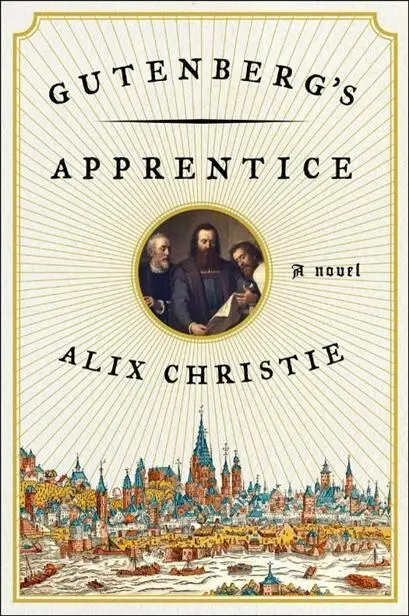
- Название:Gutenberg's Apprentice
- Автор:
- Издательство:Harper
- Жанр:
- Год:2014
- ISBN:нет данных
- Рейтинг книги:5 / 5. Голосов: 1
-
Избранное:Добавить в избранное
- Отзывы:
-
Ваша оценка:
Gutenberg's Apprentice: краткое содержание, описание и аннотация
Предлагаем к чтению аннотацию, описание, краткое содержание или предисловие (зависит от того, что написал сам автор книги «Gutenberg's Apprentice»). Если вы не нашли необходимую информацию о книге — напишите в комментариях, мы постараемся отыскать её.
Youthful, ambitious Peter Schoeffer is on the verge of professional success as a scribe in Paris when his foster father, wealthy merchant and bookseller Johann Fust, summons him home to corrupt, feud-plagued Mainz to meet “a most amazing man.”
Johann Gutenberg, a driven and caustic inventor, has devised a revolutionary — and to some, blasphemous — method of bookmaking: a machine he calls a printing press. Fust is financing Gutenberg’s workshop and he orders Peter, his adopted son, to become Gutenberg’s apprentice. Resentful at having to abandon a prestigious career as a scribe, Peter begins his education in the “darkest art.”
As his skill grows, so, too, does his admiration for Gutenberg and his dedication to their daring venture: copies of the Holy Bible. But mechanical difficulties and the crushing power of the Catholic Church threaten their work. As outside forces align against them, Peter finds himself torn between two father figures: the generous Fust, who saved him from poverty after his mother died; and the brilliant, mercurial Gutenberg, who inspires Peter to achieve his own mastery.
Caught between the genius and the merchant, the old ways and the new, Peter and the men he admires must work together to prevail against overwhelming obstacles — a battle that will change history. . and irrevocably transform them.
Gutenberg's Apprentice — читать онлайн бесплатно полную книгу (весь текст) целиком
Ниже представлен текст книги, разбитый по страницам. Система сохранения места последней прочитанной страницы, позволяет с удобством читать онлайн бесплатно книгу «Gutenberg's Apprentice», без необходимости каждый раз заново искать на чём Вы остановились. Поставьте закладку, и сможете в любой момент перейти на страницу, на которой закончили чтение.
Интервал:
Закладка:
It wasn’t that the master loathed the guildsmen, Hans said when he learned of the new plan. It was more that he had never feared the nobles or the clergy. Why, back in Strassburg, he’d had them eating from his hands. The parties at his farmhouse were a legend. He rigged a way to make a liquor out of every plant that grew about the place. He had the gold, you see — and then that roaring, blazing mouth.
“Mainz gold,” said Peter, not without admiration.
“He even held your treasurer for ransom once.” Hans grinned.
“I heard.”
“The stories I could tell you,” said the smith, and laughed, his brown face creasing in a thousand folds. Peter should have asked him then about those cryptic comments that the master made about the business he had there. But something else was on the young man’s mind.
“Stories about women?” he prompted.
“You heard no word from me.” Hans held him with a beady eye. Peter nodded. Well, said Hans, it happened long ago, before his time. “The way I heard it, he was once engaged.”
“Poor wench.”
Hans laughed. “The lady thought so, anyway — and when Henne refused, she sued him for breach of promise.” That much he knew for sure. That, and her name: Anna of the Iron Door. The master won the suit, but had to pay the court a fine, to compensate for the extremity and foulness of his mouth. Hans shook his head and grinned. “He said he didn’t care who knew it, it was God’s own truth: he wished to hell her iron door had rusted shut.”
And Peter wished for just the opposite when he took Anna Pinzler walking in the fields. She was a slip of girl, a clean-limbed filly — yet possessed of such a keenness that it took his breath away. He bent his energies to capturing her bright and concentrated gaze, threw off without a backward look his monkish habits.
It seemed to him his youth returned, slipping with ease inside the man he had become. They dashed among the crumbling dirt clods of those summer lanes and barefoot through the copses, picking cherries; lay panting on their backs, picking out the pictures in the fleet and shifting clouds. The first time that he kissed her, Anna closed her eyes and stood on tiptoe underneath a tree. He held her narrow face between his palms and watched the sun and shadow play across its smooth, sweet planes. Her eyes flew open. “What?” A sylph, a woodland nymph, is what you are, he almost said. Instead he took her in his arms. He did not care from whence she came or who her father was. The world was shifting and the old rules breaking down. His own father, after all, had married down in choosing Grede. Down, up, in any case were monstrous fictions — each one of them was equal, in the Book they made — this Book that one day all would reach with hungry hands to grasp.
His Anna’s eyes were dark, yet brilliant in their shining, and her painter’s hands both delicate and strong. She brought chalk and charcoal and a little sketchbook everywhere; she was a maker as he was. What most delighted him, though, was the way she saw. Despite her stillness, her containment, she could be touched quite instantly by beauty and transformed. It might be a sudden blazing of the flax, gone yellow overnight to gird the city in a sunburst. Or else a tiny thing, a drop of dew that swelled with rainbows on a leaf. Her painter’s eye saw harmony in every shifting contrast. She’d take his hand and point, and marvel at God’s artistry. She’d turn to him and say she guessed he did the same with his own hand and quill. He found that he could not naysay her. It was a gift, he said, that God had given him: a scribe he was, and always would be. He longed to tell her how that grace had put his hand now to this new, uplifting service. But he was bound as ever by his vow. He’d teach her then, he said instead, to wrest the magic of the meaning from the letters that he used. It was not Anna’s fault that she’d been born a girl, and poor, and never learned to read.
Somehow Grede guessed: it was that women’s mystery, their strange alertness to the unseen world. There was a new lightness to his step perhaps, or else she marked his Sunday absences. However she had learned, she bent her wiles to teasing out the secret of which maiden might have caught his eye. He’d scouted out the Elder girls, both she and Fust assumed. No harm there, said his father, just so long as you are sure to quench your ardor at the baths. Take Echenzeller’s Hannah, he would say, or even better, Molsberg’s Judith. Peter laughed, and left them guessing. He was too happy then to gird himself yet for the battle that would surely come.
He never knew just how it was arranged — which guilds were brought into the secret, and what sureties they gave. The only thing he knew for sure was that from then on Gutenberg and Fust paid guild dues to a dozen brotherhoods.
Jakob must have taken some delight in writing out the notice. He might have handled it the way his brother had, with subtlety. But then he would have had to pass up that rich chance to taunt a member of an Elder clan.
They knew the notice had been served by the loud kicks they heard among the stools that lined the drying hall. Gutenberg stalked in among them with a sheet unfolded in his hand, and threw it down among the crucibles and cupels.
“So much for bloody freedom.” He swung his grizzled mane around, a baleful look in his gold eyes. “We’re all inducted now.
“You’re all to scratch out your full name, and year of birth, if you sad bastards even know it.” His eyes on Peter were remote and cold.
Peter laid his punch down and came to sign his name.
The master smelled of beer and smoldering resentment. He licked his lips and bent his head close; his eyes and mouth were foul. “From here on out you keep your tongue inside your head,” he hissed, “or I will nail it there myself.”
CHAPTER 5: SPONHEIM ABBEY
Winter 1485
IT WAS HIS ARROGANCE — his hubris and his arrogance that wrecked it all.” Peter Schoeffer stands and takes a turn about the room.
Trithemius is rubbing at the closed domes of his eyes. “‘Therefore he set over them masters of the works, to afflict them with burdens’.” Wanly he smiles and quotes the book of Exodus.
Peter’s throat is tight. It is surprising — and disturbing, to discover rage still lodged against his ribcage after all this time.
“The man could never bear to share — or to be challenged.” He shakes his head. “He thought of all of it as his, from start to finish.”
“It’s not surprising, considering it was his whole life’s work,” the monk observes.
Peter snorts. “Try working for a man like that. He thought of no one else — he thought of nothing but the glory he deserved.”
It was the way that Gutenberg could open up his heart, then snap it shut that hurt the most, he thinks.
Trithemius is nodding. “How hard is too hard? That is what I often wonder.” He smooths a hand across his close-shaved scalp, a strange expression on his face. “Ruthlessness does serve its purpose.” He adds, after a pause: “My monks hate me, to speak truthfully. But they are lazy, stubborn, gluttonous — they are a blot, I think, on the whole order. One must be hard, sometimes, push far beyond our human weakness to fulfil God’s will.”
Peter turns it over in his mind. He too has been a hard man — a hard master — in his workshop. It’s years now, yet he knows it must be true. He was as jealous as the master to keep safe the secrets of the art. But he never rode roughshod over friend and foe alike, the way the master had.
“How do you know if it’s His will you’re serving — and not simply your own pride?” He sees all three of them in his mind’s eye, each doing his own part. “If we are truly touched by Him, what need is there to shout it from the rooftops?”
Читать дальшеИнтервал:
Закладка:
Похожие книги на «Gutenberg's Apprentice»
Представляем Вашему вниманию похожие книги на «Gutenberg's Apprentice» списком для выбора. Мы отобрали схожую по названию и смыслу литературу в надежде предоставить читателям больше вариантов отыскать новые, интересные, ещё непрочитанные произведения.







Обсуждение, отзывы о книге «Gutenberg's Apprentice» и просто собственные мнения читателей. Оставьте ваши комментарии, напишите, что Вы думаете о произведении, его смысле или главных героях. Укажите что конкретно понравилось, а что нет, и почему Вы так считаете.